Table of Contents
Overview
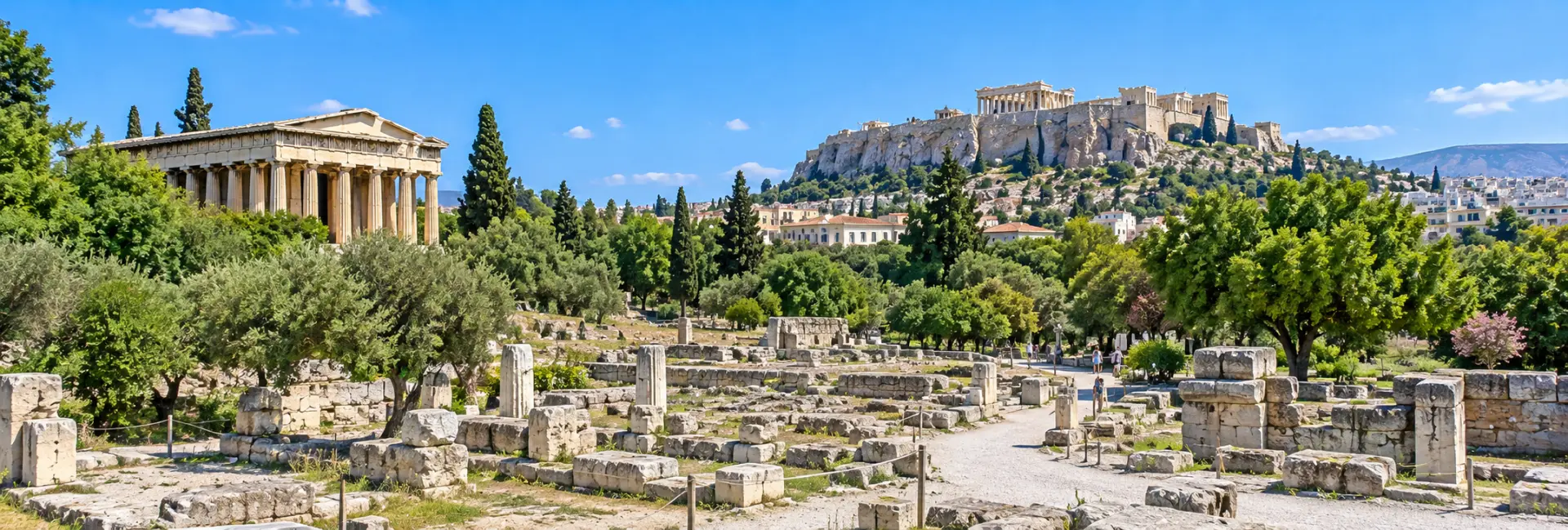
Spread across a wide, tree-shaded park northwest of the Acropolis, the Ancient Agora was the working centre of Athenian public life for well over a thousand years. Long before it became an archaeological site, this open square hosted markets, elections, criminal trials, philosophical debates and religious festivals, functioning as something close to a combined town hall, courthouse, marketplace and public square all at once.
Unlike the Acropolis, which was reserved for temples and sacred rituals, the Agora was where ordinary Athenians actually ran their city and went about daily business. Walking its paths today means passing scattered column bases, a fully reconstructed stoa, and one of the best-preserved temples anywhere in Greece, all set among olive trees and wildflowers rather than behind glass.
History
Founding and Early Use
The site was first laid out as a public square in the sixth century BC, replacing what had previously been a residential and burial area used since as early as the Late Bronze Age. Over the following two centuries it filled up with the buildings needed to run a growing city-state: council chambers, law courts, shrines, and the long covered walkways known as stoas, which sheltered merchants, teachers and idle conversation alike from sun and rain. It was here, rather than on the Acropolis, that the machinery of Athenian democracy actually operated day to day, from jury selection to the drafting of new legislation.
Destruction and Rebuilding
Invading Persian forces burned the Agora in 480 BC during their occupation of the city, and Athenians spent much of the following decades rebuilding on a grander scale, adding many of the structures whose foundations are still visible today, including a new Bouleuterion and expanded stoas. A further blow came in 86 BC, when the Roman general Sulla besieged and sacked Athens during a civil war, damaging several of the square's buildings and toppling parts of its colonnades. The Romans later invested in the site themselves, adding a large concert hall known as the Odeon of Agrippa to its centre and relocating an entire temple to Ares from elsewhere in Attica, stone by stone, to stand near the square's northern edge.
Decline and Rediscovery
A raid by the Heruli, a Germanic seafaring people, devastated the Agora in 267 AD, and although parts of the area stayed in use afterward, including a small Byzantine church built directly over its ruins in the eleventh century, the square never regained its earlier role as the city's civic core. Centuries of subsequent habitation buried most of the ancient remains beneath an ordinary residential neighbourhood that grew up over the ruins during Byzantine, Ottoman and early modern Athens. Serious excavation only began in the mid-nineteenth century, and the American School of Classical Studies at Athens undertook a far larger, systematic dig starting in 1931 that continues in a more limited form today, a project that required clearing roughly four hundred modern houses from the site to expose the ancient square beneath them.
Key Areas & Notable Monuments
The Temple of Hephaestus
Overlooking the square from a low rise on its western edge, the Temple of Hephaestus is widely considered the best-preserved ancient Greek temple still standing anywhere. Built at roughly the same time as the Parthenon and dedicated to the god of metalworking and craftsmanship, alongside Athena in her role as patron of artisans, the building owes its remarkable condition to a long second life as a Christian church, a role it held from around the seventh century until the early nineteenth. Its Doric colonnade and carved metopes, depicting the labours of Heracles and the exploits of Theseus, survive largely intact, giving visitors a rare sense of how a complete classical temple once looked.
Civic Buildings
Toward the western side of the square, the foundations of the Bouleuterion and the round Tholos mark where Athens conducted much of its day-to-day government. The Bouleuterion housed the Council of Five Hundred, the body responsible for preparing business for the citizen assembly, while the Tholos served as a dining hall and round-the-clock headquarters for the small group of councillors, chosen by lot, who stayed on duty at any given time to handle urgent state business.
Public Life on the Panathenaic Way
A wide diagonal path once known as the Panathenaic Way cut across the square from northwest to southeast, the route taken by the great procession of the Panathenaic Festival on its way up to the Acropolis. Nearby, the Monument of the Eponymous Heroes functioned as a kind of ancient public notice board, where announcements of laws, lawsuits and military call-ups were posted for citizens to read, organised beneath statues of the ten legendary heroes for whom the city's voting tribes were named.
The Stoa of Attalos & Museum
On the eastern edge of the square stands the Stoa of Attalos, a long, two-storey colonnaded building originally built around 150 BC as a gift from King Attalos II of Pergamon, a former student in Athens grateful for his education there. In its original form it housed rows of shops sheltered behind a covered walkway, giving Athenians a place to browse and trade out of the weather, with a lower colonnade of Doric columns and an upper storey of Ionic ones.
The stoa visible today is a careful mid-twentieth-century reconstruction, rebuilt between 1953 and 1956 by the American School of Classical Studies using techniques and, where possible, materials close to the ancient originals, including Pentelic marble for many of its columns. It now houses the Museum of the Ancient Agora, whose collection focuses on the everyday objects of Athenian civic and domestic life rather than grand sculpture alone, giving a more grounded sense of how the square actually functioned than the ruined foundations outside can convey on their own.
- Pottery and household items spanning the Bronze Age through the Byzantine period
- Ostraka, inscribed pottery fragments once used as ballots in the practice of ostracism
- Bronze and terracotta objects tied to Athenian law courts and public administration
- A ground-floor colonnade that lets visitors walk the same covered walkway ancient shoppers once used
Recognition & Status
The Ancient Agora is protected under Greek antiquities legislation and managed by the Ministry of Culture through its local archaeological authority, the Ephorate of Antiquities of the City of Athens. While the neighbouring Acropolis carries its own individual UNESCO World Heritage listing, the Agora is treated as part of the wider network of ancient sites threaded through central Athens by a long-running project to link the city's major archaeological areas with pedestrian walkways, including routes connecting it to the Acropolis, the Pnyx and Kerameikos.
Excavation and study of the site remain active more than ninety years after the American School of Classical Studies began its work there, with ongoing research continuing to refine understanding of the square's many overlapping building phases. Finds from the dig are published in a long-running academic series, and the site continues to serve as a training ground for archaeology students from the school each year.
Ways to Experience It
Most visitors explore the Agora on foot at their own pace, following gravel paths that loop past the major ruins before climbing to the Temple of Hephaestus and finishing at the Stoa of Attalos and its museum.
- Self-guided walks using site maps posted at the entrance
- Licensed guided tours, often paired with the nearby Acropolis or Ancient Agora combined tickets
- A single ticket covering both the archaeological grounds and the Stoa of Attalos museum
- Shaded benches throughout the park, useful for a longer, unhurried visit
Best Time to Visit
Spring brings wildflowers and mild temperatures across the site's open, largely unshaded grounds, making it one of the more comfortable times of year to walk the full loop of ruins. Given how much of the park sits under open sky, visiting outside the hottest midday hours of summer makes for a noticeably more pleasant walk.
- Spring and autumn for comfortable temperatures and good light for photography
- Early morning in summer, before the heat builds up over the exposed paths
- Weekday visits, which tend to be quieter than weekends
Visitor Tips
- Wear comfortable, sturdy shoes, since the paths cross uneven ground and loose gravel
- Bring water and sun protection, as shade is limited across most of the open square
- Buy the combined archaeological sites ticket in advance if you also plan to visit the Acropolis, Roman Agora or Kerameikos
- Set aside at least ninety minutes to see the Temple of Hephaestus and the Stoa of Attalos museum without rushing
- The main paths are largely flat and manageable for visitors with limited mobility, though some original stone surfaces remain uneven
Nearby Attractions
- The Acropolis and Parthenon, a short walk uphill to the southeast
- The Roman Agora and Tower of the Winds, a smaller Roman-era marketplace nearby
- Monastiraki, a lively square and flea-market district bordering the site
- Kerameikos, the ancient cemetery and city gate a short walk to the northwest
FAQs about visiting the Ancient Agora of Athens
What was the Ancient Agora used for? +
It served as ancient Athens' civic and commercial centre, hosting markets, law courts, council meetings, religious rites and philosophical teaching all in one open square.
How long does a visit take? +
Most visitors spend around ninety minutes to two hours walking the site and its museum, longer if combined with a guided tour.
Is the Temple of Hephaestus part of the Agora? +
Yes, it stands on a low hill at the western edge of the site and is included in the same admission ticket.
Do I need a separate ticket from the Acropolis? +
The Ancient Agora has its own ticket, though a combined ticket covering several Athens archaeological sites, including the Acropolis, is available and often better value for a longer stay.
Is the site suitable for visitors with mobility limitations? +
The main paths are generally flat and walkable, though some ancient stone surfaces are uneven, so visitors with mobility needs should expect a slower pace in places.
What's inside the Stoa of Attalos? +
The reconstructed stoa houses the Museum of the Ancient Agora, displaying pottery, ballots, everyday objects and other finds from the square's long civic history.
Is there shade on site? +
Some, mainly from scattered trees, but much of the open square is exposed, so sun protection and water are worth bringing in warmer months.
What else can I combine with a visit here? +
The Roman Agora, Monastiraki and Kerameikos are all close by on foot, making it easy to pair the Ancient Agora with several other archaeological sites in one day.