Table of Contents
Overview
Tucked behind a grand neoclassical facade on Patission Street, the National Archaeological Museum is the largest museum in Greece and a cornerstone for anyone hoping to understand the ancient Mediterranean world. Its galleries hold more than 11,000 objects, gathered from sites across the country rather than from Athens alone, so a single visit effectively tours the whole arc of Greek civilization in one building.
What sets the museum apart is the sheer density of world-famous objects packed into its halls: gold funerary masks from Mycenae, a bronze god pulled from the sea, and a corroded gearwheel that turned out to be an ancient computer. Few museums anywhere can claim a comparable concentration of pieces that shaped how historians picture the Bronze Age and Classical periods.
Unlike many national museums built around a single city's finds, this one was conceived from the outset as a repository for the entire country, which is why objects from Crete, the Peloponnese, the Aegean islands and Thessaly sit side by side under one roof. That breadth makes it less a local history museum than a survey of ancient Greek culture as a whole, stretching from Neolithic farming communities to the twilight of antiquity.
History of the Museum
Origins and Construction
The idea of a national collection dates back to 1829, when Greece's first governor set up an early archaeological repository on the island of Aegina to protect finds uncovered after independence. As excavations multiplied around Athens and the wider country through the mid-1800s, that modest collection outgrew a series of temporary homes, prompting officials to hold an international design competition for a purpose-built museum.
Construction on the present site began in 1866 on land donated by benefactor Eleni Tositsa, with additional funding from the Greek state, the Greek Archaeological Society, and private donors abroad. The building took over two decades to finish, opening in stages before its formal completion in 1889 and adopting its current name in 1881, replacing an earlier, more generic title as the country's "Central Museum."
The timing mattered as much as the architecture: the late nineteenth century was a period of intense excavation across Greece, with archaeologists including Heinrich Schliemann uncovering the shaft graves at Mycenae just as the new building was rising. That coincidence turned the museum into an immediate showcase for discoveries that were reshaping European understanding of the Bronze Age.
Expansion and Modern Era
Growing collections forced repeated expansions through the early twentieth century, adding wings and exhibition halls to keep pace with new discoveries. During the Second World War, staff dismantled the displays and buried the antiquities in protective crates to shield them from destruction and looting, only restoring the exhibits after 1945.
A major renovation completed in 2004, timed to the Athens Olympics, modernized the building's infrastructure and repaired damage from a 1999 earthquake. Plans approved in 2023 call for a large underground extension with a rooftop garden, intended to roughly double the museum's usable space by the end of the decade.
Architecture & Building
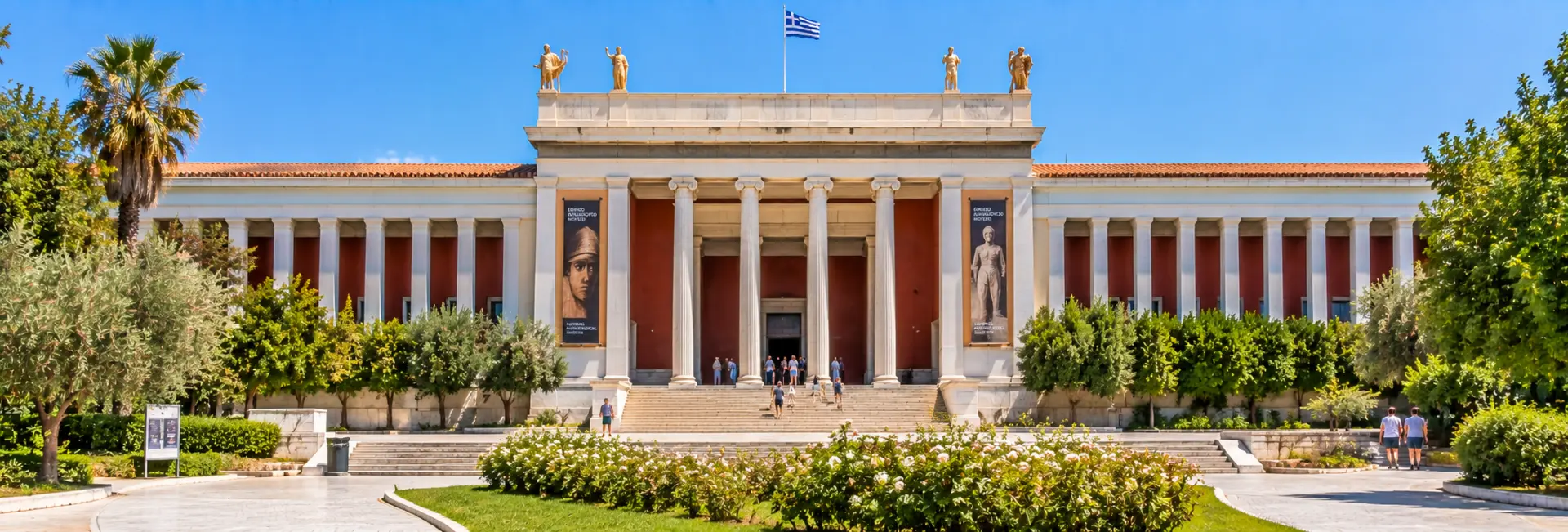
The museum occupies an imposing neoclassical structure typical of the grand public buildings raised in Athens during the late nineteenth century, when architects looked to ancient forms to give the young Greek state a visual identity to match its heritage. The original design came from architect Ludwig Lange, was reworked by Panagis Kalkos as the project's chief architect, and was later refined by Ernst Ziller, whose neoclassical buildings shaped much of central Athens.
- A columned entrance facade facing a landscaped garden with sculptures and shaded seating
- A layout of interconnected halls spread across roughly 8,000 square metres of exhibition space
- A south wing added in the twentieth century to house the Epigraphical Museum's inscriptions
- Later additions, including an east wing and a two-storey block built in the 1930s to hold expanding collections
The building sits between Epirus, Bouboulinas and Tositsas streets in the Exarcheia district, with its main entrance and address facing Patission Street beside the historic campus of the National Technical University of Athens.
Inside, the layout still reflects the building's nineteenth-century origins: high-ceilinged halls lit by clerestory windows, wide door frames designed to move large statuary, and a central axis that leads visitors naturally from the entrance hall toward the sculpture galleries. Later climate-control and lighting upgrades were fitted discreetly into the historic shell rather than altering its exterior character.
Collections & Exhibits
The museum's holdings are arranged into distinct sections, each tracing a different thread of Greek antiquity rather than a single chronological sweep. The Prehistoric Collection anchors the ground floor, covering Neolithic pottery, Cycladic marble figurines, and the golden treasures Heinrich Schliemann excavated at Mycenae in the nineteenth century, including finds from the shaft graves of Grave Circle A.
The Sculptures Collection spans the largest number of rooms, following the development of Greek sculpture from stiff, early kouroi figures through the naturalism of the Classical period and into Hellenistic and Roman works. A separate hall preserves wall paintings recovered from the Bronze Age settlement at Akrotiri on Santorini, buried and remarkably preserved by a volcanic eruption.
- Vase and Minor Objects Collection – pottery and small luxury items spanning roughly a thousand years, including the Stathatos jewellery collection
- Metallurgy Collection – bronze statues and mechanical finds, most famously from a shipwreck off Antikythera
- Egyptian and Near Eastern Antiquities Collection – Greece's only dedicated Egyptian collection, with mummies, funerary goods and statuary
- Epigraphical Museum – a separate wing holding one of the world's largest collections of inscribed ancient Greek texts
Because the collections are organized thematically rather than strictly by date, visitors can move between rooms depending on their interests: someone drawn to early art can linger over Cycladic figurines whose spare, geometric forms influenced twentieth-century sculptors, while another visitor might head straight for the gold-heavy Mycenaean rooms or the ship-wrecked bronzes upstairs.
Must-See Highlights
With more than a dozen must-see rooms, first-time visitors often benefit from targeting a handful of signature pieces rather than trying to absorb everything. The so-called Mask of Agamemnon, a beaten gold funerary mask from Mycenae, remains the museum's most photographed object, even though modern scholarship dates it centuries before the Trojan War figure it was named after.
- The Antikythera Mechanism – a corroded bronze device now understood as an astronomical calculator built more than two thousand years ago
- The Artemision Bronze – a life-sized statue of Zeus or Poseidon, recovered from a shipwreck and poised mid-throw
- The Jockey of Artemision – a bronze horse and rider salvaged from the same wreck site
- The Thera frescoes – wall paintings from Akrotiri depicting boxing children, antelopes and springtime landscapes
- The Marathon Boy – a bronze youth prized for its delicate, lifelike pose
- Grave goods from Mycenae's shaft graves – gold cups, death masks and jewellery excavated in the 1870s that first proved Homeric-era Greece had real material wealth behind its legends
Even visitors with limited time are encouraged to seek out these pieces specifically, since the museum's sheer size means it is easy to walk past a room-defining object while focused on a floor plan.
Ways to Experience It
Most visitors move through the museum roughly by chronology, starting with the Prehistoric Collection on the ground floor before working through the sculpture halls and finishing upstairs among the Thera frescoes and pottery rooms. Self-guided visits with a floor plan work well for travelers who want to prioritize specific highlights rather than see every room.
- Official guided tours, offered in multiple languages, that walk through the key collections in roughly ninety minutes to two hours
- Self-paced audio guides for visitors who prefer to set their own rhythm
- Temporary exhibitions, mounted periodically alongside the permanent galleries, that spotlight specific sites or themes
- A museum shop and garden café, useful for a break partway through a longer visit
Best Time to Visit
Weekday mornings, shortly after opening, tend to offer the calmest galleries, since tour groups and cruise-ship visitors typically arrive later in the day. Weekends and the middle of the day are noticeably busier, particularly during the peak summer tourist season from June through August.
Visiting outside the height of summer brings a double benefit: smaller crowds and a more comfortable walk to and from the museum, since Athens summer heat can make the short walk from Victoria metro station feel longer than it is. Spring and autumn generally combine pleasant weather with lighter visitor numbers.
Visitor Tips
- The nearest metro stop is Victoria Station on Line 1, roughly a five-minute walk from the entrance
- Opening hours and ticket prices change seasonally and around public holidays, so check the museum's official website shortly before your visit
- The building is wheelchair accessible, with facilities and guided options available for visitors with hearing impairments
- Photography without flash is generally permitted in most galleries, though rules can vary for temporary exhibitions
- Bags larger than a small daypack typically need to be checked at the cloakroom before entering
- Budget at least two hours for a focused visit, or half a day to see the collections in depth
Nearby Attractions
The museum's central location makes it easy to combine with other Athens landmarks in the same day. The Exarcheia neighborhood surrounding it is known for street art, bookshops and casual tavernas, offering a low-key contrast to the museum's grand halls.
- The National Technical University of Athens, an architecturally significant neoclassical campus next door
- Omonia Square, a short walk away and a major transit hub with easy connections across the city
- The Numismatic Museum, housed in Heinrich Schliemann's former residence and reachable by a short walk or metro ride
- The historic center and Acropolis area, a longer walk or a quick metro ride south
FAQs about visiting the National Archaeological Museum
What is the National Archaeological Museum known for? +
It's Greece's largest museum and home to its richest collection of ancient artifacts, including the gold treasures of Mycenae, the Antikythera Mechanism, and frescoes from Bronze Age Santorini.
How much time should I plan for a visit? +
Two hours covers the main highlights, but history and archaeology enthusiasts often spend half a day or more moving through all nine major collections.
Is the museum easy to reach without a car? +
Yes. Victoria Station on Metro Line 1 sits about a five-minute walk away, and several bus and trolleybus lines also stop nearby on Patission Street.
Do I need to book tickets in advance? +
Advance booking isn't always required, but it's worth checking the museum's official website before visiting, since ticketing policies and hours shift seasonally and around holidays.
Is the museum suitable for children? +
Yes, especially the Mycenaean gold and Egyptian collections, which tend to capture younger visitors' attention; a family-paced visit focusing on a few standout rooms usually works better than trying to see everything.
Is the museum accessible for visitors with disabilities? +
The building is wheelchair accessible throughout, and services are available for visitors with hearing impairments; contacting the museum ahead of time can help arrange any specific needs.
What else is nearby worth visiting? +
The Exarcheia neighborhood, the National Technical University's historic campus, and the Numismatic Museum are all within easy walking distance, with the Acropolis and historic center a short metro ride south.
Can I take photos inside the museum? +
Non-flash photography is generally allowed in the permanent galleries, though restrictions sometimes apply to temporary exhibitions, so it's worth checking signage in each room.