Table of Contents
Overview
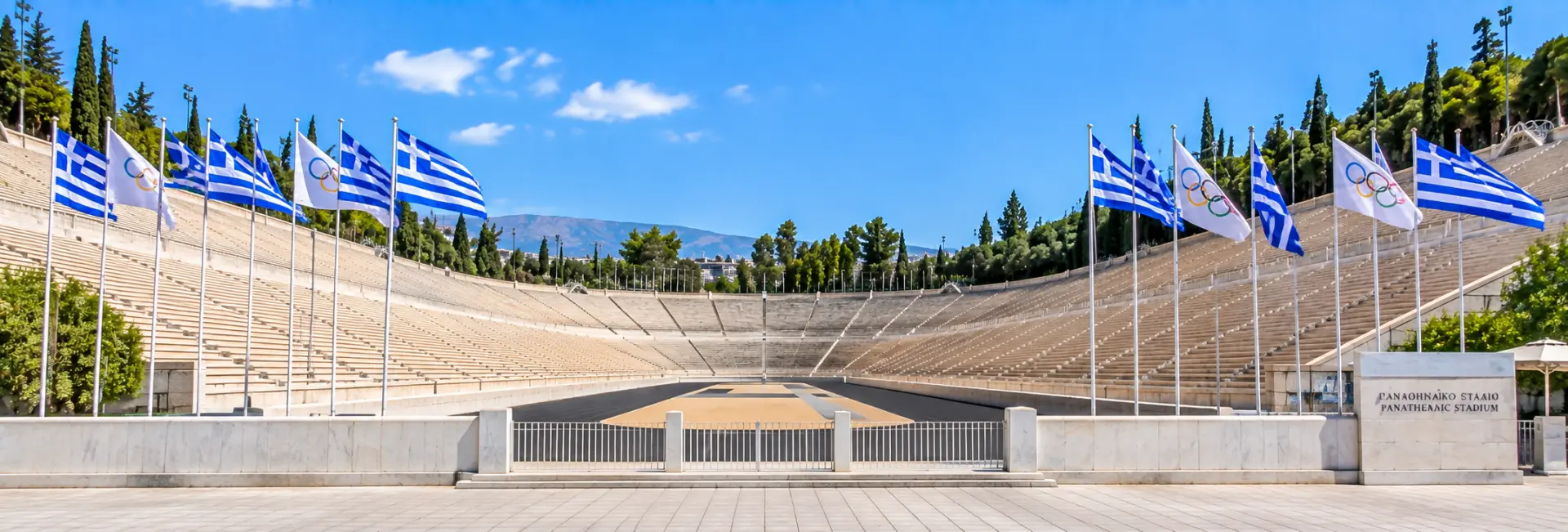
The Panathenaic Stadium, known locally as Kallimarmaro, meaning "beautiful marble," sits in a natural hollow between two low hills just southeast of central Athens. It is the only stadium in the world built entirely from marble, and its long horseshoe-shaped track has hosted everything from ancient religious festivals to the opening act of the modern Olympic movement.
What visitors see today is a layered structure. The footprint and shape trace back to the 4th century BC, the marble seating dates from a 2nd-century AD Roman-era rebuild, and the finished stadium standing now was restored in the 1890s specifically to bring the Olympic Games back to life. Walking its track means standing in a place that has been used for competition, on and off, for well over two thousand years.
History
Ancient Origins
A stadium first took shape on this spot in the 6th century BC, when it was little more than an open racecourse cut into the natural valley between the Agra and Ardettos hills. Spectators simply sat on the grassy slopes to watch. Around 330 BC, the Athenian statesman Lykourgos financed a proper stadium here for the Panathenaic Games, a major religious and athletic festival held every four years in honor of the goddess Athena.
The Marble Rebuild
The stadium's defining transformation came in the 2nd century AD, when the wealthy Athenian-born Roman senator Herodes Atticus funded a complete reconstruction. Workers sheathed the seating in white Pentelic marble, the same stone used on the Acropolis, and reshaped the open end into the curved horseshoe form still visible today. The project took roughly a decade and left the stadium able to seat around 50,000 spectators, an extraordinary scale for its era.
Abandonment and Rediscovery
Once Christianity became the dominant religion of the Roman Empire in the 4th century, the old pagan games fell out of favor and the stadium was gradually deserted. Over the following centuries its marble was stripped for reuse elsewhere, and the site slowly filled in with soil until it resembled a shallow, overgrown field rather than a monument. German architect Ernst Ziller led the first major excavation of the buried stadium in 1869, uncovering enough of the ancient outline to confirm its original shape and size. Greek benefactor Evangelis Zappas then used the partly excavated site to stage early athletic revivals in 1870 and 1875, decades before the modern Olympics existed, proving the old stadium could still draw a crowd long before Averoff's rebuild made it permanent.
The 1896 Revival
When Athens was chosen to host the first modern Olympic Games, the ruined stadium needed a full rebuild, and Greece's treasury could not cover the cost. Shipping magnate Georgios Averoff stepped in and personally financed the reconstruction, insisting on real Pentelic marble to match the ancient original. Architect Anastasios Metaxas oversaw the work, and the finished stadium opened in time to host the 1896 Games, giving the modern Olympic movement its very first home.
Architecture & Design
The stadium's most unusual feature is structural honesty: unlike a modern arena built on steel or concrete framing, the Panathenaic Stadium is essentially carved into its own landscape. Its long U-shaped bowl follows the natural contours of the valley between the Agra and Ardettos hills, and tiered rows of stone seating rest directly on that sloped ground rather than on an artificial superstructure.
The track and seating stretch roughly 204 meters in length, with 47 rows of marble benches running the full span on either side. Every seat and step was quarried, cut, and fitted from Pentelic marble without mortar, a method that has allowed much of the stone to survive nearly two thousand years of earthquakes and weathering. At the closed, curved end of the horseshoe, known as the sphendone, a raised viewing point still marks where spectators once gathered for the best vantage over the whole arena. By modern standards the stadium is narrow and steep rather than wide and shallow, a byproduct of squeezing a full-size arena into a natural ravine instead of an open, level plot, and that constraint is exactly what gives the space its dramatic, tightly enclosed feel.
Notable Decorative Elements
- A marble portrait of Georgios Averoff carved beside the main entrance, honoring the benefactor who paid for the 1896 rebuild
- Twin herm statues on the track near the sphendone, ancient sculptures rediscovered during 19th-century excavation and believed to depict Hermes and Herakles
- Royal boxes built into the sphendone for the 1896 Games, still visible today
- Original marble parapet slabs near the tunnel entrance, dating to the ancient stadium itself
Olympic Legacy
The Panathenaic Stadium holds a singular place in Olympic history as the venue that hosted the opening and closing events of the first modern Games in 1896, where roughly 50,000 spectators watched athletes compete in cycling, fencing, gymnastics, shooting, swimming, weightlifting, and wrestling. That single event effectively launched the Olympic movement as it exists today.
The stadium's Olympic role did not end there. It returned to the international stage in 2004, when Athens hosted the Games again and the stadium was used for the archery competitions and as the finish line for both marathon events. It also continues to serve a quieter but no less symbolic function: before every edition of the Games, the Olympic flame is formally handed over to the next host nation in a ceremony held on this same track.
Beyond the Olympics, the stadium set a lasting record in 1968, when a European basketball final drew an estimated 70,000 spectators, still recognized as the largest crowd ever to watch a basketball game. It remains the finish line for the annual Athens Classic Marathon, letting recreational runners cross the same threshold as the athletes of 1896. The stadium's name also lives on in Greek football and basketball through Panathinaikos, one of the country's most successful sports clubs, which took its name directly from the venue when it was founded in the early 20th century.
What to See There
A visit typically starts at the marble entrance tunnel, the same passage ancient and modern athletes once used to enter the arena, and opens onto the full sweep of the horseshoe-shaped track and seating bowl.
- The full 204-meter marble track, open for visitors to walk or jog its length
- The sphendone, the curved southern end of the stadium and the best vantage point over the whole site
- A small on-site museum tracing the history of the modern Olympics through torches, medals, and posters from past Games
- The ancient herm statues and marble parapet fragments preserved on the track
- Panoramic views toward the Acropolis and Mount Lycabettus from the upper rows of seating
Ways to Experience It
Admission includes a self-guided audio tour, available in multiple languages, that walks visitors through the stadium's ancient origins, its Roman rebuild, and its Olympic revival at a relaxed pace of about half an hour.
Visitors who want a deeper dive can arrange a licensed guide through the stadium's tourist guide association, useful for connecting the site to the wider story of Athenian and Olympic history. For a more active experience, some operators offer short organized track sessions that let visitors run a lap on the historic surface under supervision, a novelty few other ancient sites can offer.
The stadium also periodically hosts public concerts, ceremonies, and cultural events, so it is worth checking ahead if a performance happens to coincide with a visit.
Best Time to Visit
Early morning or late afternoon are the most comfortable times to visit, especially in the warmer months, since the marble seating and open track offer little shade during the middle of the day. Visiting close to opening time also means smaller crowds and softer light for photographs against the white stone.
Spring and autumn bring milder temperatures and are generally the most pleasant seasons for exploring Athens on foot, the stadium included. Winter visits are quieter still, though the marble steps can become slippery after rain, so sturdy shoes are worth packing.
Visitor Tips
- Wear comfortable, flat shoes, since the marble steps and track can be slippery, especially in wet weather
- Bring water and sun protection in summer, as there is very little shade inside the stadium
- Check current ticket prices and opening hours on the official website before visiting, since these can change
- The track and the stoa area are wheelchair accessible, though some upper seating sections involve uneven stone steps
- Allow roughly 45 minutes to an hour for a relaxed visit, including the audio tour and museum
- The stadium sits within easy walking distance of central Athens, making it simple to combine with a longer sightseeing route
Nearby Attractions
The Panathenaic Stadium sits close to several other major Athens landmarks, making it easy to build into a half-day walking route through the historic center.
- The National Garden, a shaded park just a short walk away, ideal for a break after the sun-exposed stadium
- The Zappeion exhibition hall, a 19th-century neoclassical building set within the National Garden
- The Temple of Olympian Zeus, the towering ruins of one of antiquity's largest temples
- Hadrian's Arch, a Roman-era gateway standing just beside the temple ruins
- The Acropolis and Acropolis Museum, roughly a 20 to 30 minute walk or a short tram and metro ride away
FAQs about visiting the Panathenaic Stadium
What is the Panathenaic Stadium famous for? +
It is famous as the only stadium in the world built entirely of marble and as the venue that hosted the first modern Olympic Games in 1896, a role that makes it one of the founding sites of the modern Olympic movement.
Is Kallimarmaro the same place as the Panathenaic Stadium? +
Yes. Kallimarmaro is the Greek nickname for the stadium, meaning "beautiful marble," and both names refer to the same site in central Athens.
How old is the Panathenaic Stadium? +
The site has been used as a stadium since the 6th century BC, with the current marble structure dating mainly from a 2nd-century AD Roman-era rebuild and a full restoration completed in 1896.
How much time should I set aside for a visit? +
Most visitors comfortably see the stadium, walk the track, and visit the small museum in around 45 minutes to an hour.
Can visitors walk or run on the track? +
Yes, the marble track is open to visitors as part of a standard visit, and some tour operators also offer short supervised running sessions on it.
Is the Panathenaic Stadium free to visit? +
No, there is an admission fee that includes an audio tour, though current prices and any free-entry days should be checked on the official website, since these details change from time to time.
How do I get to the Panathenaic Stadium? +
It is centrally located and reachable on foot from Syntagma Square in around 15 to 20 minutes, or by tram or bus to the nearby Zappeion stop, making a taxi or car largely unnecessary.
Is it worth visiting with children? +
Yes, the open track and dramatic marble seating tend to appeal to kids, and the Olympic history angle, including torches and medals in the small museum, gives the visit an easy hook for younger visitors.