Table of Contents
Overview
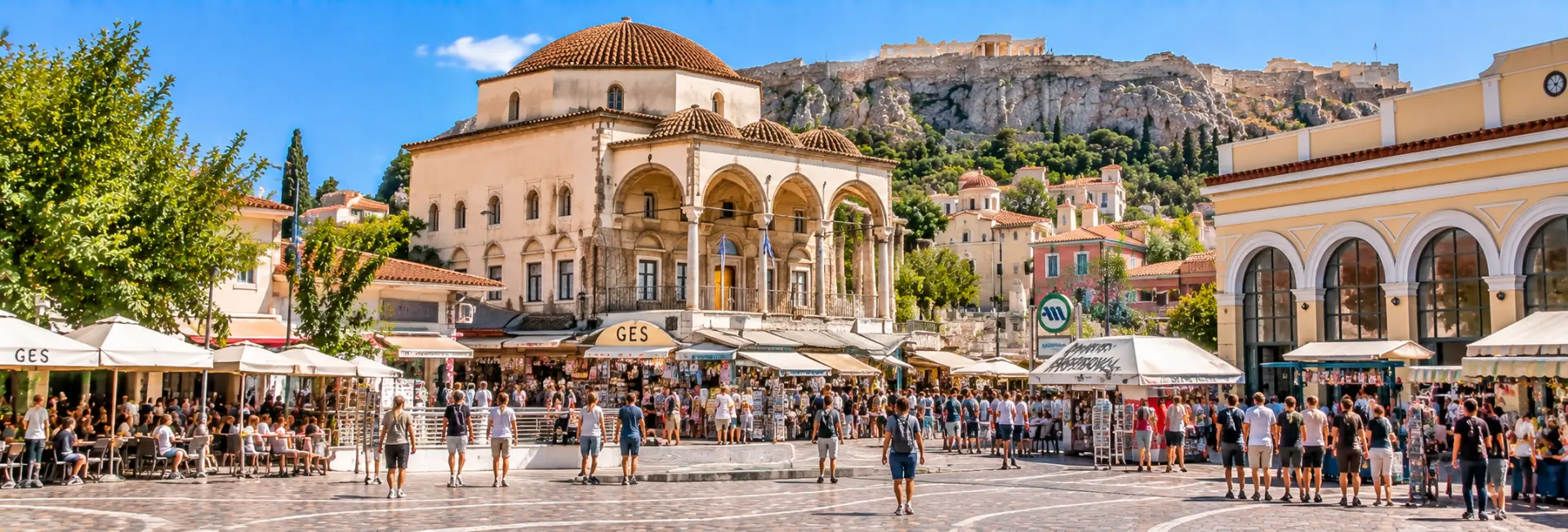
Monastiraki Square sits at one of the busiest crossroads in central Athens, a wide open plaza where a Byzantine church, an Ottoman-era mosque and the ruins of a Roman marketplace all stand within sight of one another, with the Acropolis rising in the background. Few squares anywhere pack quite so many layers of the city's history into such a small footprint, spanning roughly two and a half thousand years from classical antiquity to the present day.
By day the square functions as a transit hub and open-air market; a metro station sits directly beneath it, and stalls selling everything from antiques to souvenirs spill into the surrounding lanes. By evening it becomes more of a social gathering spot, with street performers, snack vendors and café tables filling the paved expanse in front of the church, and rooftop bars nearby offering some of the most photographed Acropolis views in the city.
History
A Vanished Monastery
The square takes its name from a small monastery that once stood on the site, remembered today mainly through the surviving Church of the Pantanassa, a tenth-century structure that served as the katholikon, or main church, of that religious community. In the post-Byzantine period it was known as the Great Monastery and functioned for a time as a women's convent. Over the centuries the wider monastery complex around it disappeared, but locals kept referring to the area by a diminutive form of the Greek word for monastery, and the name eventually attached itself to the square and the wider neighbourhood around it.
Ottoman Athens
During the long period of Ottoman rule, the square became a bazaar district at the heart of daily commercial life in the city, and in 1759 the local Ottoman governor, Mustafa Agha Tzistarakis, commissioned a mosque on its southern edge, reportedly using stone taken from a nearby ancient monument, possibly a column from the Temple of Olympian Zeus or Hadrian's Library, to make the lime needed for construction. A plague outbreak the following year was popularly blamed on this act, adding a layer of local legend to the building's origins. After Greek independence, the mosque was repurposed for a string of civic uses, serving over time as barracks, a prison, and eventually a museum, while the Pantanassa church continued in active religious use, as it still does today.
A Modern Crossroads
Monastiraki grew into one of the busiest corners of the city over the nineteenth and twentieth centuries, helped along by the arrival of one of Athens' earliest railway stations in 1895, among the oldest on what became the city's metro network. The nineteenth century also brought a wave of new residents and traders to the area, cementing its role as a commercial crossroads rather than a purely residential quarter. Major construction work tied to the modern Athens Metro, carried out in the years leading up to the 2004 Olympic Games, uncovered an extensive layer of ancient and Byzantine remains directly beneath the square, work that ultimately reshaped both the metro station and the paved plaza above it when the renovated square reopened to the public in 2008.
Landmarks Around the Square
Church of the Pantanassa
Facing the metro station entrance, this small domed Byzantine church dates to around the tenth century and gave the whole area its name. Its interior keeps a modest scale compared with the grand landmarks nearby, but it remains an active parish church, its dim, incense-scented interior a quiet contrast to the crowds passing just outside its doors. A restoration completed in 2007 refreshed its painted interior without altering its compact Byzantine form.
Tzistarakis Mosque
On the square's southern side stands the Tzistarakis Mosque, built in 1759 and among the better-preserved Ottoman-era buildings left in Athens. Its central dome and triple-arched entrance porch now shelter a branch of the Museum of Greek Folk Art, with rotating exhibitions rather than any surviving religious function. A belfry added in the nineteenth century and later neoclassical-style alterations to its interior reflect the building's long afterlife once its original religious purpose had ended.
Hadrian's Library
Just off the square's edge, the ruined entrance wall and columns of Hadrian's Library recall a vast second-century complex built under the Roman emperor Hadrian, combining a library with lecture halls and a garden courtyard. Its scale hints at how significant this corner of the city once was for both Roman-era administration and learning, and its surviving western facade, with its tall Corinthian columns, remains one of the more photographed ruins in central Athens.
The Flea Market
Monastiraki's flea market has occupied the streets around the square for well over a century, growing out of the secondhand trade that settled here after Greek independence, when merchants and craftsmen displaced from other parts of the rebuilt city gravitated toward its bazaar-era streets. What began as a Sunday-only market has since spread into a network of permanent shops and stalls that stay open through the week, selling everything from genuine antiques and vintage vinyl to inexpensive souvenirs and clothing, with the character of the goods shifting noticeably from one street to the next.
- Sunday mornings for the largest, most traditional flea market atmosphere
- Pandrosou Street for antiques, jewellery and collectibles
- Ifestou Street for vintage clothing, records and secondhand goods
- Surrounding lanes for everyday souvenir shopping any day of the week
Beneath the Square
Excavations carried out for the metro station beneath Monastiraki Square uncovered remains of continuous settlement stretching from the eighth century BC through the nineteenth century AD, layered above and around the ancient Eridanos River. The river once rose from springs near Lycabettus Hill and ran through the heart of ancient Athens before joining the Ilissos, and archaeologists traced its stone-lined channel, bounded by large conglomerate blocks as early as the fifth and fourth centuries BC, later covered over with a brick vault during Hadrian's reign and converted into a covered drain.
Rather than sealing the finds away, the metro station was designed to display them: a glass walkway roughly twenty-four metres long crosses directly over a stretch of the exposed riverbed, and passengers can look down through glass panels at the layered remains of houses, workshops, graves and water systems recovered during construction. A smaller viewing panel set into the paving of the square itself lets pedestrians glimpse a further section of the ancient riverbed without descending into the station at all.
Ways to Experience It
Most visits to Monastiraki combine a look at the square's landmarks with a wander through the surrounding market streets, since the two experiences sit only steps apart from one another and rarely require more than an hour or two of unhurried walking.
- A short self-guided loop taking in the church, mosque and Hadrian's Library
- Browsing the flea market streets, especially lively on Sunday mornings
- A stop inside Monastiraki metro station to see the exposed Eridanos riverbed
- Rooftop cafés and bars nearby offering views back across the square toward the Acropolis
- Guided walking tours that link Monastiraki with neighbouring Plaka or the Ancient Agora
Best Time to Visit
Sunday mornings bring the square to its liveliest, busiest state, with the flea market at its fullest extent and vendors spreading further into the surrounding streets than on other days. For a calmer visit, weekday mornings offer a noticeably quieter version of the same scene.
- Sunday morning for the full flea market experience
- Weekday mornings for a quieter walk through the square and its landmarks
- Early evening for people-watching and views of the Acropolis as the light softens
Visitor Tips
- Keep a close eye on belongings in the square and market streets, which draw large, dense crowds
- Bargaining is common in the flea market, though many fixed-price souvenir stalls do not expect it
- Combine a visit with the neighbouring Ancient Agora and Plaka, both an easy walk away
- Pop into the metro station even without travelling anywhere, since the archaeological display is free to view from the concourse
- Sunday mornings get crowded quickly, so arrive early if browsing the market is the priority
Nearby Attractions
- Hadrian's Library and the Roman Agora, immediately adjacent to the square
- Plaka, the historic old town, a short walk to the south
- Psyrri, a neighbouring district known for its bars and street art
- The Ancient Agora and Temple of Hephaestus, a short walk to the southwest
FAQs about visiting Monastiraki Square
Why is it called Monastiraki? +
The name comes from a small vanished monastery once centred on what is now the Church of the Pantanassa, whose diminutive Greek name for "little monastery" eventually attached itself to the whole square.
When is the flea market busiest? +
Sunday mornings bring the largest, most traditional flea market atmosphere, though many shops and stalls in the surrounding streets stay open throughout the week.
Is Monastiraki safe for visitors? +
Generally yes, though like any dense, crowded tourist area it's worth keeping a close watch on bags and pockets, especially during the busiest market hours.
What can I see inside the metro station? +
A glass walkway and viewing panels display the excavated bed of the ancient Eridanos River along with layers of ancient and Byzantine remains uncovered during construction.
Can I go inside the Tzistarakis Mosque? +
Yes, it now operates as a branch of the Museum of Greek Folk Art and is open to visitors rather than functioning as an active place of worship.
How long should I spend at the square? +
An hour or so covers the main landmarks and a look through nearby market streets, though flea market browsing can easily stretch a visit longer.
Is the square well connected by public transport? +
Yes, Monastiraki metro station sits directly beneath the square and serves two Athens Metro lines, making it one of the easiest points in the city to reach.
What else is within walking distance? +
Plaka, the Ancient Agora, Hadrian's Library and the Psyrri nightlife district are all a short walk away, making Monastiraki a convenient base for exploring central Athens on foot.