
Table of Contents
Overview
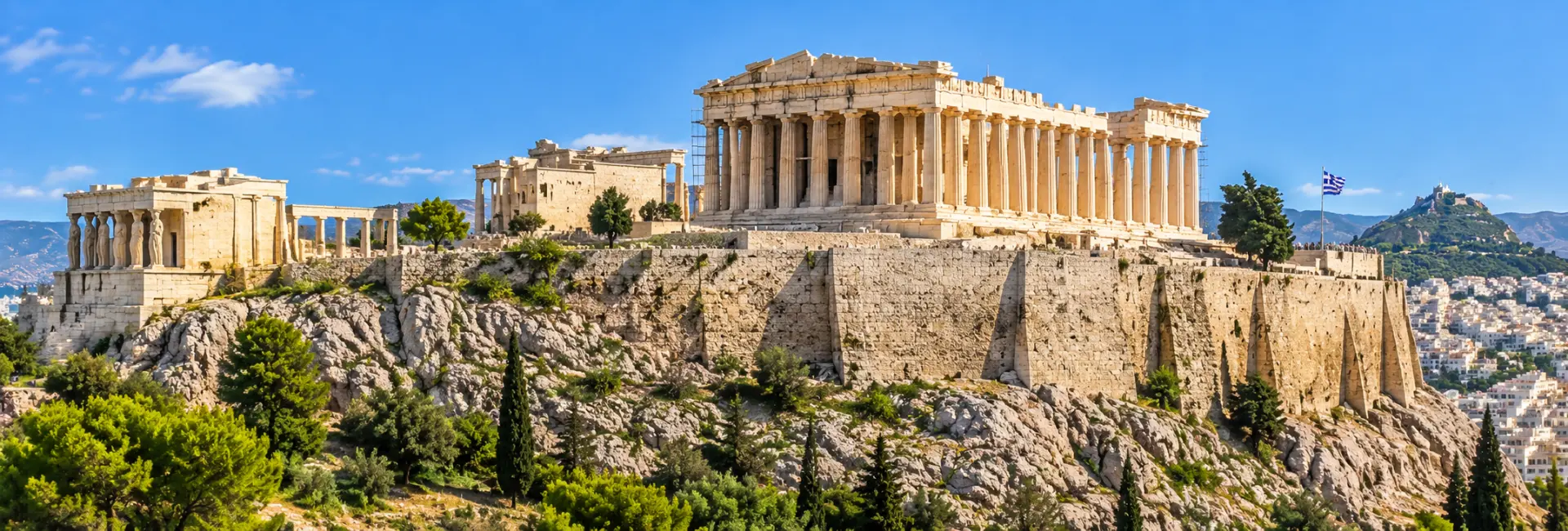
Rising roughly 150 meters above the streets of modern Athens, the Acropolis is a flat-topped limestone outcrop crowned by some of the most influential buildings in Western architecture. Its name comes from the Greek words for "high point" and "city," and for nearly 3,000 years it has served as a fortress, a religious sanctuary, and a stage for civic life. Today it stands as the single most recognizable emblem of ancient Greece, drawing visitors from every corner of the globe to walk among ruins that shaped ideas about art, democracy, and philosophy still felt today.
At its heart sits the Parthenon, the great marble temple built to honor Athena, patron goddess of the city. But the hill holds far more than one building: gateways, smaller temples, a theater, and a concert hall are woven into the rock itself, forming a complete sacred precinct that visitors can explore on foot in a single, unforgettable morning or afternoon.
History
Early Settlement and the Mycenaean Citadel
People have occupied this rock since at least the Neolithic period, drawn by its natural defenses and commanding view over the surrounding plain. By the Late Bronze Age, around the 13th century BC, Mycenaean rulers had enclosed the summit with massive Cyclopean walls and built a palace complex, traces of which archaeologists have uncovered beneath later construction.
Destruction and the Golden Age Rebuilding
In 480 BC, invading Persian forces under Xerxes sacked Athens and razed the temples standing on the hill. Rather than rebuild immediately, the Athenians left the ruins as a memorial for decades. It was the statesman Pericles who, starting around 447 BC, launched an ambitious building program funded largely through the treasury of the Delian League, an alliance of Greek city-states. Over the following decades, the Parthenon, Propylaea, Erechtheion, and Temple of Athena Nike rose in quick succession, employing the finest architects and sculptors Athens could gather.
Later Centuries
The site continued to evolve under Roman, Byzantine, Frankish, and Ottoman rule, serving at various points as a Christian church, a Catholic cathedral, and a mosque, with each era leaving its own additions and alterations to the ancient buildings. Its most devastating modern blow came in 1687, when a Venetian bombardment ignited Ottoman gunpowder stored inside the Parthenon, blowing out its central section and scattering architectural fragments across the hillside. In the early 19th century, Lord Elgin removed a large portion of the Parthenon's surviving sculptures and shipped them to Britain, a move that remains the subject of an ongoing repatriation debate between Greece and the United Kingdom. Large-scale restoration efforts began after Greek independence in the 1830s and have continued, in various forms, ever since.
Recognition & Status
The Acropolis was inscribed as a UNESCO World Heritage Site in 1987, recognized for its outstanding influence on architecture, sculpture, and civic thought across the ancient Mediterranean world and beyond. UNESCO's citation highlights the site's universal significance as a symbol of classical Greek genius and of the democratic ideals associated with the city that produced it.
An ongoing restoration and conservation program, launched in 1975 and still active, uses a technique called anastylosis to carefully reassemble original fragments using modern materials only where necessary. Scaffolding and cranes are a familiar sight around the Parthenon as a result, a visible reminder that the monument's preservation is a continuous, painstaking effort rather than a finished project.
Architecture & Design
The buildings atop the Acropolis represent the high point of classical Greek architecture, blending the sturdy Doric order with the more slender, decorative Ionic order within a single sacred complex. Architects Iktinos and Kallikrates designed the Parthenon with subtle curves and adjustments, since perfectly straight lines were understood to look slightly concave to the eye from a distance, correcting for this with barely perceptible bulges in the columns and platform.
The sculptor Phidias oversaw the monument's decorative program, including the now-dispersed frieze depicting a great Athenian procession and, originally, a towering gold-and-ivory statue of Athena that no longer survives. The architect Mnesikles designed the Propylaea, the monumental entrance gate, working around the steep, irregular terrain of the hill's western approach in a way still admired by architects today.
- Doric columns on the Parthenon's exterior, paired with Ionic details inside
- Optical refinements, including gently curved foundations and tapered columns
- Pentelic marble, quarried locally, prized for its fine grain and warm color
- Sculptural friezes and pediments illustrating myth and civic identity
Key Monuments
The Parthenon
The largest and most famous structure on the hill, the Parthenon was built between 447 and 438 BC as a temple to Athena Parthenos. Its sculptural decoration once ranked among the most ambitious in the ancient world, though many original marbles are now dispersed to museums abroad, most notably the British Museum in London.
The Propylaea
This grand ceremonial gateway marks the formal entrance to the sacred precinct. Built in the 430s BC, its columned wings and central passage were designed to impress visitors before they even reached the temples beyond, and its unfinished northern wing hints at the building program's abrupt halt when the Peloponnesian War broke out.
The Erechtheion
Known for its asymmetrical plan and the Porch of the Caryatids, where six sculpted maidens serve as supporting columns, the Erechtheion housed some of the site's oldest and most sacred cult objects. Legend places the mythical contest between Athena and Poseidon for the city's patronage on this exact spot.
The Temple of Athena Nike
Perched on a defensive bastion at the hill's edge, this small, elegant temple was dedicated to Athena in her aspect as goddess of victory. Its compact Ionic design and sweeping views over the Saronic Gulf make it a favorite stop for photographers.
The Theatre of Dionysus and Odeon of Herodes Atticus
On the southern slope, the Theatre of Dionysus, dating to the 4th century BC, is considered the birthplace of Greek tragedy, having hosted premieres of works by Sophocles and Euripides. Nearby, the Roman-era Odeon of Herodes Atticus, built in 161 AD, still hosts concerts and performances during the summer festival season.
Ways to Experience It
Most visitors explore the site independently, following a marked path that loops past each major monument, though a licensed guide can add valuable context that plaques alone don't cover. Audio guide devices, available for rent near the entrance, offer a flexible middle ground for those who want narration without a group tour.
- Self-guided walking route past all major monuments
- Licensed guided tours, available in multiple languages
- Rentable audio guides for independent exploration at your own pace
- Combined tickets that also grant entry to nearby ancient sites, such as the Ancient Agora and Kerameikos
Because ticket structures, included sites, and online booking options change from time to time, it's worth checking the official Greek Ministry of Culture ticketing page shortly before your visit to confirm current pricing and entry conditions.
Visitors who prefer a more active approach sometimes pair the archaeological site with a walk along the surrounding Pikionis-designed pedestrian paths, which wind past the Pnyx and Philopappos Hill and offer some of the best framed views of the Parthenon from a distance, away from the crowds on the summit itself.
Best Time to Visit
The Acropolis is at its most pleasant in spring (April to May) and autumn (September to October), when temperatures are mild and the summer crowds have not yet arrived or have thinned out. Summer brings intense heat with little shade on the exposed rock, along with the largest crowds of the year, especially around midday.
Whatever the season, arriving right at opening time or during the last couple of hours before closing tends to offer cooler temperatures, softer light for photography, and noticeably thinner crowds than the midday peak. Opening hours shift seasonally and around public holidays, so confirming the current schedule on the official site before you go is always a good idea.
Visitor Tips
- Wear closed, comfortable shoes with good grip; the ancient marble paving is smooth, uneven, and slippery, especially after rain
- Bring water and sun protection, since there is very little shade once you're on the summit
- An accessible route with an elevator on the north slope serves wheelchair users and visitors with limited mobility
- Large bags, tripods, and drones are generally restricted; check current rules before arriving with equipment
- Photography for personal use is normally permitted outdoors, though flash and commercial filming usually require permission
- The climb involves steps and sloped paths, so allow extra time if traveling with young children or older relatives
Nearby Attractions
The Acropolis anchors a dense cluster of historic sites, making it easy to build a full day of sightseeing around it without much travel time.
- Acropolis Museum, a short walk downhill, houses artifacts recovered from the site, including original sculptures and the Caryatids
- Ancient Agora, the marketplace and civic heart of classical Athens, just to the northwest
- Plaka, the picturesque old town at the foot of the hill, known for its winding lanes and tavernas
- Areopagus Hill, a rocky outcrop offering panoramic views and a spot associated with ancient Athenian law courts
- Philopappos Hill, a quieter, green hill facing the Acropolis, popular for sunset views
- Temple of Olympian Zeus and the nearby Arch of Hadrian, a short walk to the southeast
FAQs about visiting the Acropolis of Athens
What is the Acropolis of Athens? +
It's an ancient hilltop citadel in the heart of Athens, home to the Parthenon and several other temples built mainly in the 5th century BC, and one of the most important archaeological sites in the world.
How much time should I plan for a visit? +
Most visitors spend around two to three hours exploring the summit and its monuments, though history enthusiasts and photographers often prefer a longer, more leisurely visit.
Do I need to book tickets in advance? +
Advance booking is strongly recommended, especially in peak season, since entry can be capped and same-day tickets may sell out or involve long queues.
Is the Acropolis suitable for visitors with mobility issues? +
Yes, an elevator on the north slope provides step-free access to the summit for wheelchair users, though some pathways elsewhere on the site remain uneven.
Is the Acropolis suitable for young children? +
Older children generally enjoy the site, especially with some storytelling about Greek mythology, but the uneven terrain, steps, and lack of shade can be tiring for very young children.
What should I combine with an Acropolis visit? +
The Acropolis Museum, Ancient Agora, and the Plaka neighborhood all sit within easy walking distance and pair naturally with a visit to the hill.
What's a common mistake first-time visitors make? +
Underestimating the sun exposure and uneven footing is common; many visitors wish they'd worn sturdier shoes and packed more water and sun protection than they initially planned.
Can you see the original Parthenon sculptures on site? +
Many original sculptures and friezes are displayed in the Acropolis Museum rather than on the monument itself, with a further portion held in the British Museum in London; what remains in place today are largely later reconstructions and original fragments too fragile to move.
