Table of Contents
Overview
Standing at the southeastern foot of the Acropolis, the Acropolis Museum was purpose-built to hold the sculptures and everyday objects recovered from the sacred hill above it, in conditions no ancient site could ever offer: controlled light, stable temperature and enough open floor space to lay out entire architectural sequences as they were originally arranged. Since opening in 2009, it has become one of the most visited museums in Greece and an essential stop for anyone touring the Acropolis.
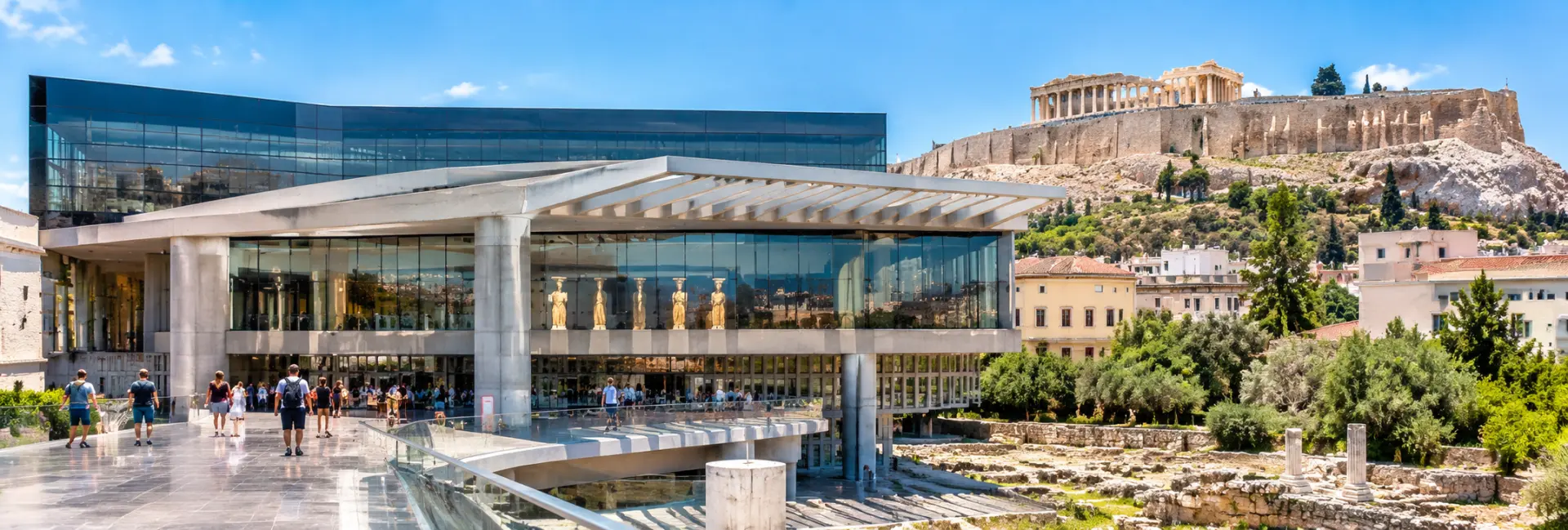
The building itself is part of the draw. Raised on slim concrete pillars over a working excavation site, with glass floors that let visitors look straight down into the remains of an ancient Athenian neighbourhood, the museum treats archaeology as something to walk through rather than simply view behind glass. Its top floor, wrapped in glass and turned to match the exact orientation of the Parthenon on the hill above, brings the ancient temple's surviving frieze back into something close to its original context.
History of the Museum
An Old Idea, Slow to Take Shape
The wish for a proper museum dedicated to the Acropolis dates back to the 1860s, not long after Ottoman forces left Athens, when a small museum was first built directly on the hill to house finds from early excavations. As archaeologists kept uncovering material through the following century, that original building on the summit grew increasingly cramped and unable to display its collection properly, and successive Greek governments floated plans for something larger, without ever settling on a workable site or design.
Decades of False Starts
Three earlier design competitions for a new museum, stretching across more than thirty years, failed to produce a building that was ever constructed, partly because of disagreements over where such a large structure should sit so close to a protected ancient site. Early proposals had also drawn criticism from archaeologists and heritage bodies for paying too little attention to the ancient remains almost certain to be uncovered wherever the museum was eventually built. A fourth and final competition, launched in 2000, addressed those concerns directly by requiring the winning design to be raised above ground level so that any archaeological remains discovered during construction could be preserved rather than destroyed.
Construction and Opening
The Swiss-born architect Bernard Tschumi, working with the Athens-based architect Michael Photiadis, won that competition in 2001, with the jury chaired by fellow architect Santiago Calatrava. Building work soon turned up the remains of a substantial ancient neighbourhood on the site, including houses, wells and drainage systems spanning from the Mycenaean era through the early Christian period, prompting a lengthy and closely supervised excavation that was folded into the final design rather than cleared away. The museum opened to the public on 20 June 2009, replacing the original nineteenth-century building on the Acropolis summit, which today survives as a research centre rather than a public gallery.
Architecture & Building
The museum is organised as a stack of distinct layers, each one corresponding to a different chapter of the Acropolis story. Reinforced concrete pillars lift the main structure clear of the archaeological excavation beneath it, and large sections of the ground floor are made of load-bearing glass so that visitors walk directly over the exposed foundations of the ancient neighbourhood the builders uncovered.
The most distinctive architectural move comes at the very top. The uppermost gallery is rotated several degrees away from the alignment of the floors beneath it, so that its glass walls face in exactly the same direction as the real Parthenon standing on the hill above. Natural light floods this room from every side, letting visitors compare the carved marble on display with the actual building it once decorated, visible just outside the glass.
Below that top floor, the middle levels function almost as a diagram of the hill itself: a ground level representing the paths and shrines on the Acropolis's lower slopes, a first floor devoted to the Archaic period sculpture found on the summit before the Parthenon was built, and a mezzanine level tucked between them holding the museum's offices, shop and café rather than exhibition space. The result is a building that reads less like a conventional gallery and more like a physical model of the site it describes.
- Around 14,000 square metres of exhibition space across the main levels
- Load-bearing glass floors over the on-site excavation
- A top-floor gallery aligned to match the Parthenon's true orientation
- Entrance directly beside the Akropoli metro station
Collections & Exhibits
More than 4,000 objects are on permanent display, arranged in roughly chronological order as visitors move up through the building. The lower levels cover finds from the slopes of the Acropolis and the sanctuaries that once stood there, including votive offerings, pottery and fragments from the Theatre of Dionysus at the base of the hill.
Higher floors move into the material most visitors come to see: sculpture from the Archaic period through to the Parthenon itself and beyond, into the Roman and early Christian centuries. Rather than grouping objects only by type, the museum leans heavily on reconstructing how each piece related to the building or space it originally came from, so that a metope or a section of frieze is shown roughly where it would once have appeared on the temple.
Everyday finds sit alongside the monumental sculpture and help fill out the picture of daily life around the ancient sanctuary. Pottery fragments, small bronze offerings and inscribed stone dedications recovered from the slopes give a sense of how ordinary Athenians engaged with the sacred hill, distinct from the grander state-funded sculpture created for the temples themselves.
- Archaic-period sculpture from the seventh century BC through the Persian Wars
- Architectural fragments from the Propylaea and the Temple of Athena Nike
- Surviving sections of the Parthenon frieze, metopes and pediment figures
- Objects spanning the Bronze Age through to Roman and early Christian Athens
Must-See Highlights
The Caryatids
Five of the six original Caryatids, the sculpted maidens that once supported the porch of the Erechtheion, stand together on an upper floor of the museum. The sixth was removed to Britain in the early nineteenth century and remains in the British Museum, and its absence from the group is left visibly unfilled.
The Peplos Kore
Among the Archaic-period sculptures, a small standing figure known as the Peplos Kore draws particular attention for the faint traces of original paint still visible on her robe, a rare survival that hints at how brightly coloured ancient marble sculpture once was.
The Parthenon Gallery
The top-floor Parthenon Gallery is generally considered the high point of a visit. Surviving sections of the frieze are displayed in sequence around the room, with plain plaster casts standing in for the portions still held abroad, allowing visitors to see the entire original composition laid out in one continuous run for the first time since antiquity. Above the frieze, the metopes and pediment figures are hung at heights that mirror their original positions on the temple, so the room reads almost like an unfolded version of the building itself.
The Excavation Beneath the Building
Easy to overlook on the way to the upper galleries, the excavated neighbourhood visible through the ground-floor glass floors is itself a highlight. Walkways cross directly over the remains of ancient houses, baths and roads, giving a rare street-level view of ordinary Athenian life that predates almost everything displayed in the galleries above.
Ways to Experience It
Most visitors move through the museum at their own pace, following the chronological layout from ground floor to top floor, though the collection also rewards a slower, more selective visit focused on one or two galleries.
- Self-guided visits with a standard entry ticket
- Official audio guides available in multiple languages
- Licensed guided tours, often combined with a visit to the Acropolis hill itself
- Temporary exhibitions on rotating themes, held in a dedicated lower-floor gallery
Best Time to Visit
Weekday mornings shortly after opening tend to be the quietest time to visit, before tour groups arrive in larger numbers later in the day. Evening hours on Friday, when the museum stays open later in parts of the year, offer a different kind of appeal, with the floodlit Acropolis visible through the glass walls of the top floor.
- Weekday mornings for the smallest crowds
- Friday evenings for extended hours and the lit-up view of the Acropolis
- Outside the June to September peak season for a generally calmer visit
Visitor Tips
- Book tickets online in advance, especially between May and September
- Note that Acropolis Museum tickets are separate from tickets to the Acropolis archaeological site itself
- Photography is generally allowed, but flash and photography inside the Archaic Gallery are not permitted
- The museum is fully wheelchair accessible, with lifts, accessible restrooms and free wheelchair loan at the entrance
- Cloakrooms near the entrance can hold bags and coats during your visit
- Set aside at least two hours to see the main galleries without rushing
Nearby Attractions
- The Acropolis and Parthenon, a short uphill walk away
- The Theatre of Dionysus, at the base of the Acropolis's south slope
- Plaka, the historic neighbourhood known for its narrow streets and tavernas
- The Odeon of Herodes Atticus, a Roman-era theatre still used for performances today
FAQs about visiting the Acropolis Museum
What is the Acropolis Museum famous for? +
It houses the original sculptures recovered from the Acropolis, including the Caryatids from the Erechtheion and the surviving sections of the Parthenon frieze, displayed in a purpose-built glass and concrete building.
How much time should I plan for a visit? +
Around two hours covers the main galleries at a comfortable pace, though visitors with a strong interest in archaeology often stay longer.
Do I need a separate ticket from the Acropolis site itself? +
Yes, the museum requires its own ticket, distinct from admission to the Acropolis archaeological site up on the hill.
Is the museum suitable for wheelchair users? +
Yes, the building is fully accessible, with elevators to every floor, accessible restrooms, and free wheelchair loan available at the entrance.
Can I take photos inside? +
Photography is allowed in most galleries, but flash photography and photography inside the Archaic Acropolis Gallery are not permitted.
What's the best time to visit to avoid crowds? +
Weekday mornings shortly after opening are generally quietest, while summer weekend afternoons and cruise-ship days tend to bring the largest crowds.
Where are the missing Parthenon sculptures? +
A significant share of the original frieze, metopes and pediment figures is held in the British Museum in London, and the Acropolis Museum marks their absence with plain plaster casts in the Parthenon Gallery.
What else is nearby that I can combine with a visit? +
The Acropolis and Parthenon are an easy uphill walk away, and the Theatre of Dionysus, Plaka and the Odeon of Herodes Atticus are all within easy reach on foot.