Table of Contents
Overview
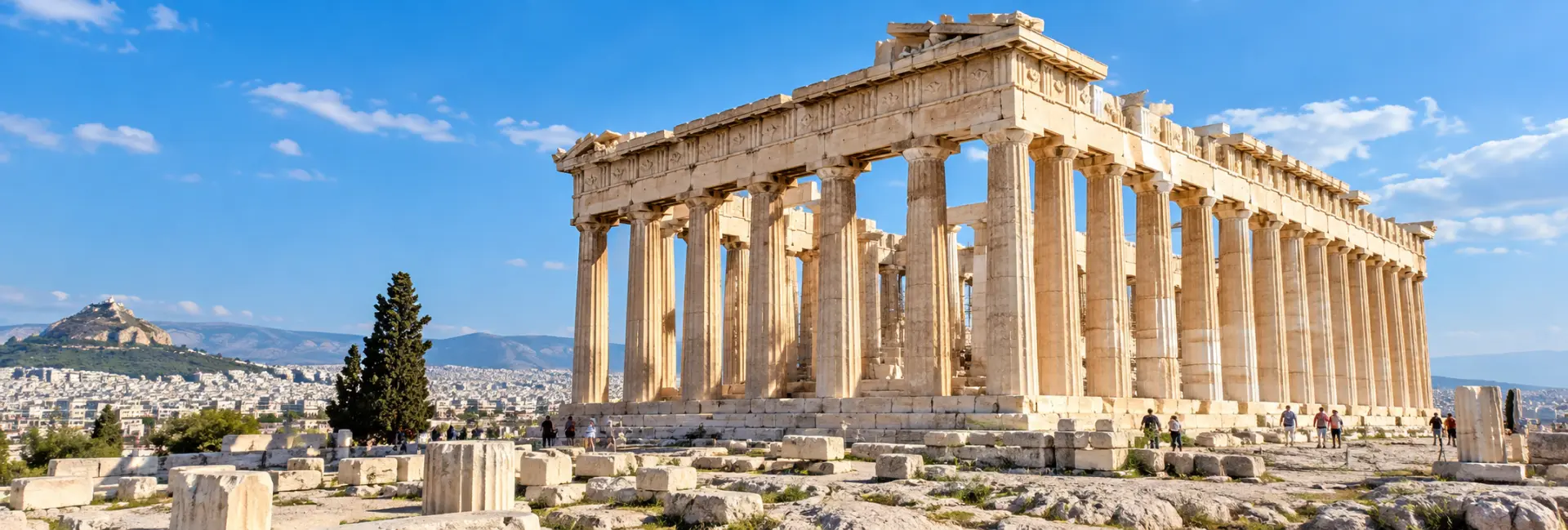
Set on the flat summit of the Acropolis, the Parthenon has represented the high point of classical Greek building for close to twenty-five centuries. It was raised as a temple to Athena, patron goddess of the city, and its clean lines and marble columns have gone on to influence public buildings, museums and monuments across the world.
Today the temple stands in a partially ruined state, missing its roof and much of its interior, yet it remains the single most recognisable structure to survive from ancient Greece. A steady programme of conservation work continues on site, and the building is visited by millions of people each year as the centrepiece of a wider archaeological site that also includes the Propylaea gateway, the Erechtheion and the Temple of Athena Nike.
History
Origins and Construction
Work on the Parthenon began in 447 BC, commissioned during the years when the statesman Pericles was steering Athens toward its greatest wealth and influence. Two architects, Iktinos and Kallikrates, oversaw the design, while the sculptor Phidias directed the building's decorative programme and is thought to have had a hand in shaping the overall design as well. The temple was substantially finished by 438 BC, though craftsmen carried on refining its carved details for a further six years.
The building replaced an earlier, unfinished temple on the same spot that had been destroyed by Persian forces in 480 BC, during their invasion of Attica. Its construction was funded in large part by tribute collected from Athens' allies in the Delian League, a naval alliance originally formed to defend Greek city-states against Persia. Diverting those funds toward a temple in Athens rather than shared defence drew criticism even at the time from rival city-states, who saw it as a sign of Athenian overreach.
From Temple to Fortress
Long after its religious purpose faded, the Parthenon kept being repurposed rather than abandoned. In the fifth or sixth century AD it was converted into a Christian church dedicated to the Virgin Mary, a role it held through the Byzantine period and into the years of Frankish rule that followed the Fourth Crusade. Under Ottoman rule from the fifteenth century, the building was converted again, this time into a mosque, complete with a minaret built into one corner of the structure that remained standing for roughly two centuries.
Damage and Rediscovery
The most damaging moment in the building's long life came in 1687, when Ottoman forces were using it to store gunpowder during a siege by Venetian troops besieging the city. A mortar shell struck the stockpile directly, and the resulting explosion blew out the centre of the temple, brought down much of its roof and walls, and scattered fragments of marble across the hillside. Further losses followed in the early 1800s, when a large share of the surviving sculptures was removed under the direction of the British ambassador to the Ottoman Empire and shipped to Britain. Since Greek independence in the nineteenth century, the site has been the subject of ongoing excavation, documentation and repair, with early restoration attempts sometimes causing their own damage through the use of iron clamps that later corroded and cracked the surrounding marble.
Architecture & Design
The Parthenon is built almost entirely from Pentelic marble, quarried from Mount Pentelicus outside Athens and prized for the warm golden glow it takes on in sunlight. The temple follows the Doric order, ringed by a colonnade of 46 fluted columns arranged eight across the short ends and seventeen along each side, a scale that was unusually large for a Doric building of its period.
What sets the Parthenon apart from a purely rigid, mathematical design is the deliberate use of subtle curves and tilts throughout the structure. The platform on which it sits rises almost imperceptibly toward the centre, the columns lean very slightly inward, and their spacing narrows near the corners, all adjustments made to counteract optical effects that would otherwise make a perfectly straight, evenly spaced building look as though it were sagging. Barely any straight lines exist anywhere in the building; even the floor and the entablature above the columns curve upward by a small, carefully calculated margin.
Inside, the temple was divided into two main chambers rather than one continuous hall. The larger eastern room housed the great statue of Athena and was ringed internally by a smaller two-storey colonnade, while a separate western chamber, entered from the opposite end, served as a treasury for the city and its allies. This second chamber gave the building its name, since "parthenon" is generally understood to mean the room or dwelling of the maiden, a reference to Athena's unmarried status.
- Overall footprint of roughly 69.5 by 30.9 metres
- Columns standing close to 10.4 metres tall
- An inner chamber, the cella, that once housed a monumental statue of Athena
- A rear chamber historically used to store treasury funds and offerings
Sculptural Decoration
The Cult Statue
At the heart of the temple stood a colossal statue of Athena Parthenos, created by Phidias from wood plated with gold and ivory. Standing close to twelve metres tall, it was lost in antiquity, and what survives today is known mainly through smaller Roman-era copies and written descriptions.
Pediments, Metopes and Frieze
The building's exterior once carried one of the richest sculptural programmes of the ancient world. Triangular pediments at each end depicted the birth of Athena and her contest with Poseidon for control of Athens, while 92 carved metope panels around the outer colonnade illustrated battles between gods, giants, centaurs and Amazons. A continuous frieze running along the top of the inner chamber wall showed a procession thought to represent an Athenian religious festival held in Athena's honour.
A Divided Collection
Roughly half of the surviving frieze, metopes and pediment figures remain in Athens, largely on display in the Acropolis Museum, whose top floor is oriented to match the Parthenon's own dimensions and alignment. A substantial portion taken in the early nineteenth century is held in the British Museum in London, and smaller pieces are scattered across a handful of other European collections. The split has made the sculptures, often referred to as the Parthenon Marbles, the subject of a long-running international debate over their return to Greece, one that continues to surface periodically in diplomatic discussions between the two countries.
Recognition & Status
The Parthenon sits within the Acropolis of Athens, which UNESCO inscribed as a World Heritage Site in 1987 in recognition of its influence on art and architecture across the ancient Mediterranean world. The monument and the wider archaeological site are owned and managed by the Greek state through the Ministry of Culture.
Since 1975, a dedicated conservation body, the Acropolis Restoration Service, has carried out careful work to stabilise the structure, correct earlier repairs that used damaging materials, and reassemble scattered marble fragments using techniques designed to be reversible wherever possible. Cranes and scaffolding are often visible on parts of the building as this work continues, a reminder that the Parthenon remains an active conservation site rather than a finished monument.
The temple's cultural weight extends well beyond archaeology. Its proportions have been studied and referenced by architects and artists for centuries, and its silhouette is widely used as a shorthand for Greece itself, appearing on currency, official emblems and countless reproductions of classical architecture around the world.
Ways to Experience It
Most visitors reach the Parthenon on foot as part of a wider walk around the Acropolis, approaching along paved paths that also take in the Propylaea gateway and the Erechtheion. The temple itself is viewed from a roped-off walkway rather than entered, since the interior is closed to the public. The full loop typically takes visitors past several other structures on the summit before reaching the main viewing points around the Parthenon's eastern and western faces.
- Self-guided visits using a standard Acropolis entry ticket
- Licensed guided walking tours covering the whole hill, often combined with the Acropolis Museum
- Audio guide apps that can be used at your own pace
- Early-morning or sunset time slots for photography with smaller crowds
Best Time to Visit
Spring and autumn generally offer the most comfortable conditions, with mild temperatures and thinner crowds than the height of summer. Visiting in July or August still works well for travellers who don't mind heat and busier queues, particularly if they arrive at opening time.
- Early morning, right at opening, for the coolest temperatures and quietest paths
- Late afternoon for softer light and warmer tones on the marble
- Weekdays outside major Greek holidays tend to be less crowded than weekends
Visitor Tips
- Wear flat, closed-toe shoes with good grip, since the marble paths and steps are uneven and can be slippery
- Bring water and sun protection, as there is very little shade on the hill
- Book tickets online in advance to choose an entry time slot and avoid the longest queues
- Consider the combined ticket that also covers other Athens archaeological sites if you plan to visit several
- The site includes an accessible route to the summit, though much of the hill's natural terrain remains uneven
Nearby Attractions
- Acropolis Museum, a short walk downhill, holding many of the original sculptures
- Ancient Agora of Athens, the civic and commercial heart of the classical city
- Plaka, the old neighbourhood beneath the Acropolis known for its narrow lanes and tavernas
- Theatre of Dionysus and the Odeon of Herodes Atticus, both built into the Acropolis slopes
FAQs about visiting the Parthenon
What is the Parthenon and why is it famous? +
It's an ancient Doric temple built in the fifth century BC to honour Athena, and it's considered one of the finest surviving examples of classical Greek architecture and sculpture.
How much time should I set aside to see it? +
Most visitors spend around two to three hours covering the Parthenon along with the rest of the Acropolis site, longer if a guided tour or the Acropolis Museum is included.
Do I need to book tickets in advance? +
Yes, booking an entry time slot online ahead of your visit is strongly recommended, since walk-up queues can be long, especially in peak season.
Can I go inside the Parthenon? +
No, the interior is closed to the public for conservation reasons; visitors view the temple from a walkway that circles the exterior.
Is the Acropolis, and the Parthenon, suitable for visitors with limited mobility? +
There is an accessible route to the summit, but much of the surrounding terrain is uneven natural rock and worn marble, so visitors with mobility needs should plan for a slower pace.
What's the best time of day to visit? +
Early morning right at opening or late afternoon tend to offer cooler temperatures, softer light and smaller crowds than the middle of the day.
Where are the original Parthenon sculptures now? +
Roughly half remain in Athens, mostly displayed in the Acropolis Museum, while a large portion taken in the early nineteenth century is held in the British Museum in London, a split that remains a point of ongoing dispute.
What should I combine a Parthenon visit with? +
The Acropolis Museum, the Ancient Agora and the Plaka neighbourhood are all within easy walking distance and pair naturally with a visit to the hill.