Table of Contents
Overview
Plaka spreads across the northern and eastern slopes of the Acropolis, a tangle of narrow lanes, neoclassical houses and hidden courtyards that has grown up in more or less the same spot since antiquity. Long nicknamed the neighbourhood of the gods for its proximity to the Acropolis and the sheer density of ancient remains underfoot, it is the closest thing central Athens has to a living open-air museum.
Unlike much of the rest of the modern city, Plaka has been shielded from large-scale redevelopment, and its low-rise, tile-roofed buildings still trace the same crooked street pattern visitors would have recognised a century ago. Cafes spill onto marble-paved lanes, small museums occupy converted mansions, and staircases climb suddenly upward toward glimpses of the Parthenon between rooftops.
History
An Ancient Foundation
The ground beneath Plaka has been inhabited more or less continuously since antiquity, sitting directly over what was once a residential district of classical Athens, with layers of Byzantine, Ottoman and modern building stacked on top of it in the centuries since. The name itself only appears in written sources from the second half of the seventeenth century, and its origin is disputed: some trace it to an Albanian word for "old," while others connect it to a since-vanished slab of marble that once served as a local landmark and gave its name to the surrounding lanes.
Capital of a New Kingdom
Plaka's fortunes changed sharply after Greek independence, when Athens was chosen as capital of the new kingdom in the 1830s and the area around the Tower of the Winds briefly served as the city's administrative centre under King Otto, before government buildings and the growing city shifted north toward what is now Syntagma Square. Neoclassical houses went up rapidly through the rest of the nineteenth century as merchants and civil servants settled in the newly fashionable district, and in the same period settlers from the small Aegean island of Anafi built a distinctive cluster of whitewashed homes on the upper slope, giving rise to the Anafiotika enclave. A large fire in 1884 destroyed a swath of the neighbourhood, but it also cleared the way for archaeologists to excavate the Roman Agora and Hadrian's Library, both of which had lain buried beneath later buildings for centuries.
Decline and Restoration
Plaka kept expanding as a fashionable address for artists and intellectuals into the early twentieth century, but by the 1950s and 1960s its narrow streets had filled with bars, nightclubs and heavy traffic, and much of its earlier charm was buried under noise and neglect. A concerted restoration effort beginning in the 1980s, backed by the Ministry of Culture, gradually banned cars from most streets, protected the neighbourhood's building stock from demolition, and pushed the nightlife that had overwhelmed it toward other parts of the city such as Psyrri and Thiseio. That work has continued in stages since, with further pedestrianisation over the following decades, and Plaka today is the only part of central Athens where twentieth-century high-rise development never took hold.
Architecture & Streetscape
Almost every building in Plaka is protected, which has kept the neighbourhood's low, tiled-roof skyline intact in a city otherwise dominated by concrete apartment blocks. Most of what stands today dates from the nineteenth century, built in the simple neoclassical style favoured in Athens after independence, with shuttered windows, wrought-iron balconies and small interior courtyards shaded by citrus and bougainvillea.
The street layout is deliberately informal, following the contours of the hillside rather than any planned grid, which makes wandering without a fixed route one of the most natural ways to experience the area. Streets narrow into stepped alleys as they climb toward the Acropolis, and several pedestrian lanes were resurfaced decades ago using a mix of reclaimed ancient stone fragments and modern materials, blending old and new underfoot in a way most visitors never notice. The architect responsible for much of that paving work, Dimitris Pikionis, deliberately mixed marble chips, broken pottery and salvaged masonry into the walkways as a quiet tribute to the layers of history beneath them.
Building heights are kept low throughout the neighbourhood, rarely rising above three or four storeys, which preserves sightlines up toward the Acropolis from many of Plaka's small squares and rooftop terraces. This consistency, along with a near-total absence of modern signage and glass-fronted storefronts, is a large part of why the neighbourhood still reads as a single, coherent historic quarter rather than a patchwork of eras.
- Predominantly nineteenth-century neoclassical houses
- Narrow, largely car-free lanes following the natural slope of the hill
- Small interior courtyards and rooftop terraces with Acropolis views
- A handful of surviving Ottoman-era and Byzantine structures tucked among later buildings
Key Areas & Sub-districts
Anafiotika
Tucked into the steepest part of the slope just below the Acropolis walls, Anafiotika is a tiny enclave of whitewashed, blue-shuttered houses built in the Cycladic style, founded by construction workers who arrived from the island of Anafi in the nineteenth century. Its narrow, stepped paths and small chapels feel closer to a quiet island village than a corner of a major capital.
Aerides
The area around the Tower of the Winds, known locally as Aerides, briefly functioned as the administrative heart of Athens in the early years of King Otto's reign, before the modern city centre shifted north toward Syntagma Square. It remains one of Plaka's most atmospheric corners, threaded with small museums and quiet lanes close to the Roman Agora.
Lower Plaka
Closer to Syntagma and Monastiraki, the lower, flatter part of Plaka along Kydathineon and Adrianou streets carries most of the neighbourhood's shops, tavernas and foot traffic, forming the main pedestrian spine most visitors follow on a first walk through the area. Filomousou Eterias Square, roughly at the midpoint of Kydathineon Street, functions as an informal gathering point, ringed by café terraces that stay busy well into the evening.
Notable Landmarks
- The Monument of Lysicrates, a small marble choragic monument from 334 BC, among the earliest structures anywhere to use Corinthian columns on its exterior, originally built to display a prize won in a theatrical competition
- The Tower of the Winds, an octagonal first-century BC marble structure built as a combined sundial, water clock and weather vane, with carved figures representing each of the eight winds around its frieze
- The Church of the Metamorphosis, an eleventh-century Byzantine chapel tucked into a courtyard off Kydathineon Street, one of several small Byzantine churches scattered through the neighbourhood
- The Benizelos Mansion, generally considered the oldest surviving house in Athens, with parts dating back several centuries and now open to visitors as a small house museum
- Small specialist museums covering Greek folk art, traditional musical instruments and private art collections, several housed in converted historic mansions along the neighbourhood's quieter lanes
Ways to Experience It
Plaka rewards slow, undirected walking more than any fixed itinerary, since much of its appeal lies in stumbling across a quiet courtyard, a hidden church or a sudden view of the Acropolis rather than following a checklist of sights.
- Self-guided walks along Kydathineon and Adrianou streets, the neighbourhood's two main pedestrian spines
- A climb up into Anafiotika for its narrow, whitewashed lanes and Acropolis views
- Guided walking tours that combine Plaka with the Acropolis or nearby Ancient Agora
- An evening out at one of the neighbourhood's traditional tavernas, several with live folk music
Best Time to Visit
Spring and autumn evenings tend to bring the most comfortable temperatures for walking Plaka's uphill lanes, while a summer visit is easiest managed by exploring in the morning or after sunset, once the midday heat has passed.
- Late afternoon into evening, when café terraces fill and the light softens over the rooftops
- Weekday mornings for quieter streets before tour groups arrive from nearby coach parking
- Spring for mild weather and blooming courtyard gardens
Visitor Tips
- Wear comfortable shoes, since many lanes are stepped, cobbled or steeply sloped
- Compare a few taverna menus before sitting down, since prices can vary sharply between streets aimed mainly at tourists and quieter side lanes
- Keep an eye out for small museums tucked into converted mansions, easy to miss on a quick walk-through
- Most vehicle traffic is restricted, but watch for the occasional delivery scooter on narrow lanes
- Visit Anafiotika in daylight, since its unmarked stepped paths are easiest to navigate before dark
Nearby Attractions
- The Acropolis and Parthenon, reached on foot up Plaka's northern edge
- The Ancient Agora and Roman Agora, both a short walk away
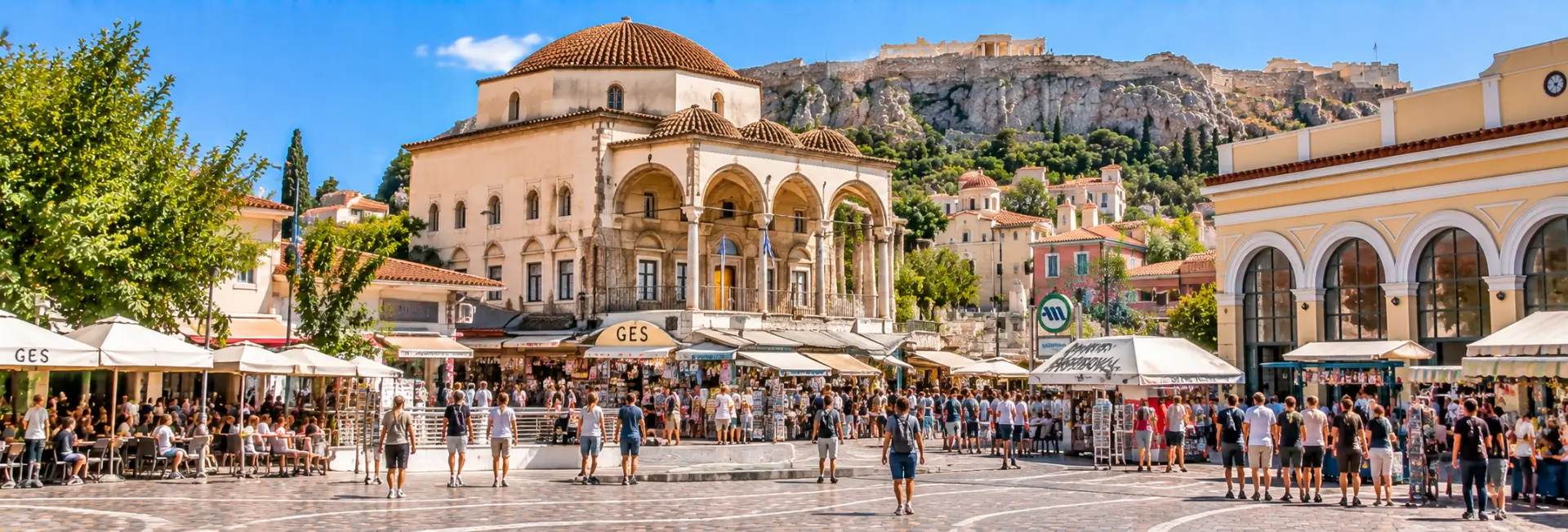
- Monastiraki Square and its flea market, bordering Plaka's lower streets
- Syntagma Square and the Greek Parliament, a walk of about fifteen minutes
FAQs about visiting Plaka
What makes Plaka different from the rest of central Athens? +
It's the oldest continuously inhabited neighbourhood in the city, largely protected from twentieth-century redevelopment, so its low neoclassical buildings and narrow lanes have survived largely intact.
How much time should I set aside? +
A couple of hours covers a relaxed walk through the main streets and Anafiotika, though it's easy to spend half a day if you stop at museums or linger over a meal.
Is Plaka walkable, or do I need transport? +
It's entirely walkable and mostly car-free, though the steep lanes near Anafiotika involve some uphill climbing.
What is Anafiotika and is it part of Plaka? +
Yes, it's a small enclave within upper Plaka built in a Cycladic island style by settlers from the island of Anafi, and it's one of the neighbourhood's most photographed corners.
Is Plaka touristy, and is that a problem? +
Parts of it, especially near Monastiraki, cater heavily to visitors, but wandering slightly further into the quieter upper lanes still reveals a much calmer, more residential side of the neighbourhood.
What's the best time of day to visit? +
Late afternoon and early evening tend to offer the best light and atmosphere, once the midday heat and coach-tour crowds have eased.
Are there museums worth visiting in Plaka? +
Yes, several small museums covering Greek folk art, traditional instruments and private art collections are tucked into converted historic mansions throughout the neighbourhood.
What can I combine a visit to Plaka with? +
The Acropolis, Ancient Agora, Roman Agora and Monastiraki are all within easy walking distance, making Plaka a natural base for a full day exploring central Athens on foot.