Table of Contents
Overview
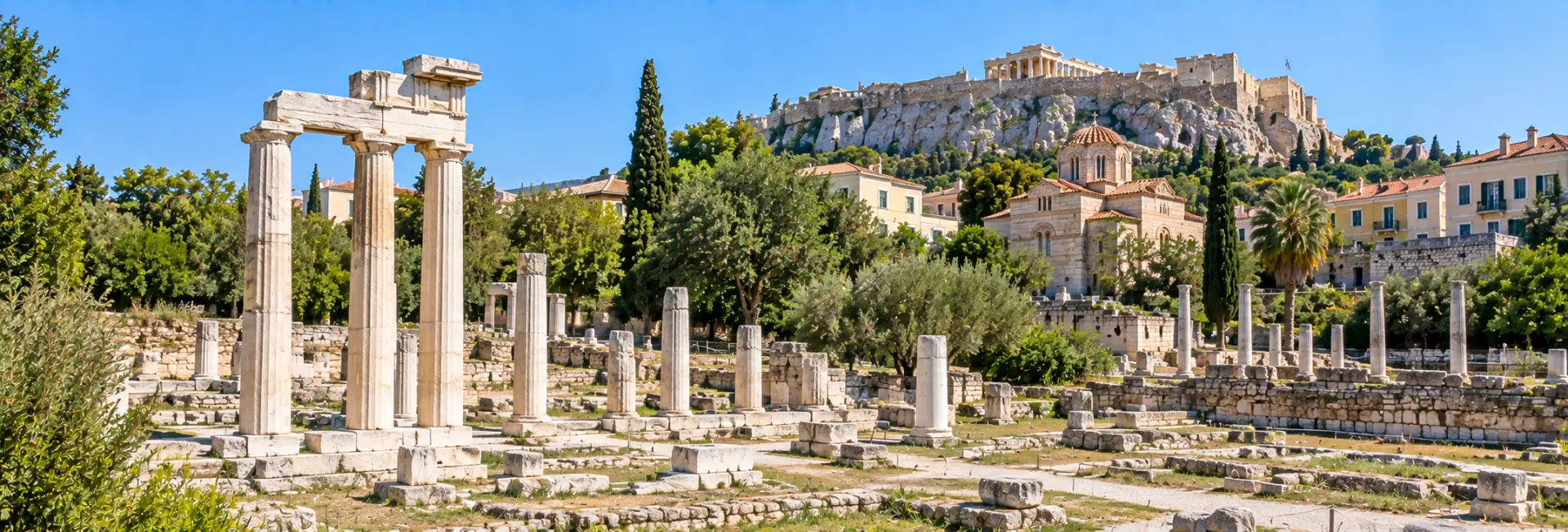
The Roman Agora of Athens is a partly excavated marketplace complex tucked into the Plaka district, just north of the Acropolis and only a short walk from the older Ancient Agora. Built in the final decades of the first century BC, it took over as the commercial heart of the city once the Classical Agora became too crowded for everyday trade. Today the site preserves a rectangular courtyard, the columned remains of two monumental gateways, and one of the best-preserved structures to survive from antiquity anywhere in Greece: the octagonal Tower of the Winds.
Unlike the sprawling ruins of the Acropolis, the Roman Agora rewards a slower, closer look. Much of it can even be taken in for free from the surrounding railings, making it an easy add-on to a walk through Plaka or Monastiraki, while a modest entrance fee opens up the interior for a more detailed visit. The site's small footprint, tucked between quiet lanes and cafe terraces, also means it rarely feels as crowded as the major landmarks nearby, even in peak season.
History
Origins and Construction
Funds for a new market square were first promised by Julius Caesar in 51 BC, but it was Emperor Augustus who eventually paid for the project, with construction carried out under the supervision of the Athenian benefactor Eucles of Marathon. Most scholars place the building work sometime between 19 and 11 BC, roughly a hundred metres east of the existing Classical Agora, though some estimates push the start of construction back into the 20s BC.
The new agora was designed as an open, rectangular courtyard enclosed by colonnaded stoas, with shops and administrative offices lining its edges. An inscription found on-site refers to an Agoranomion, the office of the officials who oversaw weights, measures, and trade, underlining the market's practical purpose. By moving everyday commerce into a purpose-built square, the project also freed up the older Agora to the west to remain the city's civic and philosophical gathering place, a division of roles that shaped how central Athens functioned for centuries afterward.
Expansion Under Hadrian
The Roman Agora took on a more monumental appearance in the second century AD, when Emperor Hadrian had the courtyard repaved with large marble slabs. Some of these slabs were later inscribed with an imperial edict setting out taxes and rules for the sale of olive oil, a trade Athens depended on both economically and symbolically, since olive cultivation was closely tied to the city's own foundation myth. After a Herulian raid devastated much of the city in AD 267, the Roman Agora took on an even larger role, becoming the administrative and commercial centre of a much-diminished Athens, whose defensive walls were redrawn to enclose a far smaller area than before.
Byzantine and Ottoman-Era Changes
Long after its Roman heyday, the site kept being reused rather than abandoned. During the Byzantine period, houses, workshops, and small churches were built over and around the old market, gradually burying much of the original layout under later construction. Following the Ottoman conquest of the city, the Fethiye Mosque was constructed at the agora's edge in 1456 to mark the event, and the surrounding area continued to serve as a working bazaar for centuries, with the ancient colonnades absorbed into everyday shops and dwellings. Only in the nineteenth and twentieth centuries were later structures gradually cleared away to expose the ruins visible today, though excavation of the site remains incomplete and new details are still occasionally uncovered.
Key Structures & Highlights
Several distinct structures survive well enough to give a real sense of how the Roman Agora once worked, from its ceremonial entrances to the ordinary conveniences of everyday market life.
Gate of Athena Archegetis
The best-preserved entrance to the site is the Gate of Athena Archegetis on the west side, a Doric propylon of four columns dedicated to Athena as the city's guiding goddess. Its inscription credits both Julius Caesar and Augustus as donors, and the gate is generally dated to around 11-10 BC. A statue of Lucius Caesar, grandson of Augustus, is thought to have once stood on top of it. On the gate's north face, a later inscription records Hadrian's regulations for the local olive oil trade, a reminder of how central that commodity was to the Athenian economy.
Tower of the Winds
At the eastern end of the agora stands the Tower of the Winds, an octagonal marble tower usually dated to the first century BC and remarkably intact considering its age. It functioned as a combined sundial, water clock, and weathervane, originally topped by a bronze figure of Triton that turned with the wind to point toward whichever deity's relief matched the current direction. Each of its eight faces carries a carved personification of one of the eight winds of Greek mythology, complete with attributes suited to the weather it was thought to bring. The tower's continued survival is partly thanks to later reuse: at different points in its long history it served functions unrelated to its original purpose, including a spell as a place of worship, which helped protect it from the demolition that claimed so much of the surrounding agora.
Fethiye Mosque and the Vespasianae
On the north side of the site, the Fethiye Mosque still stands much as it did when it was completed in 1456, one of the oldest surviving Ottoman-era buildings in central Athens and a rare structure to have escaped the wider clearance of later additions around the ruins. It has been used at various times for storage and for hosting temporary exhibitions rather than as an active place of worship. Near the agora's eastern gate, archaeologists have also identified the remains of public latrines, known by their Latin name vespasianae, along with traces of a fountain that once stood at the southern end of the courtyard - modest but telling details of daily life in the ancient market that sit quietly alongside its grander monuments.
Ways to Experience It
Because much of the agora sits behind a low perimeter fence, it's possible to see a good deal of the site, including the Gate of Athena Archegetis and the Tower of the Winds, without paying for a ticket. Visitors who want to walk among the ruins themselves need a paid entry ticket, which is well worth it for a closer look at the inscriptions and stonework.
- Buy a standalone ticket at the on-site booth or online through the official Greek culture ministry site
- Combine the visit with the wider Athens archaeological sites pass, which also covers the Acropolis, the Ancient Agora, and other nearby ruins
- Join a guided walking tour that links the Roman Agora with the neighbouring Ancient Agora, Plaka, and Monastiraki
- Bring a guidebook or phone for context, since on-site signage is limited
- Set aside time to walk a full loop of the perimeter fence first, which gives a useful overview before deciding whether to go inside
Best Time to Visit
The site has very little shade, so the cooler parts of the day make for a far more comfortable visit. Arriving shortly after opening in the morning also means smaller crowds and softer light for photographs of the Tower of the Winds. Spring and autumn bring milder temperatures than the height of summer, when midday heat on the exposed stone courtyard can be intense and the marble underfoot reflects even more warmth back up. Since the Roman Agora is small, it also works well as a short stop late in the afternoon on the way to or from Plaka, once the harshest sun has passed and the surrounding cafes start to fill up for the evening. Visiting outside the busiest summer months tends to mean a quieter, more unhurried walk around the ruins as well.
Visitor Tips
A little planning makes the visit smoother, since the site is compact but has some uneven ground underfoot.
- Wear flat, sturdy shoes - the ancient paving and loose stone are uneven in places
- Carry water and sun protection, since the courtyard offers almost no shade
- Check current opening hours and ticket prices before visiting, as these are adjusted seasonally
- Look out for free-admission days offered periodically throughout the year
- Allow roughly 30 to 45 minutes for a relaxed visit, more if you want to study each structure closely
- Combine the visit with a walk through Plaka immediately afterward, since the two areas sit side by side
- Keep small change or a card handy for the ticket booth, since it sits apart from the entrance gate itself
Nearby Attractions
The Roman Agora sits at the meeting point of several of Athens's most walkable historic districts, making it easy to fold into a longer route on foot without needing a taxi or the metro in between.
- Ancient Agora of Athens - the earlier civic and political centre of the city, a few minutes' walk to the west, with its own well-preserved temple and stoa
- Library of Hadrian - a monumental building complex just north of the Roman Agora, built during the same era of Roman patronage and worth pairing with it on the same visit
- Plaka - Athens's old neighbourhood of narrow lanes, tavernas, and small shops, wrapping around the southern edge of the site
- Monastiraki Square and flea market - a lively square with shopping, street food, and cafes, a short walk north
- Acropolis and Acropolis Museum - the city's most famous landmark, within easy walking distance to the south, and easily combined into the same day
FAQs about visiting the Roman Agora of Athens
What is the Roman Agora of Athens? +
It's a partly excavated Roman-era marketplace in central Athens, built in the late first century BC to replace the older Ancient Agora as the city's main commercial centre. Today it preserves a colonnaded courtyard, two monumental gates, and the well-known Tower of the Winds.
How is the Roman Agora different from the Ancient Agora? +
The Ancient Agora, a short walk to the west, was the Classical-era civic and political heart of Athens, while the Roman Agora was built later, under Roman patronage, specifically as a marketplace once the older site became too crowded for trade.
How much does it cost to visit? +
There's a modest entrance fee that varies by season, with reduced or free admission available for certain age groups, EU citizens, and on select free-admission days throughout the year. The site can also be combined with a multi-attraction Athens archaeological ticket.
How long should I spend at the Roman Agora? +
Most visitors need around 30 to 45 minutes to walk the site and take in the main structures, though history enthusiasts may want closer to an hour to read the inscriptions and study the Tower of the Winds in detail.
What is the Tower of the Winds? +
It's an octagonal marble tower at the eastern edge of the agora that combined a sundial, water clock, and weathervane, with each of its eight sides carved with a relief of a different wind deity. It's one of the best-preserved structures to survive from ancient Athens.
Can I see the Roman Agora without buying a ticket? +
Yes, a good portion of the site, including views of the Tower of the Winds and the Gate of Athena Archegetis, is visible from outside the perimeter fence, though a ticket is needed to walk among the ruins themselves.
What's the best time of day to visit? +
Early morning is ideal, since the site has little shade and gets warm quickly in the sun, and arriving soon after opening also means fewer crowds around the main structures.
What else is nearby? +
The Ancient Agora, the Library of Hadrian, Plaka, Monastiraki Square, and the Acropolis are all within a short walk, making the Roman Agora easy to combine with a longer day of sightseeing in central Athens.