
Table of Contents
Overview
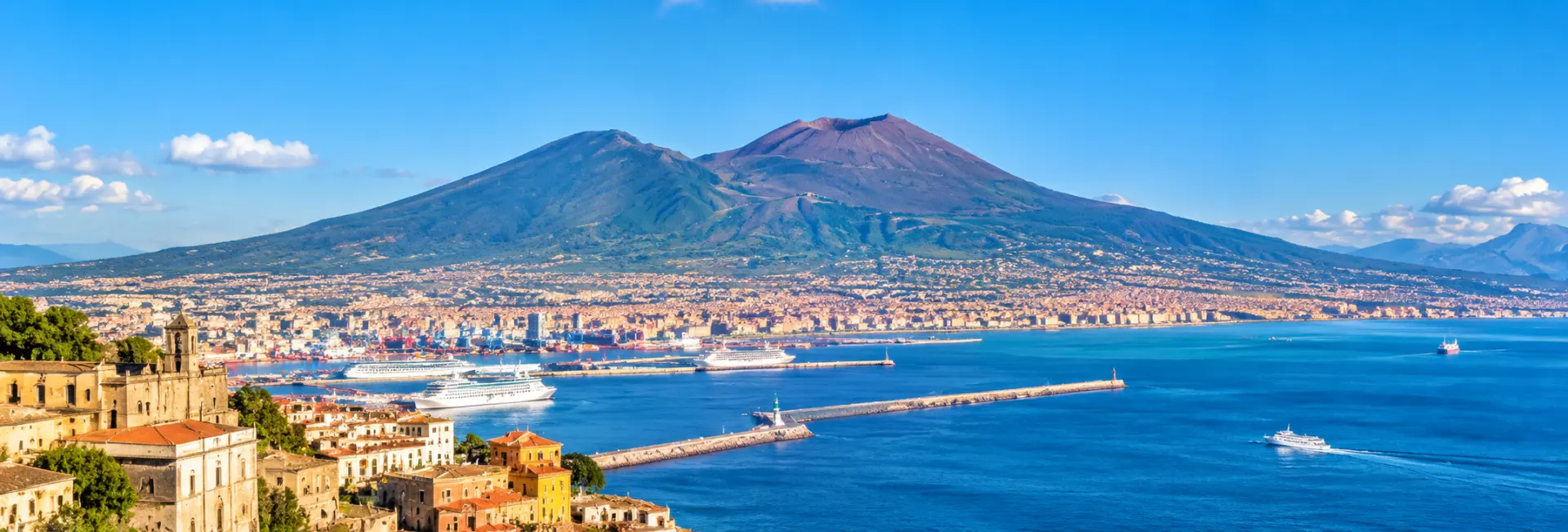
Mount Vesuvius is the volcano that defines the skyline of the Bay of Naples, a brooding double-peaked mass rising roughly nine kilometres east of the city centre. At 1,281 metres, it is the only active volcano on the European mainland, and although it has been quiet since March 1944, it is still watched as closely as any volcano on Earth.
Its fame rests on the catastrophe of AD 79, when it buried Pompeii, Herculaneum and Stabiae. Today people come for a different kind of experience: a signposted walk to a viewpoint above the crater, wide views across the bay to Capri and Sorrento, and a landscape of black lava, silvery lichen and fragrant broom that feels a long way from the busy streets below.
The visit is approachable for most travellers. The main trail is a walk of about four kilometres in total on a broad path, with a volcano guide accompanying each group on the upper section. The very rim of the crater is protected, so the reward is the panorama and the sense of standing beside a living giant rather than a scramble to the edge.
Formation and Eruption History
How the Volcano Formed
Vesuvius is a somma-stratovolcano, meaning a younger cone that sits inside the broken rim of an older, taller volcano. The curved ridge to the north, Monte Somma, is what remains of that earlier structure, and its highest point, Punta Nasone, reaches 1,132 metres. The valley that separates the ridge from the modern cone is called the Valle del Gigante, and its western end is known as Atrio del Cavallo.
The magma is fed by the collision zone where the African plate is pushed beneath the Eurasian plate, part of the Campanian volcanic arc that also includes the Phlegraean Fields west of Naples. The volcano itself is around 17,000 years old, built from alternating layers of lava, ash and pumice.
The AD 79 Eruption
This is the event that made Vesuvius famous worldwide. A vast column of ash and pumice rose above the mountain and rained down on Pompeii, while fast-moving clouds of superheated gas and debris swept through Herculaneum. The towns were sealed under volcanic deposits that preserved streets, houses, frescoes and everyday objects in extraordinary detail.
Pliny the Younger watched the eruption from across the bay and described it in letters that scientists still study. The term Plinian eruption, used for tall, explosive columns of this kind, is named after his account.
Later Eruptions and the Quiet Since 1944
Vesuvius has erupted many times since antiquity, with activity ranging from slow lava flows to violent explosions. In the eighteenth and nineteenth centuries it was so often active that painters routinely showed a plume of smoke above the crater, and it drew scientists and travellers from across Europe.
The most recent eruption ran from 17 to 23 March 1944, sending lava down the slopes and reshaping the summit crater. Since then the volcano has settled into a period of rest, showing only weak seismic activity and steam vents, known as fumaroles, on the inner walls of the crater.
Recognition and Monitoring
A Protected Landscape
Vesuvius National Park was created by presidential decree in 1995 to protect the volcano and its surrounding habitats. In 1997 the area was added to UNESCO's network of biosphere reserves as Somma-Vesuvio and Miglio d'Oro, a designation that also covers the coastal strip around Pompeii and the grand villas of the Golden Mile.
The park is part of the European Natura 2000 network, and it includes the Creste del Monte Somma, recognised as the first volcanic wilderness area in Italy.
The World's Oldest Volcano Observatory
The Vesuvius Observatory was founded in 1841 by King Ferdinand II of the Two Sicilies on the volcano's western slope, and it is regarded as the oldest volcanological institution in the world. Its historic building now houses a museum of early instruments, rocks, photographs and film of past eruptions.
Modern monitoring is carried out around the clock by the Naples section of Italy's national geophysics and volcanology institute. Italy's civil protection department reports the alert level as green, meaning no unusual activity, and maintains an emergency plan with defined red and yellow zones covering roughly 700,000 people who live on and around the mountain.
Flora and Fauna
At first glance the upper slopes look barren, but life has steadily colonised the ash and lava. Etna broom is the signature plant, filling the air with scent as the weather warms, and it grows alongside red valerian, docks and sorrels, which are among the first species to settle on fresh volcanic ground. On the lava of the 1944 eruption, a silvery-grey lichen called Stereocaulon vesuvianum spreads in pale patches across the dark rock.
Lower down, the Tirone-Alto Vesuvio forest reserve covers about 1,000 hectares and brings in pine and birch woodland, a cooler and shadier contrast to the exposed cone.
The crater walls and rocky ground also suit birds of high, stony habitats. Rock thrushes, black redstarts, northern wheatears and black-eared wheatears are all recorded here, and common ravens are often heard over the upper trail. Bring binoculars if you enjoy birdwatching, especially outside the busiest hours.
Key Areas, Trails and Viewpoints
The Gran Cono (Path 5)
This is the main visitor route and the one most people mean when they talk about hiking Vesuvius. It begins at the Piazzale Quota 1000, at the end of the provincial road from Ercolano, and climbs a wide path through a series of scenic hairpin bends. Along the way the view opens up over Monte Somma, the Valle del Gigante and the Tirone forest.
A checkpoint at roughly 1,118 metres marks the start of the guided section, and the path continues to viewpoints over the crater and on to the Capannuccia at about 1,170 metres. The top edge of the crater cannot be walked by visitors, but the views into the elliptical crater, about 580 metres across at its widest, are impressive.
Monte Somma and Punta Nasone
For a wilder outing, the network includes a route around Monte Somma leading to Punta Nasone, the highest point of the old caldera rim. Some sections of the park's trail network are closed from time to time for maintenance, so check the park's official page before planning a longer walk.
Valley of Hell and the River of Lava
The Valle dell'Inferno trail crosses some of the most dramatic and least-visited scenery on the mountain. Nearby, the River of Lava path lets you walk across an old lava flow in an almost lunar landscape.
Forest and Pinewood Walks
The Tirone reserve trail explores the forested slopes, while the path through the Terzigno pinewood is flat and gentle, a good choice for anyone who wants a nature walk without the climb.
Ways to Experience It
The Guided Crater Walk
Access to the Gran Cono is by timed online ticket only. Groups of up to 20 people set off together with a guide from the Vesuvius Volcano Permanent Base, and the guides stop at wider points on the path to explain the geology and the history of the eruptions. Numbers on the trail are capped each hour to protect the environment, which keeps the experience calmer than you might expect.
The complete outing lasts between two and three hours depending on the route chosen, and the walk must be finished within an hour of the last permitted entry to the crater.
Getting Up the Mountain
- By car: take the A3 Naples-Salerno motorway to the Torre del Greco exit, follow signs for Vesuvio and continue on the SP144 to the car park at around 800 metres.
- From that car park, walk the remaining 1.8 kilometres of road in about half an hour, or take the local shuttle for the short ride to the Piazzale Quota 1000.
- By train: take the Circumvesuviana line from Naples to Ercolano Scavi, where taxis and private shuttles such as the Vesuvio Express run up the mountain, in a round trip that takes about three hours.
- Alternatively, alight at Pompei Villa dei Misteri, where local EAV buses connect to the volcano.
Combining Vesuvius With Other Sites
Many visitors pair the volcano with Pompeii or Herculaneum, and combined passes make this simple. Seeing the mountain first and the ruins afterwards gives the story a natural order: the cause, then the consequence.
Best Time to Visit
Spring and early autumn are usually the most comfortable seasons, with milder temperatures on the exposed slopes and good conditions for long views. April to June and September also come with generous opening hours, though the exact times change by month.
Summer is the busiest period and the hottest, and there is almost no shade on the upper trail. The trail keeps its longest hours in July and August, which helps with planning, but a morning slot will be cooler and leaves the afternoon free for another site.
In winter the hours are shorter, with the last visits ending in the mid-afternoon, and it can be cold, windy and cloudy on the mountain even when Naples is mild. Clouds sometimes hide the bay entirely, so a clear forecast is worth waiting for if the view matters to you.
The trail is closed automatically on days when the regional civil protection authority issues weather alerts at orange level or higher, so check the forecast before you travel.
Visitor Tips
- Book your timed ticket online before you go, since tickets are not sold on the mountain and slots are limited.
- Wear sturdy shoes with good grip, as the path crosses loose volcanic ash and small stones.
- Carry water, sun protection and a windproof layer, because the summit area is more exposed and cooler than the city.
- Do not count on facilities at the piazzale. The park has noted that public toilets are not currently available there, and parking is not permitted in the square itself.
- Stay on the marked path and follow your guide, as the route along the crater rim is closed to the public for safety and conservation.
- Check the official park website for current opening hours, prices, trail status and any alerts on the day of your visit.
- Reduced prices and free entry exist for some groups, including young people under 25 with valid ID, and free entry applies for children under 6 and for disabled visitors and their carers with a certificate.
Nearby Attractions
- Herculaneum: the small, remarkably intact Roman town lies at the foot of the mountain in Ercolano, and it is the natural starting point for most Vesuvius trips.
- Pompeii: about ten kilometres from the volcano, this is the most famous buried city in the world and a common pairing for a full day out.
- Villa Regina in Boscoreale: a rural Roman villa buried in AD 79, now a small museum that shows how farming life looked around the volcano.
- Vesuvius Observatory museum: the historic observatory building on the western slope tells the story of volcano monitoring.
- Villas of the Golden Mile: grand sixteenth and seventeenth century villas along the coast, part of the same UNESCO biosphere reserve.
- Naples: the city lies less than 12 kilometres away and offers its historic centre, the National Archaeological Museum and one of Italy's great food cultures.
FAQs about visiting Mount Vesuvius
Is Mount Vesuvius still an active volcano? +
Yes. It last erupted in March 1944 and has been quiet since, but it is classed as active and monitored around the clock. The official alert level is currently green, which means there is no unusual activity.
Can you walk to the crater rim? +
You can walk to viewpoints above the crater on the Gran Cono trail, but the path along the top of the crater is closed to visitors. Only people with special authorisation from the park can go there.
Do I need to book tickets for Vesuvius in advance? +
Yes. Access to the crater trail is by timed ticket bought online, and there is no ticket office at the site. A small share of last-minute slots is released shortly before each time, but booking ahead is much safer, especially in summer.
How long does a Vesuvius visit take? +
The walk itself takes roughly two to three hours depending on the route, and organised trips from Ercolano usually run to about three hours including transport. Allow half a day if you are travelling from Naples.
How do I get to Mount Vesuvius from Naples without a car? +
Take the Circumvesuviana train to Ercolano Scavi and continue by taxi or a shuttle such as the Vesuvio Express. You can also go to Pompei Villa dei Misteri and use the local EAV buses.
Is the hike difficult, and is it suitable for children? +
The park rates it as low difficulty, and the path is wide, but it is steep in places and the ground is loose. Most reasonably active visitors and school-age children manage it well, while people with mobility issues should check conditions with the park first.
Can I see Vesuvius and Pompeii or Herculaneum in one day? +
Yes, and many people do. Herculaneum is close to the mountain's access road, and Pompeii is a short journey away, so a morning on the volcano followed by an afternoon at the ruins works well.
Will I see Capri and the Bay of Naples from the top? +
On a clear day the views take in the whole Gulf of Naples, the coast towards Sorrento, the island of Capri and the plain of Campania. Cloud can reduce visibility, so a clear forecast improves the experience.
