
Table of Contents
Overview
Napoli Sotterranea is a guided walking route through the hollowed-out ground beneath Naples' historic centre. Starting from a street-level entrance in Piazza San Gaetano, visitors descend roughly 40 metres into a world of tunnels, water cisterns and vast chambers carved from soft volcanic rock. It is one of the clearest ways to understand that Naples is really two cities, one built on top of the other.
What makes the visit memorable is how many eras are packed into a single underground loop. In roughly ninety minutes, the story runs from ancient stone quarrying and Roman-era water supply to wartime air-raid shelters and the odd afterlife of the cavities in the decades that followed. The route is run by the cultural association Napoli Sotterranea, and it is only accessible with a guide.
The setting is cool, dim and atmospheric, which is a welcome change from the noise and heat of the streets above. For anyone curious about how Naples grew, why its ground is so full of holes, and what daily survival looked like during the bombings of the 1940s, this is one of the most rewarding stops in the city.
History
Quarries Beneath a Greek City
The story begins with the founding of Neapolis, the "new city" established by Greek settlers on this stretch of the Bay of Naples in the 5th century BC. The local stone, a soft, golden-yellow volcanic tuff, was easy to cut and hardened once exposed to air. Builders extracted it directly from the ground beneath the growing settlement, and the empty spaces they left behind became the first layer of the underground.
The quarrying method explains the shape of many chambers you see today. Blocks were cut out and hauled up through shafts, leaving tall, cavernous voids under what would later become streets and houses.
Roman Water and Its Long Afterlife
Under Roman rule, the hollows were put to a new purpose. Channels and tunnels linked the cavities to an aqueduct system, and many spaces were turned into cisterns that stored water for homes above. Small shafts cut into the ceilings let residents lower buckets straight from their own buildings.
Later generations kept using and adding to this network. Water systems remained in service for centuries, maintained by specialist workers who crawled through narrow passages to clean and repair them. The arrangement lasted until the 1880s, when a serious cholera epidemic pushed the city towards modern sewers and waterworks. The old network was abandoned, and many chambers were sealed, filled or forgotten.
Shelter in the Second World War
The tunnels returned to everyday life during the Second World War. As Allied bombing raids struck Naples repeatedly, thousands of residents sought protection underground. Some chambers were fitted out as shelters, and the route today includes preserved traces of that period, such as rooms where families waited out the raids and objects left behind.
After the war, parts of the underground served as a convenient dumping ground for rubble and discarded items. It took decades for the spaces to be cleared, studied and gradually opened to the public as a heritage attraction.
Recognition / Status
Napoli Sotterranea sits within the Historic Centre of Naples, which UNESCO inscribed on the World Heritage List in 1995. That listing recognises the extraordinary continuity of the old city, whose street plan still follows the grid laid out in Greek and Roman times.
The underground network is a physical record of the same continuity. While the official designation covers the historic centre as a whole, the tunnels below provide a rare view of the foundations that made the city above possible.
The site is best described as a cultural and archaeological visitor attraction operated under an association rather than as a single monument. It is one of several underground visits in Naples, each with its own entrance and focus, so it is worth knowing which one you are booking.
What You'll See Underground
The Descent
The visit starts with a long staircase leading down from street level. Many visitors mention the drop in temperature almost immediately, since the air underground stays cool and steady regardless of the season above.
Tunnels and Cisterns
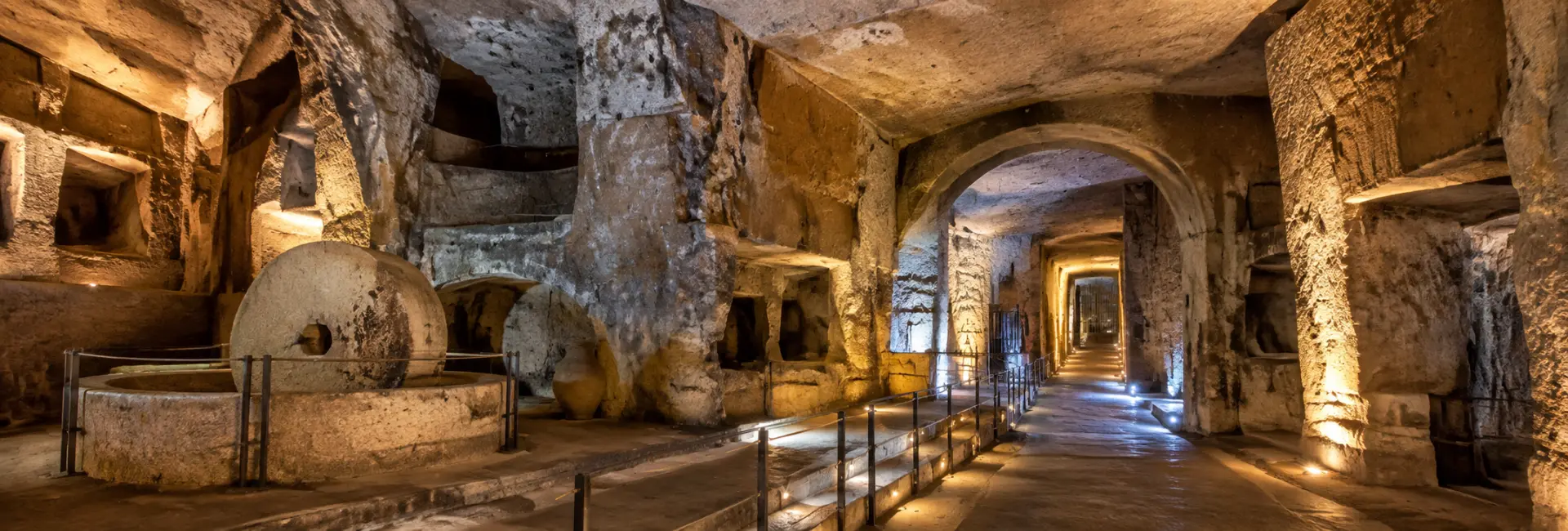
Much of the route follows passages linked to the historic water system. You walk through tall chambers, look at the vertical shafts used to draw water, and learn how the tuff was carved and reused. Guides explain the geology in simple terms, so no prior knowledge is required.
Narrow Passages
Parts of the network are tight, and some sections are lit only by candlelight to give a sense of how water workers once moved around. Those who would rather avoid squeezing through the smallest gaps can usually stay on the wider main route.
War-Era Rooms and Objects
One of the most memorable stretches is the shelter area, where display items and preserved details bring the bombing years to life. It is quietly moving, and the guide's context makes the space feel less like an exhibit and more like a real place where people once huddled together.
Notable Highlights
Because the route packs so many layers into a compact visit, a few moments tend to stand out for visitors:
- The scale of the ancient quarry voids and the sheer height of the chambers carved by hand.
- The Roman-era water infrastructure, including cisterns and the shafts that connected them to buildings above.
- The wartime shelter section, with its everyday objects and its reminder of how recently these tunnels sheltered families.
- The candlelit narrow passages, which give a physical feel for how tight the working spaces were.
- The ancient theatre stop, often included at the end of the tour, where a Roman theatre survives beneath and inside ordinary buildings.
The theatre is an especially surprising finale. Its curved structure lies hidden within the fabric of the surrounding city, and local tradition links it to the Emperor Nero, who is said to have performed in Naples. The exact details of the stop can vary, so it is worth asking at the ticket desk what your particular tour includes.
Cultural Significance & Local Legends
For Neapolitans, the ground beneath the city has always been part of local identity. Generations grew up knowing that their homes had wells reaching into the dark, and that the space below was tied to the city's survival, from the daily water supply to the shelter it offered during air raids.
The underground also feeds local folklore. One of the best-known figures is the munaciello, the "little monk," a mischievous spirit said to move through hidden passages and wells. Stories say he can bring luck or misfortune, and he is often linked to unexplained coins or missing objects. Part of the legend's origin is thought to lie in the well workers who moved unseen through the narrow passages and appeared suddenly in people's houses.
Today, the site also plays a role in how Naples talks about its own past. Visits emphasise the city's resilience: a place that repeatedly reused, reshaped and survived what lay beneath it.
Ways to Experience It
The Standard Guided Tour
The main option is the guided route from Piazza San Gaetano 68, lasting around ninety minutes. Tours run at set times through the day, and the site is entered only with a guide, so there is no independent wandering. Sessions are typically offered in Italian and English, with other languages depending on availability.
Booking Ahead
Group sizes are limited, which means popular slots can sell out, particularly at weekends and in high season. Booking in advance saves you from a long wait or a missed slot. Always double-check the language of the session before confirming.
Combining Underground Experiences
Naples has several separate underground attractions, each with different entrances and tickets. Napoli Sotterranea is not the same as the Bourbon Tunnel or the excavations under San Lorenzo Maggiore, so if you want to see more than one, plan each visit separately.
Best Time to Visit
Because the tunnels remain cool and constant all year, Napoli Sotterranea works in any season. That makes it a smart fallback for a rainy day in winter or a sweltering afternoon in July and August, when the underground offers welcome relief from the heat.
Weekday mornings usually give the calmest experience and the best chance of getting a spot without a long wait. Weekends, school holidays and summer afternoons tend to be busier, so reserve early if you are visiting during those periods.
If you plan to explore the surrounding historic centre on foot, consider pairing the tour with a morning start, then lunch nearby before wandering the streets in the afternoon.
Visitor Tips
- Book in advance where possible, and choose the correct language for your session.
- Arrive early. Check-in normally takes place before the tour starts, so give yourself extra time rather than turning up at the last minute.
- Dress for the cool air. A light layer is useful even in summer, and sturdy, comfortable shoes help on the stairs and uneven ground.
- Expect steps and tight spaces. The descent involves a long staircase, and some passages are narrow. The site is generally not suited to visitors with limited mobility, so check with the operator before booking.
- Consider claustrophobia. The wider parts of the route are fine for most people, but the narrow sections can feel confined.
- Confirm current details. Opening hours, ticket prices and tour times can change, so check the official website before you go.
- Bring a small camera or phone and be ready for low light, which can make photos difficult without steady hands.
Nearby Attractions
Piazza San Gaetano sits at the heart of the historic centre, so several major sights are within a few minutes' walk.
- San Lorenzo Maggiore: a historic church and museum with an excavated Greek and Roman marketplace below it, next to the square.
- Via dei Tribunali: a busy street lined with pizzerias, cafés and small shops, and one of the most atmospheric places to eat in Naples.
- Naples Cathedral (Duomo): a short walk away, home to the Chapel of the Treasure of San Gennaro.
- Via San Gregorio Armeno: the famous street of nativity-scene craftsmen, especially lively in the run-up to Christmas.
- Pio Monte della Misericordia: a small church and gallery known for a major Caravaggio altarpiece.
Together these make it easy to build a full day of exploring the old city around a single underground visit.
FAQs about visiting Naples Underground (Napoli Sotterranea)
What is Napoli Sotterranea? +
It is a guided route through tunnels, cisterns and chambers about 40 metres below Naples' historic centre. The tour covers ancient Greek quarrying, Roman-era water systems and wartime air-raid shelters.
Where is the entrance? +
The entrance is at Piazza San Gaetano 68, in the historic centre and just off Via dei Tribunali. Look for the signs near the square, and note that entry and exit are at the same place.
How long does the tour take? +
The standard guided route lasts around ninety minutes. It is worth allowing a little extra time for check-in and for the walk back up to street level.
Can I visit without a guide? +
No, the site can only be visited on a guided tour. If you miss your slot, you would need to wait for the next available departure.
Do I need to book in advance? +
Booking ahead is strongly recommended, especially at weekends and in high season, because groups are limited. Make sure you pick the right language for your session.
Is it suitable for children or people with mobility issues? +
Older children who are comfortable with stairs and dim lighting generally cope well. The long staircase and uneven, narrow sections make it a poor fit for visitors with limited mobility, so ask the operator before booking.
Is it claustrophobic? +
Most of the route runs through large, open chambers, but some optional sections are very tight. Nervous visitors can usually stay on the wider paths, and it is worth telling your guide at the start.
What should I wear? +
Bring a light jacket, since the underground stays cool all year, and wear comfortable shoes with good grip. The ground can be damp and uneven in places.
How is it different from the other underground tours in Naples? +
Napoli Sotterranea, the Bourbon Tunnel and the excavations beneath San Lorenzo Maggiore are separate attractions with their own entrances and tickets. Each focuses on a different part of the city's hidden layers, so check which one you are booking.
What can I combine it with nearby? +
San Lorenzo Maggiore, Via dei Tribunali, the Duomo and Via San Gregorio Armeno are all within a short walk. Together they make an easy half-day or full-day plan around the historic centre.
