
Table of Contents
Overview
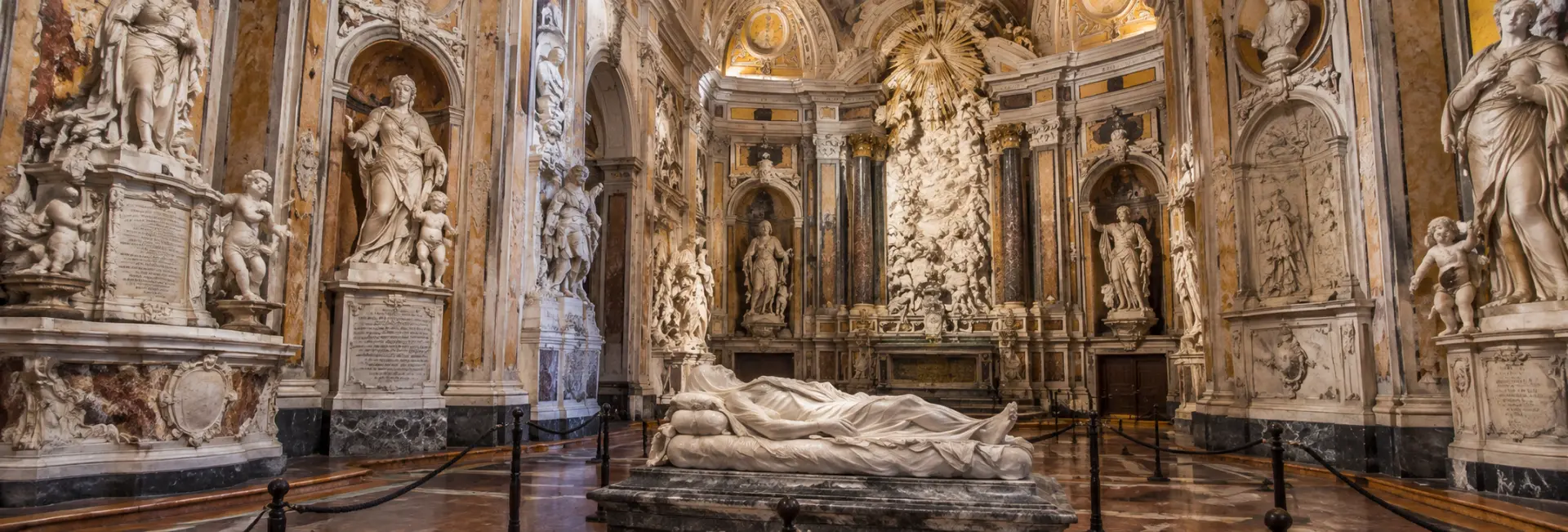
Cappella Sansevero is a small private chapel in the heart of Naples' old town, and one of the most celebrated art spaces in Italy. It is best known for the Veiled Christ, a marble sculpture so delicate that many visitors need a moment to believe it is carved stone. Around it, the chapel is packed with Baroque statues, painted ceilings and symbolic details that reward slow looking.
The building was created as a burial place for the di Sangro family, one of the great noble houses of southern Italy. In the 18th century, Prince Raimondo di Sangro turned it into something far more unusual: part family mausoleum, part artistic manifesto and part showcase for his own restless curiosity.
Despite its fame, the chapel is compact, and a visit is usually short but intense. It is also a museum today, so entry is ticketed and access is managed to keep the space calm.
History
A Family Chapel Is Born
The origins of the chapel go back to the late 16th century. A local tradition says that a piece of wall in the garden of the di Sangro palace collapsed to reveal an image of the Madonna, and that a family member who later recovered from serious illness built a small chapel in thanks. The sanctuary, dedicated to Santa Maria della Pietà, became a family burial place and is sometimes called the Pietatella.
Raimondo di Sangro's Transformation
The chapel's present appearance is mainly the work of Raimondo di Sangro, seventh Prince of Sansevero, who reworked it from the 1740s onwards. Sources give slightly different end dates, but the major campaign of decoration took place around the middle of the century, and he continued to refine the project until his death in 1771.
Raimondo brought in some of the best sculptors and painters then working in Naples and beyond. He also directed the iconography himself, shaping a programme of statues and symbols that reflected his own ideas about virtue, family and knowledge.
Loss and Survival
Not everything has survived intact. The original patterned marble floor, designed by Francesco Celebrano, was badly damaged when part of the chapel and the neighbouring palace collapsed in 1889. Fragments of it can still be seen in a passage beside the main space. The rest of the interior, including the statues and ceiling, has come down to us remarkably well preserved.
The Veiled Christ
A Sculpture That Seems Impossible
The Veiled Christ, completed in 1753 by the Neapolitan sculptor Giuseppe Sanmartino, lies at the centre of the chapel. It shows the dead Christ stretched out on a mattress, covered by a thin shroud that clings to the body. Through the veil you can see the outline of his face, ribs, veins and feet, all rendered with astonishing fineness.
The figure and its veil were carved from a single block of marble. That fact alone is remarkable, but it is the sense of transparency and weight that has made the work famous. It feels both heavy and weightless, like fabric in the instant after it has settled.
Origins of the Commission
Raimondo di Sangro first turned to the Venetian sculptor Antonio Corradini for the work, but Corradini died before he could carry it out. Sanmartino, then a young Neapolitan artist, took the project over and gave it a new and more dramatic emotional character. The result is one of the defining works of late Baroque sculpture.
Art or Alchemy?
The realism of the veil was so striking that a popular legend grew up around it. People claimed that the prince, known for his experiments, had somehow turned a real cloth into marble by means of an alchemical process. Art historians see the effect as the result of exceptional skill, and the legend has become part of the sculpture's charm rather than an explanation of it.
Other Masterpieces & Interior Design
Modesty and Disillusion
Two other sculptures rank among the chapel's most admired works. Modesty (Pudicizia), by Antonio Corradini, shows a woman in a fine, clinging veil and is associated with Raimondo's mother. Disillusion (Disinganno), by Francesco Queirolo, shows a man struggling to free himself from a net, and is commonly read as a tribute to the prince's father and his troubled life. Both statues use stone to imitate textiles in an almost theatrical way, and both are close cousins of the Veiled Christ in technique.
The Virtues and Family Monuments
Along the walls stand statues representing virtues, each linked to a member of the di Sangro family. They form a kind of moral gallery, mixing family pride with allegory. Several were made by leading sculptors of the time, including Francesco Celebrano and others working in the Neapolitan Baroque tradition.
The Painted Ceiling
Overhead, a ceiling fresco painted in 1749 by Francesco Maria Russo fills the chapel with colour. Its vivid tones have survived far better than might be expected, which has fed stories that the prince developed special pigments. Whether or not that is true, the contrast between the bright vault and the pale marble below is one of the most striking effects in the space.
A Programme of Symbols
Nothing in the chapel is purely decorative. Symbols, inscriptions and patterns are woven into the marble, the floor fragments and the statues. Some have religious meanings, others are philosophical, and a few are linked by tradition to Masonic ideas, which adds to the chapel's mystique.
Raimondo di Sangro & Local Legends
Prince, Inventor, Scholar
Raimondo di Sangro (1710–1771) was one of the most intriguing figures of 18th-century Naples. He was a nobleman, soldier, writer, inventor and scientific experimenter, interested in everything from military technology to printing, textiles and chemistry. He also moved in intellectual and esoteric circles, and is traditionally linked to Freemasonry.
Controversy and Reputation
His writings and experiments made him both admired and distrusted. At one point he ran into serious trouble with the Church, and he was said to have been excommunicated, a penalty that was later lifted. The mixture of science, secrecy and religion in his life helped create the enduring image of the "alchemist prince".
Where Fact Ends and Folklore Begins
Many tales about Raimondo cannot be documented. Stories of magical potions, secret laboratories and dark experiments are part of Naples' oral tradition, and they colour how people experience the chapel today. It is best to treat them as legend, and to enjoy them as part of the city's storytelling rather than as established history.
The Anatomical Machines
Below the main chapel, a lower chamber houses one of its strangest attractions: two human skeletons, a man and a woman, on which the arteries and veins have been reproduced in extraordinary detail. They are known as the Anatomical Machines and date to the 1760s, when Raimondo commissioned an anatomist to prepare them.
A grim story says the prince injected chemicals into living people to preserve their circulatory systems. Modern studies of the objects have suggested that the vessels were reproduced with materials such as wire, wax and silk, which points to an artificial construction rather than a chemical miracle. However you read the evidence, the machines are a haunting reminder of the period's mix of science and spectacle.
Visitors sometimes find this part of the museum unsettling, so it helps to be prepared. Children and sensitive visitors may prefer to skip it, and the atmosphere is very different from the elegant marble above.
Recognition / Status
Cappella Sansevero stands within the historic centre of Naples, which UNESCO inscribed on the World Heritage List in 1995. That designation reflects the city's exceptional continuity as an urban centre, and the chapel is one of the most famous cultural sites within it.
Today the site operates as the Museo Cappella Sansevero. It is regularly ranked among the most visited attractions in Naples, and the Veiled Christ is often described as one of the greatest sculptural masterpieces in the world.
Because the chapel is small, demand is high compared with its size. That is why access is timed and managed, and why booking ahead is usually sensible.
Ways to Experience It
Self-Guided Visit
Most visitors enter with a standard ticket and explore the chapel at their own pace. The visit does not take long, but the density of detail encourages you to slow down and look closely at the sculptures, ceiling and floor fragments.
Audio Guide
An audio guide is normally available and can help explain the symbolism and the stories behind each statue. It is a useful addition if you like context, especially for the more complex allegories.
Guided Tours
Some local operators offer guided visits that combine the chapel with other sights in the historic centre. These can add depth if you are interested in the prince's life and the wider history of Baroque Naples.
Photography
The museum has traditionally restricted photography inside the chapel to protect the artworks and maintain the atmosphere. Check the current rules before you go, and plan to enjoy the space with your eyes rather than a camera.
Best Time to Visit
Because the chapel is small, timing matters. Early morning slots and late afternoon usually feel calmer than the middle of the day, when tour groups and day-trippers tend to arrive. Weekdays are typically easier than weekends.
Spring and autumn are pleasant seasons to combine the chapel with a walk through the old town. In summer, the interior offers welcome shade, though queues outside can be tiring in the heat. Winter is generally quieter, with fewer visitors and a more contemplative mood.
Whatever the season, booking a timed ticket in advance is the best way to avoid long waits. Confirm the current opening days and hours with the museum, as these can change.
Visitor Tips
- Book ahead. Entry is often by timed ticket, and popular slots can sell out, especially at weekends and in high season.
- Arrive a little early. Give yourself extra time to check in and collect an audio guide if you want one.
- Dress respectfully. The chapel is a former place of worship, so covered shoulders and knees are a sensible choice.
- Follow the photography rules. Photography has usually been restricted inside, so check the latest policy and respect staff instructions.
- Take your time with the Veiled Christ. Look from several angles and notice the feet, the veins and the texture of the veil.
- Prepare for the lower level. The Anatomical Machines can be disturbing, and the stairs may be difficult for some visitors.
- Check accessibility. The building is historic and compact, so contact the museum in advance if you have specific mobility needs.
- Confirm current details. Ticket prices, opening days and visitor rules change, so use the museum's official channels for the latest information.
Nearby Attractions
The chapel sits just off Spaccanapoli, the long straight street that cuts through the old town, so many major sights are a short walk away.
- Piazza San Domenico Maggiore: a lively square beside the chapel, with a grand church and cafés.
- Spaccanapoli: the narrow, atmospheric main artery of the historic centre, lined with shops and small churches.
- Piazza del Gesù Nuovo and the Gesù Nuovo church: a striking church with a distinctive faceted stone façade.
- Santa Chiara Monastery: a famous complex with a colourful majolica-tiled cloister.
- Via San Gregorio Armeno: the street of nativity-scene craftsmen, a short walk to the north.
- Napoli Sotterranea and San Lorenzo Maggiore: underground Naples and an excavated Greek and Roman marketplace, within easy walking distance.
Combining the chapel with these stops makes for a rich half-day in the old town.
FAQs about visiting Cappella Sansevero
What is Cappella Sansevero known for? +
It is best known for the Veiled Christ, a 1753 marble sculpture by Giuseppe Sanmartino that appears to show a translucent shroud over the body of Christ. The chapel also contains other Baroque statues, a painted ceiling and the Anatomical Machines.
Where is it located? +
The chapel is at Via Francesco de Sanctis 19/21 in the historic centre of Naples, just off Piazza San Domenico Maggiore and close to Spaccanapoli.
Do I need to book tickets in advance? +
It is strongly recommended. The chapel is small and access is managed, so popular time slots can sell out, especially on weekends and in high season.
How long does a visit take? +
Most people spend around 30 to 45 minutes, depending on whether they use an audio guide and how long they linger at the sculptures. Allow a little extra time for check-in and any queue.
Can I take photos inside? +
Photography has traditionally been restricted inside the chapel to protect the artworks. Check the current rules on the museum's official website before your visit.
Who was Raimondo di Sangro? +
He was the seventh Prince of Sansevero, an 18th-century Neapolitan nobleman, soldier, scholar and inventor who reshaped the chapel into its present form. Many legends about alchemy and secret experiments surround him, but much of that is folklore.
Is the Veiled Christ really made from one piece of marble? +
Yes, the figure and its veil are carved from a single block of marble. The realism of the fabric is why some visitors think it must have been made by a magical process, but it is the result of extraordinary carving skill.
Are the Anatomical Machines suitable for children? +
They are two skeletons with reproduced circulatory systems, and some visitors find them unsettling. Parents may prefer to skip that section for young or sensitive children.
Is the chapel accessible for people with limited mobility? +
The building is historic and compact, and the lower level involves stairs. If you have specific accessibility needs, it is best to contact the museum in advance to ask what is possible.
What else can I visit nearby? +
Piazza San Domenico Maggiore, Spaccanapoli, the Gesù Nuovo church, Santa Chiara Monastery and Via San Gregorio Armeno are all within a short walk.
