
Table of Contents
Overview
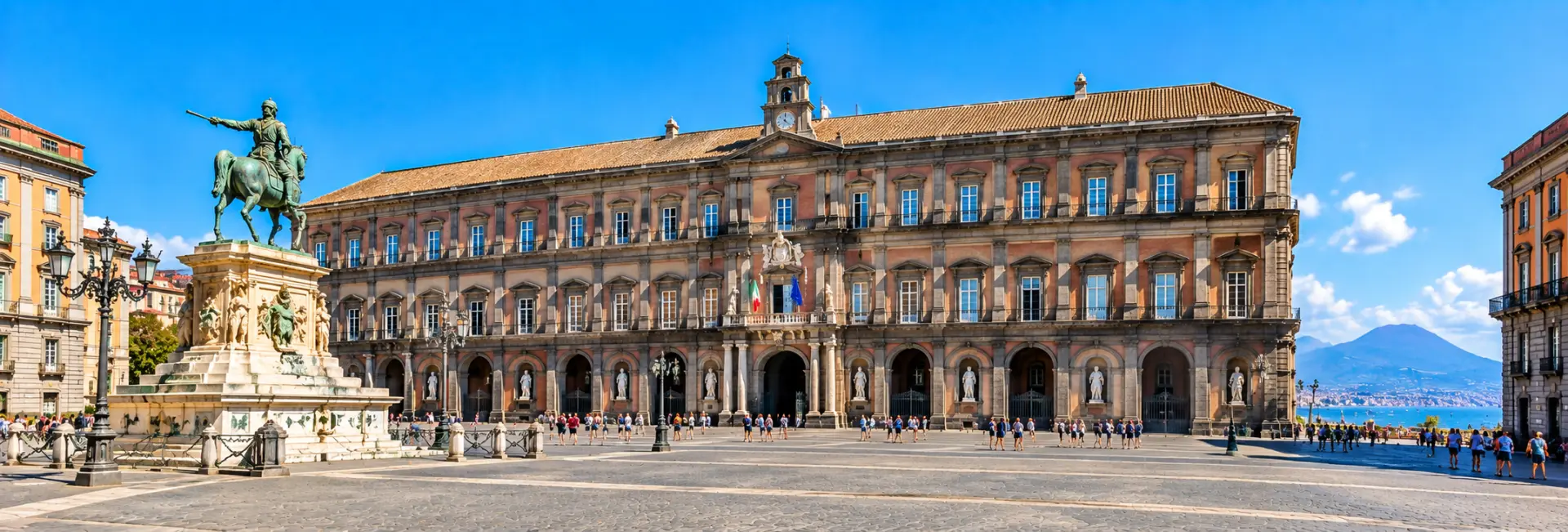
The Royal Palace of Naples (Palazzo Reale di Napoli) fills the western side of Piazza del Plebiscito, facing the colonnaded Basilica of San Francesco di Paola across one of the city's grandest open spaces. Begun in 1600 for the Spanish viceroys who governed Naples, it later became the main residence of the Bourbon kings and, after Italian unification, a royal home for the House of Savoy.
Its reddish-brick façade runs for about 169 metres and hides a monumental staircase, a court theatre, a long suite of state rooms, terraced gardens above the bay and one of Italy's major libraries. Today the historic Royal Apartment is open as a museum, while the eastern wing houses the National Library.
What makes the palace so rewarding is its layering. Spanish-era frescoes, Bourbon silks, Napoleonic furniture and Savoy neo-Baroque additions sit side by side, so a single walk through the rooms traces more than three centuries of rule in southern Italy.
History
A Palace for a Visit That Never Happened
The viceroy Fernando Ruiz de Castro, Count of Lemos, ordered the new palace as a fitting welcome for King Philip III of Spain, who was expected to visit Naples. The king never came, and later historians have argued that the viceroy was really building a grand seat for himself. The first stone was laid in 1600, and Domenico Fontana, one of the most celebrated architects of his day, designed a late Renaissance building arranged around a central courtyard.
The site on the western edge of the old city, beside the port and next to Castel Nuovo, gave commanding views of the harbour and a possible escape route in case of attack. Over the following century and a half, 22 Spanish and 11 Austrian viceroys lived here, and each one reworked the interiors to suit his own taste.
The Bourbon Court
Charles of Bourbon entered Naples in 1734 and turned the palace into the seat of an independent kingdom. He found it stripped bare, because departing viceroys had always taken their furniture with them, so he commissioned a new scheme of decoration from Neapolitan painters including Francesco Solimena and Francesco de Mura. His marriage to Maria Amalia of Saxony in 1738 was celebrated in ceiling frescoes that can still be seen today.
The wedding of Ferdinand IV and Maria Carolina of Austria in 1768 brought the creation of the court theatre by Ferdinando Fuga. From 1780 the court preferred the palace at Caserta and spent at least half of each year outside Naples. Joseph Bonaparte and Joachim Murat then lived here during the French decade from 1806 to 1815, bringing new furniture and decorative fashions.
Fire, Unification and War
A fire on 6 February 1837 destroyed much of the eastern half of the palace. The architect Gaetano Genovese rebuilt and completed it between 1837 and 1844, giving the complex a more uniform neoclassical character and finishing the sea-facing front that had been left unfinished for so long.
Francis II left the palace on 6 September 1860 as Garibaldi's forces closed in, and it passed to the House of Savoy. Victor Emmanuel III was born here in 1869, and in 1919 he ceded the palace to the Italian state. During the Second World War, an Allied air raid on 4 August 1943 destroyed the roof of the court theatre, the chapel and other areas, and restoration work continued from 1950 to 1954.
Architecture & Notable Rooms
The Façade and Courtyard
Fontana's façade stacks three classical orders, Tuscan, Ionic and Corinthian, in a pattern borrowed from ancient Roman theatres, with grey stone detailing set against warm red brick. The ground-floor arcade was walled up in 1753 to a design by Luigi Vanvitelli because the pillars were under strain. Eight statues of rulers of Naples were later placed in the new niches in 1888, running from Roger II of Sicily and Frederick II through Charles V and Charles of Bourbon to Joachim Murat and Victor Emmanuel II.
Beyond the main portal lies the square Courtyard of Honour, with five arches on each side. Its fountain was made in 1742 by Giuseppe Canart and originally stood near the port.
The Grand Staircase
The monumental staircase on the north side of the courtyard was first built in the mid-17th century by Francesco Antonio Picchiatti, with the great staircase of the Alcázar of Toledo as its model. Montesquieu described it in 1729 as the finest in Europe. The fire of 1837 destroyed it, and Genovese replaced it with the late neoclassical version seen today, clad in pink, red and other coloured marbles and flanked by sculptures of the cardinal virtues.
Rooms Worth Slowing Down For
- The Court Theatre, remade by Fuga in 1768 and rebuilt after wartime bombing, with papier-mâché figures of Apollo, Mercury, Minerva and the nine Muses in its niches.
- The Throne Room, redecorated in 1818 with a stucco ceiling showing the fourteen provinces of the Kingdom of the Two Sicilies as crowned female figures, and an Empire-style throne modelled on Napoleon's throne at the Tuileries.
- The Ambassadors' Hall, whose painted ceiling compartments from the 1620s, by Belisario Corenzio and his workshop, celebrate Habsburg triumphs and episodes from the life of Ferrante of Aragon.
- The Hall of the Great Captain, named for Battistello Caracciolo's frescoes about the Spanish conquest of the kingdom under Gonzalo Fernández de Córdoba.
- The private rooms behind the state apartments, where nineteen preparatory canvases of Don Quixote scenes hang, painted as models for tapestries woven in Naples.
- The Palatine Chapel, a post-war reinterpretation of the 17th-century original, which houses a Neapolitan nativity scene.
Grounds & Gardens
The Hanging Garden
The Hanging Garden (Giardino Pensile) began in the 17th century as a terrace beside the viceroys' Belvedere pavilion and grew over time into a walled garden facing the sea. A long restoration completed in the late 2010s brought back citrus trees, roses and irises, and recovered a kite-shaped 19th-century paving design.
From the terrace there are wide views across the Gulf of Naples to Vesuvius, and on clear days towards the Sorrento peninsula and Capri. It is one of the few places in the city centre where the sea, the volcano and the palace can all be taken in together.
The Romantic and Italian Gardens
The Romantic Garden (Giardino Romantico) dates from 1842, when the German botanist Friedrich Dehnhardt laid it out on the former riding ground after older buildings were cleared away. Two large groups of Ficus magnolioides are its best-known trees. In the 1920s a straight avenue was added so that visitors could reach the National Library from Via San Carlo.
On the Piazza Trieste e Trento side, the smaller Italian Garden holds a statue of Liberty carved in 1861, a reference to Italian unification.
Cultural Significance & Royal Ties
For more than three centuries the palace was the administrative and ceremonial heart of Naples and much of southern Italy, first under the viceroys, then as the seat of the Kingdom of Naples and Sicily (1734 to 1816) and the Kingdom of the Two Sicilies (1816 to 1861). Its rooms hosted hand-kissing ceremonies, receptions for ambassadors and meetings of state councils, and each ruler used decoration to signal legitimacy.
The choices are often pointed. The Bourbons kept Spanish-era ceilings to claim continuity with the past. Ferdinand I redecorated the Throne Room in 1818 to wipe out the memory of the French interlude. The Savoy added the eight façade statues in 1888 to link themselves with earlier dynasties, including one of Victor Emmanuel II himself.
Under Charles of Bourbon, the court blended French fashion, Spanish tradition and Italian artistic culture. Gifts from foreign rulers, such as Sèvres porcelain from the French court and pieces presented by Tsar Nicholas I, still decorate several rooms. Many of the palace's finest paintings were moved to other Neapolitan museums over the 19th century, which is why the collection today feels like a gathering of individual pieces rather than a single formal gallery.
The palace remains a working cultural institution. The National Library moved into the eastern wing in the 1920s, encouraged by the philosopher Benedetto Croce, and it is one of the largest libraries in Italy.
Ways to Experience It
Most visitors follow the Royal Apartment route on the first floor, entering through the Courtyard of Honour and climbing the Grand Staircase. Allow at least an hour and a half for the rooms, and two to three hours if you also want to see the gardens. Tickets are sold online through the official Musei Italiani portal, which is linked from the palace website.
- The Royal Apartment: a self-guided route through the state rooms, the court theatre and the chapel.
- The Hanging Garden: reached through short guided visits at set times, usually for a small supplement on top of the museum ticket and subject to season and weather.
- The Romantic Garden and the former Bourbon stables, which have hosted the Galleria del Tempo, a multimedia journey through the history of Naples.
- The Museo della Fabbrica, which opened in July 2024 and explains how the palace was built and changed, with access from the Courtyard of Honour.
- Special programmes such as guided visits to the attics and Belvedere, behind-the-scenes tours of the furniture and art storerooms on some Saturdays, occasional evening openings and free-entry days such as the first Sunday of the month.
Best Time to Visit
Spring and autumn are the most comfortable seasons, with mild weather for the garden terrace and for the walk across Piazza del Plebiscito. In midsummer the heat can be intense, and guided visits to the Hanging Garden are often paused or reduced during the hottest weeks.
The state rooms are indoors, so the palace works well as a rainy-day plan at any time of year. Arriving soon after opening on a weekday usually means quieter rooms, and late afternoon is a good moment for photographs of the façade in warm light. In December, the palace's nativity scene adds a seasonal reason to visit.
The museum has traditionally closed one day a week, historically Wednesday, so check the current calendar before choosing your day.
Visitor Tips
- Confirm opening hours, the weekly closing day, last-entry time and ticket prices on the official palace website before you go, as these change.
- Book through the official ticket portal to avoid third-party markups.
- Some rooms close from time to time for restoration or events, so the route can differ from older guidebooks.
- The main entrance is on Piazza del Plebiscito, and other access points to the wider complex are on Piazza Trieste e Trento, Piazza del Municipio and Via Acton.
- Wear comfortable shoes, as the visit involves a monumental staircase and long corridors.
- The National Library is a working institution with its own access rules, so do not expect to wander into it as part of the museum route.
- If you have accessibility needs, contact the palace ahead of time to ask about the current route and facilities.
- The Municipio metro station is the closest stop, and the palace is an easy walk from central Naples sights.
Nearby Attractions
The palace sits in the middle of Naples' most polished stretch of monuments, so it pairs easily with other stops on foot. Piazza del Plebiscito and the Basilica of San Francesco di Paola are directly outside, and the Teatro di San Carlo, one of Italy's most celebrated opera houses, is joined to the palace complex.
Castel Nuovo, the medieval fortress also known as the Maschio Angioino, is a few minutes away, as is the glass-roofed Galleria Umberto I. Heading west along the waterfront brings you to Castel dell'Ovo and the small harbour of Borgo Marinari, while Via Toledo leads north through the busiest shopping and eating streets of the historic centre.
FAQs about visiting the Royal Palace of Naples
What is the Royal Palace of Naples known for? +
It is known as the grand residence of Spanish viceroys, Bourbon kings and later the House of Savoy, and for its 169-metre façade, its monumental staircase, its court theatre and its richly decorated Royal Apartment.
How long should I plan for a visit? +
Plan on at least an hour and a half for the Royal Apartment alone, or two to three hours if you add the Hanging Garden, the Romantic Garden and any special exhibitions.
Which day is the palace closed? +
The museum has traditionally closed on Wednesdays, but closing days and hours can change, so check the official website before you travel.
Where do I buy tickets? +
Tickets are sold online through the official Musei Italiani portal linked from the palace website, and entry prices and free-admission days are set by the museum, so confirm them close to your visit.
Can I visit the Hanging Garden? +
Yes, through short guided visits at set times that usually require a small extra ticket. They can be paused in extreme heat or bad weather, and they typically do not run on the museum's closing day.
Is this the same as the palaces at Caserta or Capodimonte? +
No, the Bourbon kings had several residences, and the Royal Palace in Piazza del Plebiscito is the one in the heart of the city. Caserta and Capodimonte are separate sites that need their own visits.
Is the palace suitable for children? +
Older children who enjoy castles and stories often like the Throne Room, the theatre with its Muses and the garden terrace, and the palace has joined city programmes for young visitors, so the events page is worth checking.
How do I get there? +
It is in the centre of Naples on Piazza del Plebiscito, close to the Municipio metro station and within walking distance of Via Toledo, Castel Nuovo and the waterfront.
