
Table of Contents
Overview
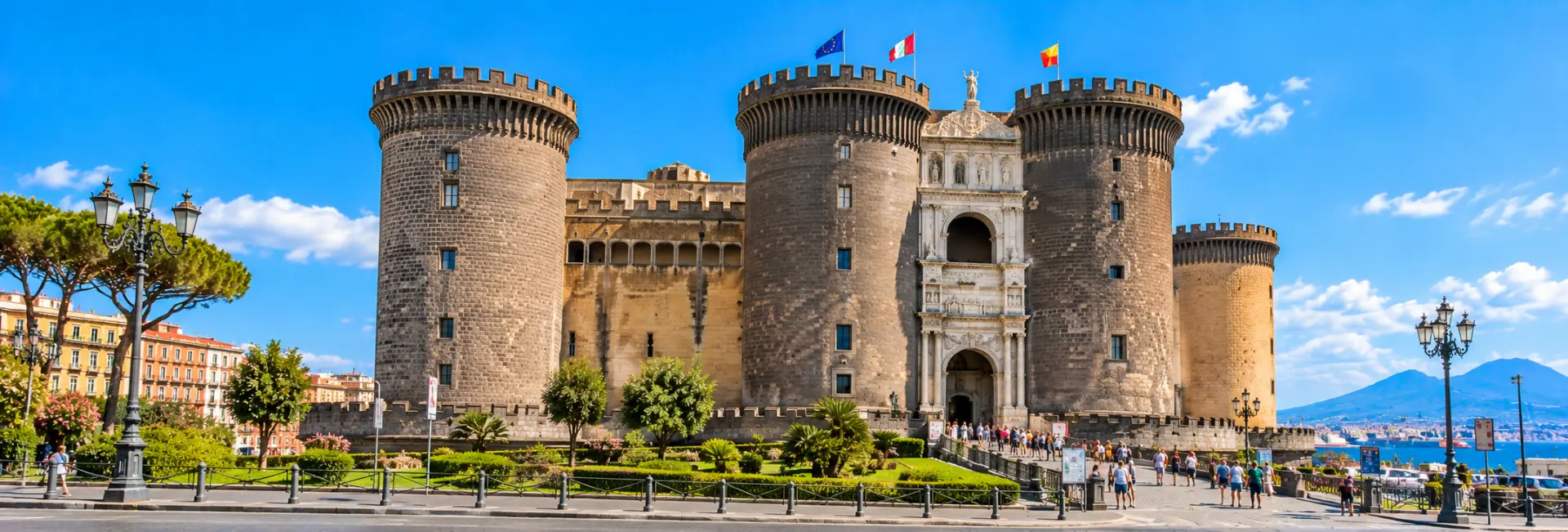
Castel Nuovo, known to almost every Neapolitan as the Maschio Angioino or "Angevin Keep," is the great medieval fortress that rises beside the port of Naples. Five massive round towers, joined by thick walls of dark stone, make it one of the most recognizable silhouettes in the city and an unmistakable landmark for anyone arriving by sea.
The name "new castle" dates back to the 13th century, when it was built to sit alongside two older fortresses already standing in Naples. It began life as a royal palace as well as a stronghold, and over the following centuries it hosted Angevin, Aragonese, Spanish and Bourbon rulers. Today it belongs to the city and is home to the Museo Civico, a courtyard-filled complex that mixes military architecture, royal halls and art.
What makes the castle memorable is the contrast between its layers. The severe towers speak of the Middle Ages, while a gleaming white marble arch at the entrance shows the confidence of the Renaissance. Inside, great halls and a small chapel carry the story of the city's rulers, from crowned kings to a pope who gave up his throne.
History
The Angevin Foundation
The castle was commissioned by Charles I of Anjou, who took the crown of Sicily in 1266 after defeating the Hohenstaufen dynasty and moved his capital from Palermo to Naples. He wanted a residence that could rival the great courts of Europe. The French architect Pierre de Chaulnes directed the work, which began in 1279 and moved forward at remarkable speed for the period.
Political turmoil delayed its use. The War of the Sicilian Vespers cost the Angevins control of Sicily, and the new palace stood empty until Charles I died in 1285. His son Charles II then moved in, and under the next king, Robert, the castle became a center of political and cultural life.
A Papal Resignation
In December 1294 the castle became the setting for one of the rare papal resignations in history. Pope Celestine V, a hermit who had been elected only a few months earlier, gave up the papacy here on 13 December. Later that month the cardinals assembled in the castle to choose his successor, Boniface VIII.
The Aragonese Rebuilding
Alfonso V of Aragon conquered Naples in 1443 and set about transforming the fortress into a showpiece of his power. The Majorcan architect Guillem Sagrera reworked the structure in the Catalan Gothic style, strengthening the walls and towers and rebuilding the great hall. Alfonso also commissioned the marble triumphal arch, which was carved between 1453 and 1468 to celebrate his entry into the city.
Later Centuries
After the Aragonese period the castle served the Spanish viceroys and later the Bourbons, and it remained a royal seat until 1815. Over time it became more of a military and administrative building than a palace. Extensive restoration in the early 20th century, along with the creation of the museum, gave it the look and function it has today.
Architecture & Towers
Five Towers and a Moat
The castle is built on a roughly triangular plan, with a cylindrical tower at each corner and one in the middle of the seaward front. The two towers flanking the entrance, known as the Torre di Mezzo and the Torre di Guardia, frame the triumphal arch and give the facade its famous, fortress-like profile. The Aragonese rebuilt the towers with a base of volcanic piperno stone, which helped them withstand artillery.
A dry moat still surrounds much of the walls, reminding visitors that this was a working fortress as much as a palace. Crossing it toward the gate is one of the most atmospheric moments of the visit.
The Triumphal Arch
Set between the two front towers, the arch borrows the language of Roman victory monuments. Its marble reliefs celebrate the triumphal procession of Alfonso, and many sculptors were involved over the years. Scholars have attributed the design to different masters, among them Pietro di Martino da Milano and Francesco Laurana, and the sculptural program is regarded as one of the key works of the early Southern Renaissance.
Behind the arch stands a bronze door that still bears the mark of a cannonball from the late 15th century. The door visible at the gate is a replica, while the original is kept inside the museum.
Courtyards and Halls
Beyond the entrance, several courtyards link the halls, chapels and staircases. The mix of Gothic pointed arches, Renaissance stonework and plain military walls shows how the building grew in stages rather than following a single plan.
Notable Rooms & Museum
Sala dei Baroni
The Hall of the Barons is the castle's grandest interior. Guillem Sagrera rebuilt the older ceiling as a striking rib vault with a large circular opening at the top, giving the room a soaring, church-like feel. It served as a throne room and ceremonial space, and it takes its name from a dark episode of the 1480s, when King Ferrante of Aragon is said to have lured rebellious nobles here under the pretext of a wedding celebration before having them arrested.
Palatine Chapel
The Palatine Chapel is the oldest surviving part of the original Angevin palace. Records place the painter Giotto in Naples around 1329 to 1331, and he was commissioned to decorate the chapel with scenes from the Bible. Only traces of that work remain, but the space still holds Gothic windows and a collection of Renaissance sculpture.
Armoury Hall
The Armoury Hall is known for a glass floor that reveals archaeological finds beneath the castle, including remains from the Roman period. It is a neat reminder that the site was inhabited long before the Angevins arrived.
Museo Civico
The upper floors house the civic museum, with paintings, frescoes and sculpture from the 15th to the 20th century. The collection includes Neapolitan Baroque and Caravaggesque painters such as Battistello Caracciolo, Luca Giordano and Francesco Solimena, and it gives visitors a compact overview of art in Naples over several centuries.
Cultural Significance & Legends
A Court of Artists and Writers
Under the Angevins and Aragonese the castle was not only a military base but also a cultural hub. Giotto is recorded working in the city, and the poets Petrarch and Boccaccio are among the writers associated with the royal court. Alfonso's Renaissance court was meant to compete with the great Italian courts of the time.
Political Turning Points
The castle stands at the center of many chapters of Neapolitan history. It witnessed a papal abdication, dynastic conquests, sieges by foreign armies and the proclamation of the short-lived Parthenopean Republic in 1799. Few other buildings in Naples connect so many eras in one place.
Local Legends
Naples has never been shy about its legends, and the castle has its share. One of the best-known stories tells of a crocodile that supposedly lived in the waters of the moat or in the dungeon below and devoured prisoners. It is a folk tale rather than recorded history, but Neapolitans still like to tell it, and it adds a shiver of mystery to a walk around the walls.
Ways to Experience It
Explore the Castle and Museum
The standard visit takes in the courtyards, the Sala dei Baroni, the Palatine Chapel and the museum galleries. Most people need around one to two hours, longer if they like to linger over the paintings or the views from the upper levels.
See It From Outside
Even without a ticket, the exterior is worth a slow walk. The best views of the towers and arch come from Piazza Municipio and from the walkways around the moat, and the castle looks especially dramatic when it is floodlit at night.
Arrive by Sea
The castle stands right beside the passenger port, so travelers arriving on ferries from the bay islands see it almost as soon as they step ashore. Its towers have been welcoming visitors this way for centuries.
Take a Guided Visit
Local guides run tours that put the building in context, linking the Angevin, Aragonese and Spanish periods and pointing out details such as the carvings on the arch that are easy to miss alone.
Best Time to Visit
Seasons
Spring and autumn offer the most comfortable weather for combining the castle with a walk through the old center and along the waterfront. In summer the heat can be intense, although the thick stone walls keep many interior spaces cooler than the streets. Winter is quieter and often pleasant on clear days.
Time of Day
Arriving soon after opening usually means fewer visitors in the halls and better light for photographs of the arch. Late afternoon is a good time to admire the towers from the piazza, when the stone takes on warmer tones. Cruise ship and ferry days can bring larger groups around midday.
Visitor Tips
- Check current details: Opening days, hours, ticket prices and any temporary closures change from time to time, so confirm them on the official museum page before you go.
- Getting there: The castle is beside Piazza Municipio, next to the Municipio stop on Metro Line 1, and is an easy walk from the ferry terminal.
- Allow time for stairs: The visit involves steps and uneven floors, so wear comfortable shoes. Ask staff about the accessible route if you need step-free access.
- Look up and down: Some of the best details are the vaulted ceiling of the great hall and the glass floor of the Armoury Hall, so do not rush past them.
- Bring a camera: The arch and the towers are especially photogenic from the piazza, and the upper levels give good views over the port.
- Pair it with the waterfront: The castle fits naturally into a half-day route that continues to the royal palace and the opera house.
Nearby Attractions
- Piazza Municipio: the large open square in front of the castle, with gardens, the city hall and views of the fortress.
- Molo Beverello: the ferry quay for boats to Capri, Ischia and Procida, just beside the castle.
- Teatro di San Carlo: one of the oldest working opera houses in Europe, a short walk away.
- Galleria Umberto I: an elegant iron-and-glass shopping arcade near the theatre.
- Palazzo Reale and Piazza del Plebiscito: the former royal residence and the grand square in front of it.
- Castel dell'Ovo: another famous seaside fortress, reachable by a pleasant stroll along the waterfront.
- Via Toledo: the main shopping and strolling street of central Naples, leading uphill from the area.
FAQs about visiting Castel Nuovo
What is Castel Nuovo? +
Castel Nuovo, also called the Maschio Angioino, is a medieval fortress and former royal palace on the Naples waterfront. It was begun in 1279 and later rebuilt by the Aragonese.
Why is it called Maschio Angioino? +
The name means "Angevin Keep" and refers to the House of Anjou, whose king Charles I commissioned the castle. Locals use it far more often than the official name.
Who built Castel Nuovo? +
Charles I of Anjou ordered its construction, and the architect Pierre de Chaulnes directed the work. Alfonso V of Aragon later rebuilt it in the 15th century and added the triumphal arch.
What can I see inside? +
Highlights include the courtyards, the Sala dei Baroni, the Palatine Chapel, the Armoury Hall with its glass floor and the Museo Civico's collection of paintings and sculpture.
How long does a visit take? +
Most visitors spend one to two hours, depending on how long they stay in the museum galleries and how many photos they take from the upper levels.
Do I need a ticket? +
Seeing the outside of the castle and the arch costs nothing, but entry to the interior and museum requires a ticket. Check the official museum page for current prices and hours before you visit.
How do I get to Castel Nuovo? +
It stands beside Piazza Municipio, close to the Municipio station on Metro Line 1 and to the ferry terminal. Many visitors also walk from Piazza del Plebiscito and the theatre district.
Is the castle suitable for children and older visitors? +
Children often enjoy the towers, the moat and the legend of the crocodile. The route includes stairs and uneven surfaces, so older visitors or anyone with limited mobility should ask about the accessible options on arrival.
