
Table of Contents
Overview
Spaccanapoli is the long, ruler-straight street that cuts through the historic center of Naples from west to east. The name is a nickname rather than an official address. It means roughly "the Naples splitter," and it comes from the way the street appears to divide the old city into two halves when seen from a high viewpoint such as the terrace of the Certosa di San Martino.
In practice the name covers a chain of streets that change identity as they run east: Via Benedetto Croce, Via San Biagio dei Librai and, beyond Via Duomo, Via Vicaria Vecchia. Together they stretch for about two kilometers and pass through one of the densest concentrations of churches, palaces, workshops and street life in southern Italy.
Visiting Spaccanapoli is less about ticking off a single monument and more about walking a living corridor of Neapolitan history. Baroque facades, Gothic cloisters, ancient statuary, family-run bakeries and washing strung across the side alleys all share the same narrow stretch, which is exactly why it makes such a good first walk in the city.
History
Greek and Roman Origins
The street follows a line drawn more than two thousand years ago. When Greek settlers laid out the city of Neapolis, they planned it on a grid of three main east-west avenues, known in Latin as decumani, crossed by shorter north-south streets called cardini. Spaccanapoli is the southernmost of those avenues, the decumanus inferior.
The other two survive too. The central decumanus is now Via dei Tribunali, while the northern one is spread across Via Anticaglia and Via della Sapienza. The Romans inherited the plan rather than replacing it, which is why the pattern of the old center is still easy to read on a modern map.
Medieval and Spanish Centuries
Much of what lines the street today was built in the medieval and early modern periods. The Angevin rulers of Naples in the 14th century founded large religious complexes along the route, including the monastery of Santa Chiara, built in the early 1300s, and the rebuilding of San Domenico Maggiore in the Gothic style.
In the 16th century the Spanish viceroy Pedro de Toledo aligned the axis with a road running through the newly built Spanish Quarter, which helped fix the long sight line that gives the street its dramatic look. During the Renaissance many of the original Gothic buildings along the way were renovated or rebuilt.
Baroque and Later Layers
The 17th and 18th centuries added the exuberant decoration Naples is famous for. After the plague of 1656 the city began a monumental spire in Piazza San Domenico Maggiore as thanks for deliverance, though it was not finished until 1737. In the same era the cloister at Santa Chiara was covered in painted majolica tiles, and the sculptor Giuseppe Sanmartino completed the Veiled Christ in 1753 in a chapel just off the street.
The 20th century left its mark as well. On 4 August 1943 an incendiary bomb struck the basilica of Santa Chiara during an air raid, and the church had to be painstakingly rebuilt afterward. The cloister beside it escaped the fire.
Recognition / Status
Spaccanapoli sits at the heart of the Historic Centre of Naples, which was inscribed on the UNESCO World Heritage List in 1995. The listing recognizes Naples as one of the oldest cities in Europe, one whose modern urban fabric still carries the traces of a long and eventful past.
The street is a particularly good illustration of that idea, because so many periods are visible in a single walk:
- The Greek and Roman street plan, still followed by the route itself
- Angevin Gothic churches and cloisters from the 14th century
- Renaissance palaces and their inner courtyards
- Baroque churches, spires and sculpture from the 17th and 18th centuries
- Working neighborhoods where shops, homes and workshops are still mixed together
It is worth remembering that the designation covers a lived-in district, not a museum. Residents, delivery scooters and small businesses are as much a part of the scene as the monuments.
Architecture & Streetscape
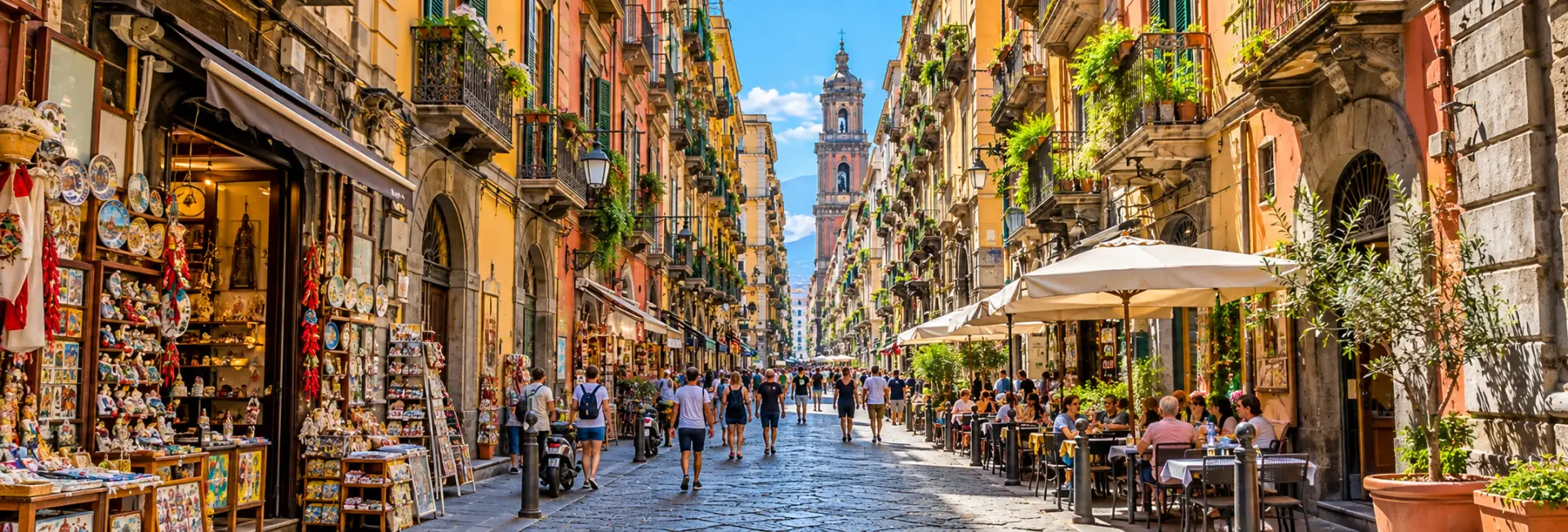
The first thing most visitors notice is the proportion of the street. It is narrow, straight and hemmed in by tall buildings, so the sky appears as a thin strip overhead and the view along the axis seems to run on without end. Shuttered balconies, faded plaster in warm colors and small votive shrines set into corner walls give it a texture that feels unmistakably Neapolitan.
Stone, Tile and Gothic Arches
The architecture changes character every few hundred meters. The facade of the Gesù Nuovo is covered in pointed, diamond-shaped stone blocks, a look inherited from the 15th-century palace it was built on before the Jesuits turned it into a church. Across the square, Santa Chiara keeps a plainer Gothic silhouette, with a delicate rose window and a freestanding bell tower.
Inside the Santa Chiara complex, the cloister designed by Domenico Antonio Vaccaro is famous for its majolica decoration. Tile makers Giuseppe and Donato Massa covered the columns and benches with floral patterns, citrus fruit and scenes of everyday 18th-century life, creating one of the most photographed cloisters in Italy.
Palaces and Courtyards
Along the street, noble palazzi hide grand courtyards and staircases behind heavy doorways. Palazzo Carafa della Spina, from the 16th century, and Palazzo Venezia on Via Benedetto Croce are two examples of how aristocratic families once built their town houses on this axis. Peeking through an open portone is often rewarded with a glimpse of a garden or a sweeping stair.
Key Areas
Piazza del Gesù Nuovo to Piazza San Domenico Maggiore
The western stretch begins at Piazza del Gesù Nuovo, the official starting point of Via Benedetto Croce. The square is dominated by the Baroque spire of the Immaculate Virgin and faces both the Gesù Nuovo church and the Santa Chiara complex. From here the street continues east past cafes, bookshops and palaces, including the building at number 12 where the philosopher Benedetto Croce lived until his death in 1952.
This section ends at Piazza San Domenico Maggiore, one of the liveliest squares in the historic center. Open-air cafe tables, noble palazzi and the tall apse of the church make it a natural place to slow down.
Piazzetta Nilo and Via San Biagio dei Librai
Just beyond the square, the small Piazzetta Nilo is home to an ancient marble statue of the Nile god. After it the street becomes Via San Biagio dei Librai, named for the booksellers who once worked here. This is the busiest and most atmospheric part of the walk, with bakeries, fried food counters, craft shops and the entrance to the famous nativity alley of Via San Gregorio Armeno.
Via Duomo and the Forcella Side
Beyond the crossing with Via Duomo, named for the Cathedral of Naples nearby, the street leaves the original walled core and continues as Via Vicaria Vecchia toward the Forcella district. This end is more local and less polished, and it shows a side of Naples that few guidebook itineraries cover.
Notable Landmarks
- Chiesa del Gesù Nuovo: a Jesuit church built between 1584 and 1601 behind a diamond-point stone facade. Its interior is among the most ornate Baroque spaces in the city, with a large fresco by Francesco Solimena above the entrance wall.
- Santa Chiara Monumental Complex: a Gothic basilica, a museum and the majolica cloister, all set directly opposite the Gesù Nuovo. The cloister is ticketed separately from the church.
- Spire of the Immaculate Virgin: the tall Baroque monument in the middle of Piazza del Gesù Nuovo, covered in sculpted detail.
- Palazzo Carafa della Spina: a 16th-century palace on Via Benedetto Croce, linked to a noble Neapolitan family.
- San Domenico Maggiore: a Gothic church begun under Charles II of Anjou, standing on the site of an earlier 10th-century church, with a monumental plague spire in front of it.
- Cappella Sansevero: a short walk north of Piazza San Domenico Maggiore, this chapel holds Sanmartino's Veiled Christ, a marble sculpture with a shroud so fine it seems woven rather than carved.
- Statue of the Nile God: a Roman-era marble figure in Piazzetta Nilo, probably set up by merchants from Alexandria. It was found without its head, and a new one was added centuries later. Locals call the little square Corpo di Napoli.
- Via San Gregorio Armeno: a side street lined with workshops making hand-crafted nativity figures, active all year and especially busy in the run-up to Christmas.
Ways to Experience It
Walk It End to End
The simplest way to experience Spaccanapoli is on foot. The route is only about two kilometers, but with church visits, coffee stops and side detours most people spend two to three hours. Starting at Piazza del Gesù Nuovo and heading east means the street gets livelier as you go.
Join a Guided Walk
Local guides run walking tours of the historic center that use the street as a spine, explaining the Greek and Roman grid, the churches and the stories behind the palaces. Tours of the underground passages beneath the old center also start close to the route, and they pair well with a walk above ground.
Eat and Shop as You Go
Food is a big part of the experience. Small bakeries sell sfogliatelle, counters serve fried pizza and street snacks, and pizzerias sit on almost every side street. For souvenirs, look for nativity figurines, handmade paper goods and secondhand books, a nod to the booksellers who gave Via San Biagio dei Librai its name.
Add a Museum or Cloister
Since the street itself is free, many visitors choose one paid highlight to anchor the day. The Santa Chiara cloister and the Cappella Sansevero are the two most popular choices, and both are easy to combine with the walk.
Best Time to Visit
Seasons
Spring and autumn are the most comfortable seasons for a long walk, with mild temperatures and light that suits the warm-toned facades. Summer can be hot, although the narrow street and tall buildings provide welcome patches of shade, and the crowds thin out somewhat during the hottest part of the afternoon.
In the weeks before Christmas the atmosphere changes completely. Via San Gregorio Armeno fills with visitors looking at nativity scenes, so the area is festive but very crowded. Come early in the day if you want space to browse.
Time of Day
Mornings are best for photography, church interiors and quiet cloister visits. Late afternoon and early evening are when the street feels most alive, as locals stroll, cafes fill up and shop shutters roll open. Many churches close for a midday break, so it helps to plan indoor stops for the morning or late afternoon.
Visitor Tips
- Getting there: Piazza del Gesù Nuovo is about a five-minute walk from Dante station on Metro Line 1, and the eastern end of the street is a short walk from the Line 1 Università station.
- Cost: Walking the street is free. Budget for entry to the Santa Chiara cloister and the Cappella Sansevero, and check current opening hours and ticket rules on their official pages before you go.
- Dress for churches: Cover shoulders and knees when going into churches, and keep your voice low during services.
- Watch your belongings: The busiest sections attract pickpockets, so keep bags zipped and phones out of back pockets.
- Mind the scooters: The street is narrow and mopeds pass through, so step aside when you hear an engine.
- Wear sturdy shoes: Paving stones are uneven and can be slippery after rain.
- Take the side streets: The best discoveries, from tiny chapels to workshops, are often one turn off the main line.
- Allow flexibility: Pair the walk with nearby sights such as the Cathedral of Naples and the Via dei Tribunali, but avoid overpacking the day.
FAQs about visiting Spaccanapoli
What is Spaccanapoli? +
Spaccanapoli is the popular name for the straight street that follows the ancient lower decumanus of Naples through the historic center. It is made up of Via Benedetto Croce, Via San Biagio dei Librai and Via Vicaria Vecchia.
Why is it called Spaccanapoli? +
The name means "Naples splitter." From a high viewpoint the street looks like a straight line that divides the old city into two parts.
Is Spaccanapoli free to visit? +
Yes, walking the street costs nothing. Some sights along or near it, such as the Santa Chiara cloister and the Cappella Sansevero, charge an entry fee.
How long does it take to walk Spaccanapoli? +
The route is around two kilometers, and most visitors allow two to three hours with stops for churches, food and photos. Adding a paid museum or cloister visit can stretch that to half a day.
Where does Spaccanapoli start and end? +
It officially begins at Piazza del Gesù Nuovo and runs east, changing its name to Via San Biagio dei Librai and later Via Vicaria Vecchia. The busiest and most scenic part lies between Piazza del Gesù Nuovo and Via Duomo.
Is Spaccanapoli safe for tourists? +
It is a busy, lively area that is generally fine to explore in daytime and evening, but crowds attract pickpockets. Keep valuables secure, stay aware in tight spots and watch for scooters.
Is it suitable for children or visitors with limited mobility? +
Children usually enjoy the atmosphere and the food stops. The street is mostly flat, but the paving is uneven and the pavements are very narrow, which can be difficult for wheelchairs and strollers.
What is the best thing to combine with a visit? +
Santa Chiara and the Cappella Sansevero are the most popular pairings, and Via San Gregorio Armeno is a short detour for nativity workshops. The Cathedral of Naples and Via dei Tribunali are also nearby.
