
Table of Contents
Overview
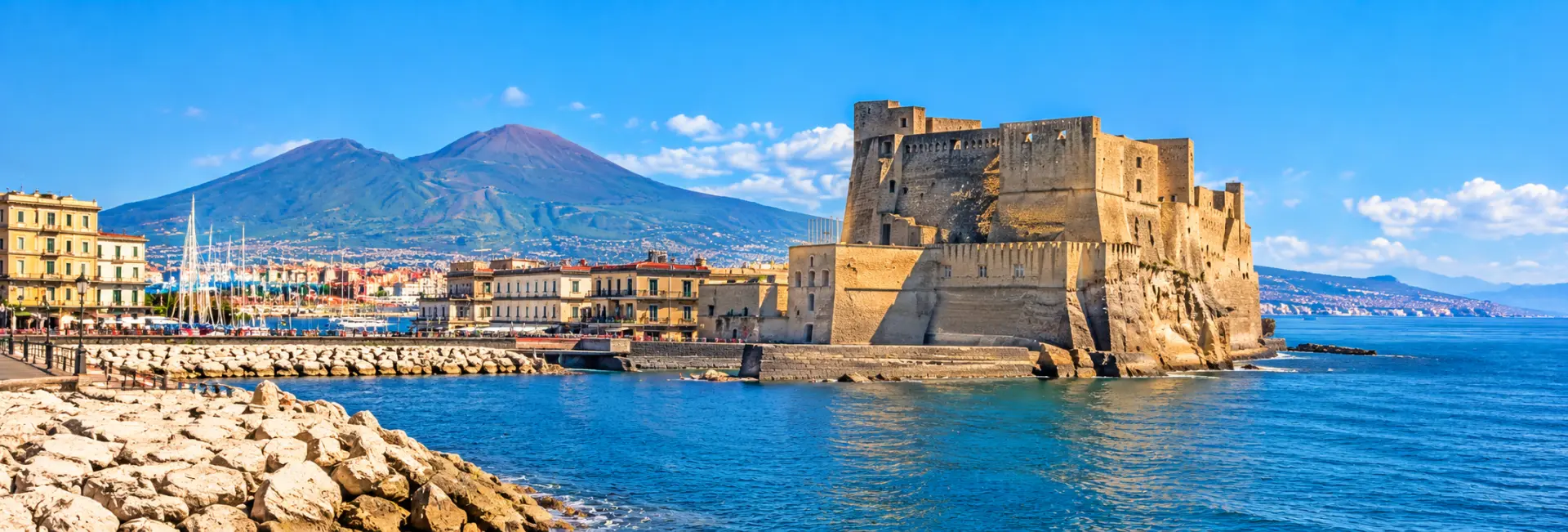
Castel dell'Ovo sits on a small rocky headland that pushes out into the Gulf of Naples, and it is generally counted as the oldest castle in the city. Its warm yellow tuff walls seem to grow straight out of the water, with Mount Vesuvius standing in the distance across the bay. A short stone causeway links the fortress to the Santa Lucia waterfront, and the stroll out along it is one of the classic moments of any Naples visit.
The name means Egg Castle, and it comes from one of the city's best-loved legends about the poet Virgil and a magical egg. The real story of the place is every bit as layered. The islet of Megaride is where Greek settlers first put down roots, and over the centuries it has hosted a Roman villa, a monastery, a royal treasury and a prison before turning into the landmark people photograph today.
Whether you go inside or simply walk the causeway and admire it from the water's edge, Castel dell'Ovo gives you a compact, atmospheric introduction to nearly 2,600 years of Neapolitan history.
History
Greek and Roman Beginnings
Greek settlers from Cumae are thought to have reached the islet around the 7th century BC, founding a settlement that became known as Palaepolis, the "old city". As the population grew, a newer town called Neapolis spread inland, and that name eventually evolved into Naples. In 2018, archaeologists working underwater near the castle announced the discovery of what appears to be part of an ancient harbor tied to those first settlers.
In the 1st century BC, the Roman general Lucius Licinius Lucullus built part of a lavish villa on the site. Later the complex was fortified, and in 476 the last Western Roman emperor, Romulus Augustulus, was sent here in exile. A monastery followed shortly after 492, but the old buildings were largely torn down in the 9th century so that Saracen raiders could not use them as a base.
Normans, Angevins and Royal Prisoners
The first true castle went up under the Normans in the 12th century, and Roger II made it his seat after taking Naples in 1140. Its status shifted when Charles I of Anjou built Castel Nuovo and moved his court there in the 13th century. The older fortress stayed important, though, serving as the home of the royal chamber and the state treasury, and it also worked as a prison.
Its list of captives is striking. Empress Constance was held here in 1191, Conradin was locked up in 1268 before his trial and execution, and Queen Joan I spent time in confinement in 1381 after her defeat by Charles of Durazzo.
Aragonese Rebuilding and Modern Restoration
The castle's present shape mostly dates from the Aragonese period in the 15th century. It was battered by French and Spanish artillery during the Italian Wars and repaired more than once, and its guns were used again during the street fighting of the 1799 Neapolitan Republic. After a long stretch of decay, a major restoration campaign began in 1975 and brought the fortifications back into shape for public and cultural use.
The Legend of Virgil's Egg
Ask a Neapolitan why this is called the Egg Castle and you will almost certainly hear about Virgil. In the Middle Ages the Roman poet had a reputation as a sorcerer, and stories grew up that he had hidden a magical egg inside a cage deep beneath the fortress. As long as the egg stayed whole, the castle and the city were safe. If it ever broke, disaster would follow.
The tale got a real-world test in 1370, when a violent storm damaged the castle and rumors spread that the egg had cracked. Panic reportedly gripped the city until Queen Joan I announced that she had placed a new egg herself and renewed the spell.
The legend sits alongside an older one about Parthenope, a siren said to have washed ashore on Megaride after failing to lure Ulysses with her song. Her name was given to the earliest settlement here. Historians offer a plainer explanation for the castle's name: the fortress was built over older ruins and ended up with a rounded, oval outline. Most visitors, understandably, prefer the version with the wizard.
Architecture & Layout
The castle stretches roughly 200 meters in length and about 45 meters at its widest, so it feels less like a single tower and more like a long stone ship moored at the edge of the bay. It is built largely from local yellow tuff, which gives the walls their warm color, especially in late afternoon light.
A causeway of a little over 100 meters connects the islet to the mainland, and a tall bastion guards the approach. Two towers, known as the Normandia and the Maestra, rise from the complex, and a row of old cannons still lines the upper level, pointing out over the water.
Roman remains, medieval walls and later Aragonese work are all layered into the structure. That mix is a big part of the castle's character: it reads as a place that was rebuilt, patched and repurposed again and again rather than designed in one go.
Inside the Castle
Over the centuries the interior has been used for everything from monks' cells to royal offices, and many of its spaces now serve as venues for exhibitions, conferences and cultural events. Access to the inside has varied over the years, so the highlights below describe what the castle has offered when its rooms are open.
- Sala Italia, the largest hall, with a tall vaulted ceiling
- Sala Sirena, a room carved entirely out of the tuff rock and named after the siren of local myth
- The Grotta di Virgilio (Virgil's Antrum), a main chamber with two smaller rooms, linked in the popular imagination to the egg legend
- Sala della Compagna and Sala Megaride, more modern-feeling spaces in the upper part of the castle
- The church of San Salvatore, with late Byzantine frescoes and granite columns topped by Roman capitals
- The monks' cells, a 15th-century loggia and the space traditionally associated with Queen Joan's imprisonment
Even without a detailed tour, the stone stairways, ramps and terraces make the castle worth exploring for the sense of moving through different eras in a single walk.
Borgo Marinari & the Waterfront
At the castle's foot lies Borgo Marinari, a small harbor village that grew out of a 19th-century fishing settlement. Today it is a marina lined with restaurants and cafes, and it is one of the easiest places in Naples to sit down to a seafood meal with a centuries-old wall as your backdrop.
The wider setting is the Santa Lucia waterfront, which runs along Via Partenope, a boulevard of grand hotels facing the bay. The castle sits between the San Ferdinando and Chiaia districts, looking across the water toward Mergellina. The causeway is also a favorite spot for wedding photographs, so on weekends you may find yourself sharing the view with a bride and groom.
Ways to Experience It
There is no single right way to do Castel dell'Ovo, and the surroundings are as much a part of the appeal as the fortress itself. Here are the most rewarding options:
- Walk out along the causeway and circle the outer edge for views of the walls rising from the sea
- Climb the terraces and ramparts, when open, for a wide look over the Gulf of Naples and Vesuvius
- Catch an exhibition or cultural event held in the castle's halls
- Eat at one of the restaurants in Borgo Marinari, right at the water's edge
- Continue along Via Partenope and the seafront promenade for the classic view of the castle from across the bay
Most people spend somewhere between one and two hours here, longer if they linger over a meal in the marina.
Best Time to Visit
By Season
Spring and autumn are the sweet spot, with mild temperatures and clear skies that make Vesuvius stand out across the bay. Summer brings long days and lively evenings on the waterfront, but the exposed terraces and causeway get hot and offer very little shade. Winter is quieter, though wind and rain coming off the sea can make the walk out less pleasant.
By Time of Day
Early morning is the calmest time and gives soft light for photos. Late afternoon is the most flattering, when the low sun warms the tuff walls, and an evening stroll along the seafront is a Neapolitan habit worth joining.
Visitor Tips
- Check the current status before you go: restoration work in recent years has affected access to the interior, so confirm what is open on the official City of Naples website.
- Entry has traditionally been free, but special exhibitions or events inside may have their own ticket rules.
- Wear comfortable shoes with good grip, as the stone surfaces, ramps and stairs can be uneven and slippery when damp.
- Bring sun protection and water in warm months, since the outer terraces are very exposed.
- The uneven ground and steep sections make some areas difficult for wheelchairs and strollers.
- To get there, take Metro Line 1 to Municipio and walk roughly 800 meters along the waterfront, or use a city bus toward Via Partenope or Santa Lucia.
- Keep an eye on your belongings in the busier waterfront stretches, as you would in any popular part of a big city.
Nearby Attractions
Castel dell'Ovo works well as the anchor of a half-day on the Naples seafront. Some easy additions:
- Castel Nuovo, the castle that replaced Castel dell'Ovo as the royal seat under Charles I of Anjou
- Piazza del Plebiscito and the Royal Palace, a short walk inland
- Teatro San Carlo, one of the most celebrated opera houses in Europe
- The Villa Comunale gardens and Lungomare Caracciolo for a long seafront walk toward Chiaia
- The Chiaia district for shopping, cafes and evening aperitivo
FAQs about visiting Castel dell'Ovo
Why is it called Castel dell'Ovo? +
The name means Egg Castle. According to legend, Virgil hid a magical egg beneath the fortress that protects both the castle and Naples. A less romantic explanation is that the oval shape of the building gave it its name.
Is Castel dell'Ovo free to enter? +
Entry has traditionally been free, although some exhibitions or events inside may require a ticket. Rules can change, so check the City of Naples website close to your visit.
Can I go inside right now? +
Interior access has been limited by restoration works in recent years. Even when the inside is closed, you can still walk the causeway and enjoy the castle and marina from outside, but confirm the current status before planning around it.
How much time do I need? +
Plan on one to two hours, including the walk out along the causeway and time in Borgo Marinari. Add more if you want a full meal or there is an exhibition on.
How do I get to Castel dell'Ovo? +
The easiest route is Metro Line 1 to Municipio, followed by a waterfront walk of roughly 800 meters. Several city buses also stop along Via Partenope and near Santa Lucia, a short walk from the castle.
Where can I get the best view of the castle? +
From the castle's own terraces when they are open, you look out over the Gulf of Naples toward Vesuvius. For the classic photograph of the castle itself, walk along Via Partenope or the seafront promenade toward Chiaia and look back at it.
Is it suitable for kids and older visitors? +
Kids usually enjoy the causeway, the sea views and the legends. Older visitors or anyone with mobility needs should be aware of the ramps, stairs and uneven stone underfoot.
What is the difference between Castel dell'Ovo and Castel Nuovo? +
Castel dell'Ovo is the older fortress, standing on a seaside islet with Roman and Norman roots. Castel Nuovo is a later Angevin castle, built in the 13th century, that sits closer to the port and the city center.
