
Table of Contents
Overview
Piazza del Plebiscito is the largest public square in Naples, covering roughly 25,000 square metres between the seafront and the southern end of Via Toledo. Open, flat and pedestrian-only, it feels like a sudden pause in a city known for tight lanes, buzzing scooters and crowded pavements. Locals use it as a stage, a playground and a meeting point all at once.
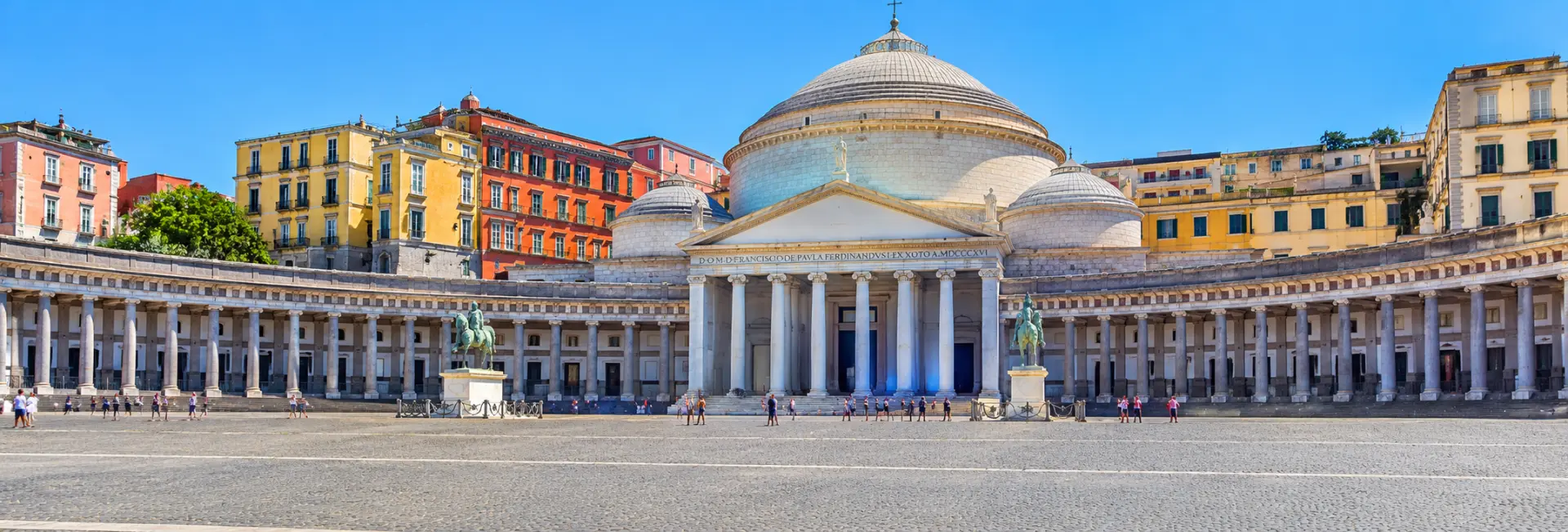
The square works because everything around it is on a grand scale. To the east stands the long façade of the Royal Palace, and to the west a curving colonnade wraps around a domed neoclassical church. Two bronze horsemen sit in the middle, and the sky above it all feels unusually wide for the city centre.
It is also one of the easiest places in Naples to start a day. You can admire the architecture in a few minutes, but the square rewards a slower visit, with time to walk the full length, look at the details and watch how the space changes from morning to evening.
History
From Palace Forecourt to Royal Forum
For much of its early life the space in front of the Royal Palace was known as Largo di Palazzo, an irregular, unpaved open area used as a forecourt rather than a designed square. The palace itself dates to the early 17th century, during the period of Spanish rule, and the open ground in front of it grew up around the building's needs.
The transformation began in the early 1800s under Joachim Murat, the Napoleonic ruler of Naples. In 1809 his architect Leopoldo Laperuta drew up plans for a grand semicircular forum, then called the Foro Gioacchino, and building work began, including the demolition of existing structures on the site. Murat's rule ended before the scheme was finished.
Bourbon Restoration
When the Bourbons returned to power after the fall of Napoleon, they did not throw out the project but reshaped it. Ferdinand I, restored to his throne, chose to give the colonnade a new purpose and placed a church at its centre, honouring a promise he had made to Saint Francis of Paola. The basilica, designed by Pietro Bianchi, was developed over the following decades, and the whole square was essentially complete by the mid-1840s.
The two equestrian statues were added as part of the Bourbon vision. They present the dynasty's kings in a Roman-inspired style that matched the neoclassical fashion of the era.
A New Name and a Difficult Century
The square took its present name after the plebiscite of 21 October 1860, when voters approved the union of the Kingdom of the Two Sicilies with the new Kingdom of Italy. In the twentieth century, however, its fortunes slipped. A municipal decision in 1963 turned the entire space into a car park, and it stayed that way for decades.
The turning point came in 1994, when Naples hosted the G7 summit. The square was cleared of vehicles and pedestrianised, and it has been a car-free civic space ever since.
Recognition / Status
Piazza del Plebiscito lies in the heart of the historic centre of Naples, an area inscribed on the UNESCO World Heritage List in 1995. That listing recognises the city's remarkable continuity as an urban centre, with layers of Greek, Roman, medieval, Spanish and Bourbon history still visible in its streets and buildings.
The square is not a stand-alone monument but a set piece within that larger story. The buildings around it, particularly the Royal Palace and the basilica of San Francesco di Paola, are treated as major cultural landmarks in their own right.
Officially it is a public space managed by the city, which helps explain why access is free and why it hosts so many civic events. For visitors, that means there are no tickets, gates or opening hours to plan around for the square itself.
Architecture & Design
The Colonnade
The semicircular colonnade is the square's defining feature. Its sweeping arms enclose the western end and echo the great embrace of St Peter's Square in Rome, though on a more compact scale. The effect is theatrical: the curve draws the eye inward and up towards the church at its centre.
San Francesco di Paola
The basilica was modelled on the Pantheon in Rome, with a shallow portico of columns leading into a domed rotunda. The dome rises to roughly 53 metres, making it one of the most recognisable shapes on the Naples skyline. Inside, the circular plan and coloured marbles create a calm, ordered interior that contrasts sharply with the bustle outside.
The Royal Palace Façade
Opposite the church, the palace stretches for around 169 metres in warm brick, pale stone and dark volcanic material. Its lower arcade contains niches holding statues of rulers from different dynasties who governed Naples, from the Normans and Swabians through the Angevins, Aragonese, Habsburgs and Bourbons to the Napoleonic and Savoy eras. Walking along it is like reading a short history of the city in stone.
The Paving and the Layout
The square is paved in dark volcanic stone, which gives it a uniform, austere look and makes the buildings stand out more clearly. The space is divided into two parts: a semicircular area at the church end and a more rectangular section leading towards the palace. Two symmetrical buildings, now home to the Prefecture and the Palazzo Salerno, close off the sides.
Notable Landmarks Around the Square
- Basilica of San Francesco di Paola: the neoclassical church at the western end, open to visitors and worth a look for its domed interior and marble details.
- Royal Palace of Naples: the former residence of Bourbon kings, with a museum of royal apartments, a monumental staircase and a historic library. Entry is ticketed and separate from the square.
- Equestrian statues of Charles III and Ferdinand I: two bronze figures standing on the axis of the colonnade. The statue of Charles III is credited to Antonio Canova, while the statue of Ferdinand I was begun by Canova and completed by his pupil Antonio Calì.
- Palazzo della Prefettura and Palazzo Salerno: the twin buildings that flank the square, mirroring each other in their neoclassical design.
- The dynastic statues on the palace façade: a row of figures in niches that traces the succession of rulers over the centuries.
Even if you never step inside a single building, the square offers a full architectural lesson in the space of a short walk.
Local Legends & Cultural Life
The Blindfold Challenge
The best-known tradition is a simple game: stand at the doors of the Royal Palace, close your eyes or wear a blindfold, and try to walk in a straight line between the two equestrian statues. Almost nobody succeeds, and tourists and locals alike enjoy trying. Various stories attach to the game, including tales of a king or queen offering a reward or even a pardon, but these are folklore rather than documented history.
A Stage for the City
Because of its size and dramatic backdrop, the square has become the city's main open-air venue. It has hosted large concerts, New Year's Eve celebrations, sporting events, political gatherings and public festivals. On ordinary days it is much quieter, with children playing football on the open paving and families strolling in the late afternoon.
Symbol of Naples
For many Neapolitans the square represents the city's political and civic heart. It sits opposite the seat of former royal power and has witnessed the transitions from monarchy to unified Italy and beyond. That layered meaning, combined with the sheer space, is why it appears so often in photographs, films and postcards of the city.
Ways to Experience It
Walk and Wander
The simplest way to enjoy the square is on foot. Start at the basilica end, walk through the centre past the statues, and finish beneath the palace arcade. Allow at least half an hour if you want to take in the details rather than rushing through.
Step Inside the Basilica
San Francesco di Paola is usually open to visitors and provides a quiet, cool pause from the open square. Dress respectfully, since it remains an active place of worship.
Visit the Royal Palace
The palace interiors are a separate ticketed visit and are well worth adding if you enjoy grand rooms, historic furniture and the story of Bourbon court life. Check current opening times and ticket details before you plan the day.
Join a Walking Tour
Many guided walks of central Naples begin or pass through the square because of its location. A guide can help connect the buildings, statues and legends into a single story.
Coffee and People-Watching
Historic cafés stand just beside the square, so it is easy to combine a sightseeing stop with an espresso or a pastry. A bench in the sun makes a good alternative if you prefer to watch the city go by.
Best Time to Visit
Piazza del Plebiscito is open and accessible at any hour, so timing is mostly about light and atmosphere. Early morning tends to be the calmest, with soft light on the palace façade and very few people in your photos.
Late afternoon brings a different mood. The heat eases, families and children arrive, and the colonnade glows in warm evening light. In the evening, illumination gives the buildings a dramatic look, and the square feels lively without being overwhelming.
Spring and autumn are the most comfortable seasons, with mild temperatures and pleasant light. Summer can be very hot on the open paving, since there is little shade, so plan to visit early or late. Winter days are often clear and quiet, though the sea wind can feel cool.
Check event calendars before you go. Concerts, festivals and other big gatherings can fill or fence off parts of the square, and while the atmosphere can be exciting, it may limit access to the statues and basilica.
Visitor Tips
- Bring sun protection. The square has almost no shade, so a hat, sunglasses and water help in warmer months.
- Wear comfortable shoes. The volcanic paving is durable but can be uneven, and the square is larger than it looks.
- Dress modestly for the basilica. Covered shoulders and knees are expected when visiting the church.
- Watch your belongings. Like any busy tourist area, it is sensible to keep bags closed and phones secure, especially during events.
- Take the blindfold challenge with care. Make sure the area is clear and stay aware of other people, cyclists and children playing nearby.
- Check for events. Public gatherings can change access at short notice, so look at local notices if you plan a specific photo or visit.
- Confirm palace and church details. Opening times and ticket prices change, so use the official sources for the current information.
- Getting there. The square is easy to reach on foot from the seafront or from Via Toledo, and nearby metro and bus stops serve the wider historic centre.
Nearby Attractions
The square sits at the meeting point of several of Naples' best-known areas, so it is easy to build a wider itinerary around it.
- Teatro di San Carlo: one of the oldest and most celebrated opera houses in Europe, a short walk away.
- Galleria Umberto I: a grand glass-roofed shopping arcade with an elegant iron-and-glass dome.
- Gran Caffè Gambrinus: a historic café beside the square, popular for coffee and Neapolitan pastries.
- Castel Nuovo (Maschio Angioino): the medieval waterfront castle, a few minutes' walk towards the port.
- Via Toledo: the long main shopping street leading north into the city, with shops, food stalls and street life.
- Lungomare and Castel dell'Ovo: the seafront promenade and the ancient island fortress, ideal for a sunset walk.
Together these make it simple to spend a full day within walking distance of the square.
FAQs about visiting Piazza del Plebiscito
What is Piazza del Plebiscito? +
It is the largest public square in Naples, framed by the Royal Palace, the basilica of San Francesco di Paola and a sweeping colonnade. It is a car-free space in the historic centre, used for everyday life and major events.
Why is it called Piazza del Plebiscito? +
The name comes from the plebiscite of 21 October 1860, in which voters approved the union of the Kingdom of the Two Sicilies with the Kingdom of Italy. Before that, the area was known as Largo di Palazzo.
Is it free to visit? +
Yes, the square is a public space and there is no charge to walk through it at any time. The Royal Palace interiors require a separate ticket, while the basilica is generally open to visitors without one.
How long should I spend there? +
Around 30 to 45 minutes is enough for the square itself, including a look at the statues and the church. Allow extra time if you want to tour the Royal Palace or stop for a coffee nearby.
What is the blindfold game about? +
Visitors try to walk in a straight line between the two equestrian statues with their eyes closed, starting from the palace doors. It is an old, playful tradition, and hardly anyone manages it.
When is the best time to go? +
Early morning is quietest and best for photos, while late afternoon and evening bring a livelier atmosphere and softer light. Summer midday can be very hot because there is little shade.
Can I go inside the church? +
Usually yes, San Francesco di Paola is open to visitors, though times can change and services may limit access. Dress respectfully, with shoulders and knees covered.
Is the square suitable for children and people with limited mobility? +
It is flat, open and car-free, which makes it comfortable for families, prams and wheelchairs. The paving is stone, so it can feel bumpy in places, and there are few benches or shaded spots.
How do I get there? +
It is a short walk from the seafront and from the southern end of Via Toledo, with metro and bus stops nearby. The centre of Naples is compact, so walking is often the easiest option.
What else is nearby? +
Teatro di San Carlo, Galleria Umberto I, Castel Nuovo and the seafront promenade are all a short walk away. Gran Caffè Gambrinus stands right beside the square for a coffee break.
