
Table of Contents
Overview
The National Archaeological Museum of Naples, usually shortened to MANN, is one of the most important archaeological museums in the world. It is also the best place to understand what daily life looked like in Pompeii and Herculaneum before Vesuvius buried them in 79 AD. Most of the mosaics, wall paintings, statues and everyday objects that once filled those towns ended up here rather than at the ruins themselves.
The museum reaches well beyond Vesuvius. It holds the Farnese Collection of monumental Roman sculpture, one of the largest Egyptian collections in Italy, and a famous cabinet of ancient erotic art that was once locked away from the public. All of it sits inside a huge palace just north of the historic center, a building with a long story of its own.
The collection is big enough that most visitors enjoy it more by choosing a few priorities than by trying to see everything. The sections below are designed to help you do exactly that.
History of the Museum
From Cavalry Barracks to University
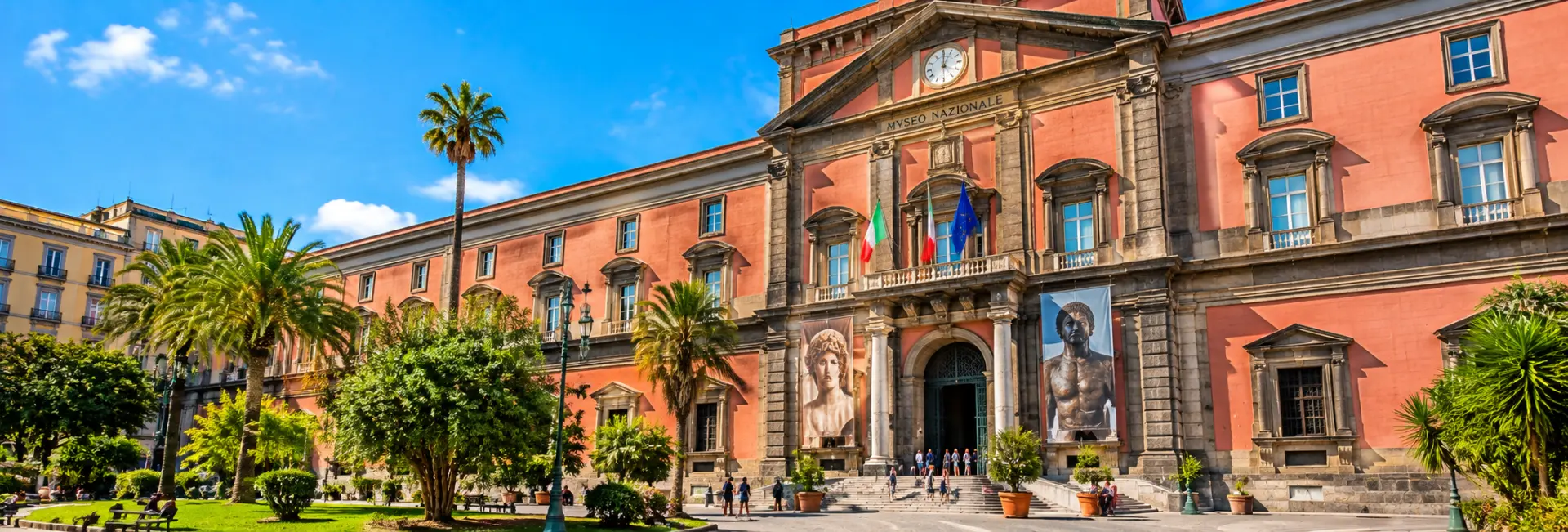
The building was begun in 1585 as a barracks for the Spanish cavalry, on land just outside the city walls that had once been part of a Greek burial ground. In the early 17th century the viceroy Pedro Fernandez de Castro, Count of Lemos, had it enlarged by the architect Giulio Cesare Fontana to house the University of Naples. The university used the palace from 1616 until 1777.
The Bourbon Museum
The idea of a royal museum took shape in the 18th century. Charles of Bourbon, king of Naples from 1734, backed the digs at Herculaneum and Pompeii and also inherited the Roman antiquities gathered by his mother, Elisabetta Farnese. His son Ferdinand IV moved the university elsewhere in 1777 so the palace could hold those collections, and in 1816 the institution took the name Real Museo Borbonico.
A National Museum
After Italian unification in 1860, the building and everything in it passed to the state, and the museum became the Museo Nazionale. It kept growing: the last rooms of the original palace were finished in 1920, and a northern wing known as the Braccio Nuovo was added between 1929 and 1932. Some collections moved on, with the library going to the Royal Palace in 1925 and the picture collection to Capodimonte in 1957.
Architecture & Building
Before you look at a single artifact, the palace itself makes an impression. It ranks among the most imposing monumental buildings in Naples, and centuries of rebuilding mean it reads as a layered structure rather than a single design. Wide stairways, huge halls and long galleries lead you from one collection to the next.
The showpiece is the Salone della Meridiana on the first floor, one of the largest covered halls in Europe. It began life as the university library and later held the Farnese library. In 1791 it was chosen as the site for an astronomical observatory, and a meridian sundial is still set into the floor. Above you is a ceiling fresco by Pietro Bardellino, dated 1781, that glorifies Ferdinand IV and his queen, Marie Caroline of Austria.
Today the hall is home to the Farnese Atlas, a marble figure of the titan holding up the celestial sphere. It is a fitting spot for it, since the room itself feels built to hold the weight of the sky.
Collections & Exhibits
The Farnese Collection
Assembled from the 16th century by Cardinal Alessandro Farnese, later Pope Paul III, this collection of Roman sculpture anchors the ground floor. Much of it was dug up in Rome, including at the Baths of Caracalla. It reached Naples through inheritance, first to Elisabetta Farnese and then to her son. Many of the works are Roman copies of lost Greek originals, which makes them some of the best evidence we have for what those famous statues looked like. The Farnese gems, a group of more than two thousand carved stones, belong to the same collection.
Pompeii and Herculaneum
The Vesuvian finds are the emotional heart of the museum. They include floor mosaics, wall paintings removed from houses and villas, bronze vessels, tools, jewelry and carbonized papyrus scrolls. The mosaics and the Secret Cabinet are on the first floor, while the second floor holds the finds from the Villa of the Papyri, a lavish Herculaneum villa explored through tunnels between 1750 and 1764. A large model of the Pompeii excavations is also on the second floor, useful for putting everything in context.
The Egyptian Collection
In the basement, the Egyptian collection numbers more than 2,500 objects and ranks among the largest in Italy. Displays follow themes such as royal power, the world of the dead, cults and magic, and everyday social and economic life. The timeline runs from the Old Kingdom to the Ptolemaic and Roman periods.
The Secret Cabinet
The Bourbon rulers created a private section for the erotic art unearthed at Pompeii and Herculaneum, and for long stretches access was banned or tightly restricted. Today it can be visited in a gallery of its own and offers a frank look at Roman attitudes to sex, humor and good luck. Parents may want to look through it before bringing children.
Must-See Highlights
If your time is limited, these are the pieces most visitors say they would not want to miss:
- The Alexander Mosaic, a floor mosaic from the House of the Faun in Pompeii, made of over a million tiny tesserae and showing Alexander the Great charging at the Persian king Darius
- The Farnese Hercules, a colossal statue of the hero found at the Baths of Caracalla, endlessly copied since the Renaissance
- The Farnese Bull, a huge multi-figure group carved from a single block of marble and often described as the largest sculpture to survive from antiquity
- The bronzes from the Villa of the Papyri, including the Seated Hermes, a lively drunken satyr and the famous runner statues
- The Herculaneum papyri, charred scrolls from the same villa that scholars are still working to read
- Pompeian frescoes and mosaics, from delicate garden scenes to portraits of ordinary residents
- The Secret Cabinet, for the intriguing and sometimes surprising side of Roman daily life
- Egyptian pieces such as the Farnese naophoros statue, the oldest item in the museum's holdings
Ways to Experience It
MANN rewards several styles of visit, from a quick focused tour to a full day of wandering:
- Self-guided visit: follow the floors in order, starting with the Farnese sculptures on the ground floor and working up to the Pompeii mosaics and the Villa of the Papyri
- Guided tour: a good option if you want the stories behind the objects, especially in the huge Vesuvian galleries
- Digital trails: the museum publishes a virtual tour, themed itineraries and video guides, including a set designed for deaf and hard-of-hearing visitors, which are handy for planning before you arrive
- Temporary exhibitions: the museum regularly stages special shows alongside the permanent galleries
- Pompeii pairing: many travelers visit MANN before heading out to the ruins so the site makes more sense once they are standing in it
Most people need three to four hours for a satisfying visit, and history fans can easily fill a full day.
Best Time to Visit
By Day and Season
Weekday mornings shortly after opening are the calmest, particularly midweek. Sundays are usually the busiest, and the free first Sunday of the month draws especially heavy crowds. Autumn through early spring tends to be quieter than the peak travel months, and because the museum is entirely indoors, it is also a smart choice on rainy days or during the hottest part of summer.
By Time of Day
Arriving at opening time lets you see the big-name pieces before the tour groups fill the halls. The late afternoon can be quiet too, though you will need to plan around last admission and remember that galleries start closing before the doors do.
Visitor Tips
- Check which galleries are open before you go: sections are sometimes closed for restoration work on a rotating basis, and this can affect major highlights such as the mosaics, so confirm on the museum's official website if there is a specific piece you want to see.
- Book tickets online in advance, especially during busy periods, to skip the ticket line.
- The museum closes one day a week, traditionally Tuesday, and on a few public holidays, so verify opening days for your dates.
- Entry is free for everyone on the first Sunday of the month under Italy's Domenica al Museo scheme, but expect big crowds and limited booking options.
- Pick three or four priorities in advance instead of trying to cover every room.
- Wear comfortable shoes, as the building is huge and involves a lot of walking and stairs.
- Some areas, including the Egyptian collection, the Secret Cabinet and some upper-floor mosaic rooms, involve stairs, so visitors with mobility needs should ask staff about current access.
- Reach the museum by Metro Line 1 to Museo station or Line 2 to Piazza Cavour.
Nearby Attractions
The museum sits at the edge of the old city, so it is easy to combine with other stops:
- Piazza Dante and Port'Alba, a lively square and historic gateway known for its old bookstalls
- Via dei Tribunali and the historic center, packed with pizzerias, churches and street life
- The Cappella Sansevero, home to the celebrated Veiled Christ sculpture
- Naples Cathedral, the city's main church, in the heart of the old town
- The Capodimonte museum and park, which holds the Farnese picture collection that once lived at MANN
FAQs about visiting the National Archaeological Museum of Naples
What is the museum best known for? +
It is best known for the artifacts from Pompeii and Herculaneum, including the Alexander Mosaic, along with the Farnese Collection, the Egyptian collection and the Secret Cabinet.
How long should I spend at MANN? +
Allow three to four hours for the highlights. If you love archaeology and want to explore several floors in depth, you could easily use a whole day.
Is the Alexander Mosaic always on display? +
Not necessarily. Parts of the museum, including the mosaic galleries, are sometimes closed temporarily for restoration or maintenance. Check the official website for current room closures before you plan around it.
Do I need to book tickets in advance? +
Booking online is recommended, especially in high season and on weekends, because it saves time at the entrance. Rules and prices can change, so confirm the details on the museum's official site.
Is it worth visiting before Pompeii? +
Yes, and many travelers do it that way. Much of the portable art and daily-life objects from Pompeii and Herculaneum are kept here, so the museum gives useful context before you walk the ruins.
Is the museum suitable for children? +
Older kids who like history often enjoy the mosaics, bronzes and gladiator and mythology themes. Younger children may tire quickly in such a large building, and the Secret Cabinet contains explicit content, so parents may want to skip or preview it.
Is the Secret Cabinet open to visitors? +
Yes, it has its own gallery on the first floor, though access can occasionally be limited on busy days or during maintenance. Ask at the information desk if you want to be sure it is open.
How do I get to the museum? +
The simplest routes are Metro Line 1 to Museo station or Line 2 to Piazza Cavour. From the historic center it is also an easy walk.
