
Table of Contents
Overview
Pompeii Archaeological Park protects the remains of a Roman town on the Bay of Naples that was buried when Mount Vesuvius erupted in AD 79. Unlike many ancient sites, where a few columns and foundations stand alone, Pompeii preserves an entire urban fabric: paved streets, shops with serving counters, public baths, theatres, temples and hundreds of homes that still carry painted walls.
The site lies about 25 kilometres south-east of Naples, beside the modern town of Pompei, and the walled city covers roughly 66 hectares. A large share has been excavated, while much of what remains buried is being left in the ground for future researchers with better tools.
Walking here feels less like visiting a museum and more like stepping into an interrupted day. Bakeries, taverns, workshops and private gardens sit side by side, giving a rare view of how ordinary Romans, not just emperors and generals, lived, worked and relaxed.
History
From Oscan Settlement to Roman Colony
Pompeii began as a modest settlement on an old lava plateau near the mouth of the Sarno river, which gave it access to both the sea and inland trade routes. Over the centuries it absorbed Greek and Etruscan influences and came under Samnite control, before becoming a Roman colony around 80 BC.
By the first century AD it was a comfortable provincial town, thought to be home to somewhere between ten and twelve thousand people. Wine, olive oil, textiles and the fermented fish sauce known as garum fuelled a prosperous merchant class. A powerful earthquake in AD 62 or 63 had damaged many buildings, and repairs were still under way when the greater disaster struck.
The Eruption of AD 79
Vesuvius, long regarded as a quiet mountain, blasted a towering column of gas and pumice into the sky. The traditional date is 24 August, taken from the letters of Pliny the Younger, but finds such as autumn fruit and a charcoal inscription uncovered in 2018 that refers to 17 October suggest the eruption may have come later in the year. Scholars still debate the exact day.
Pumice and ash rained down on Pompeii for hours, and roofs gave way under the weight. Those who stayed behind were caught the next morning by fast-moving clouds of superheated gas and ash, and the town vanished beneath several metres of volcanic material.
Rediscovery and Excavation
Digging began in 1748 under the Bourbon rulers of Naples, and an inscription confirmed the town's identity in 1763. Early work was closer to treasure hunting, but in the 1860s Giuseppe Fiorelli introduced a more scientific approach, dividing the city into numbered regions and blocks and developing the plaster-cast technique.
Excavation and conservation continue today. Recent studies of food remains, animal bones and building sites have added surprising detail, including evidence that people returned to the ruins after the eruption to salvage materials and even rebuild.
UNESCO Recognition
In 1997 UNESCO added the Archaeological Areas of Pompei, Herculaneum and Torre Annunziata to the World Heritage List. The listing groups the ancient towns of Pompeii and Herculaneum with the luxurious Roman villas of Torre Annunziata, ancient Oplontis, all buried by the same eruption.
UNESCO describes Pompeii's excavated area as the only archaeological site in the world that gives a complete picture of an ancient Roman city. The property was inscribed under three criteria:
- Criterion (iii): an exceptional testimony to a civilisation that has vanished, here the everyday life of the early Roman Empire
- Criterion (iv): an outstanding example of a type of building and architectural ensemble
- Criterion (v): an outstanding example of a traditional human settlement
Day-to-day protection is handled by the Archaeological Park of Pompeii, a state body that also looks after nearby sites such as Boscoreale, Oplontis and Stabiae.
Streets, Architecture and Daily Life
Streets and Public Life
Pompeii's streets were paved with irregular blocks of lava, and many still show deep grooves worn by cart wheels. Raised stepping stones let pedestrians cross without wading through the water and waste that ran down the roads, while street-corner fountains supplied the neighbourhood with fresh water.
Along the main roads, shops opened straight onto the pavement. Look for the L-shaped counters of thermopolia, the fast-food bars of the day, with round holes that once held jars of food and drink. Painted shop signs, election slogans and casual graffiti still survive on walls, giving a voice to ordinary residents.
Homes, Frescoes and Mosaics
Wealthier houses followed a familiar plan: a street entrance, an open-roofed atrium with a basin to collect rainwater, and rooms arranged around a columned garden courtyard. Walls were covered in colourful frescoes, which scholars group into four decorative styles, from imitation marble panels to fantasy architecture and mythological scenes.
Floors carried detailed mosaics, and gardens often held fountains and painted scenes of birds and plants. Together they show how much effort Romans of means put into making their homes beautiful.
Key Areas and Landmarks
The Forum
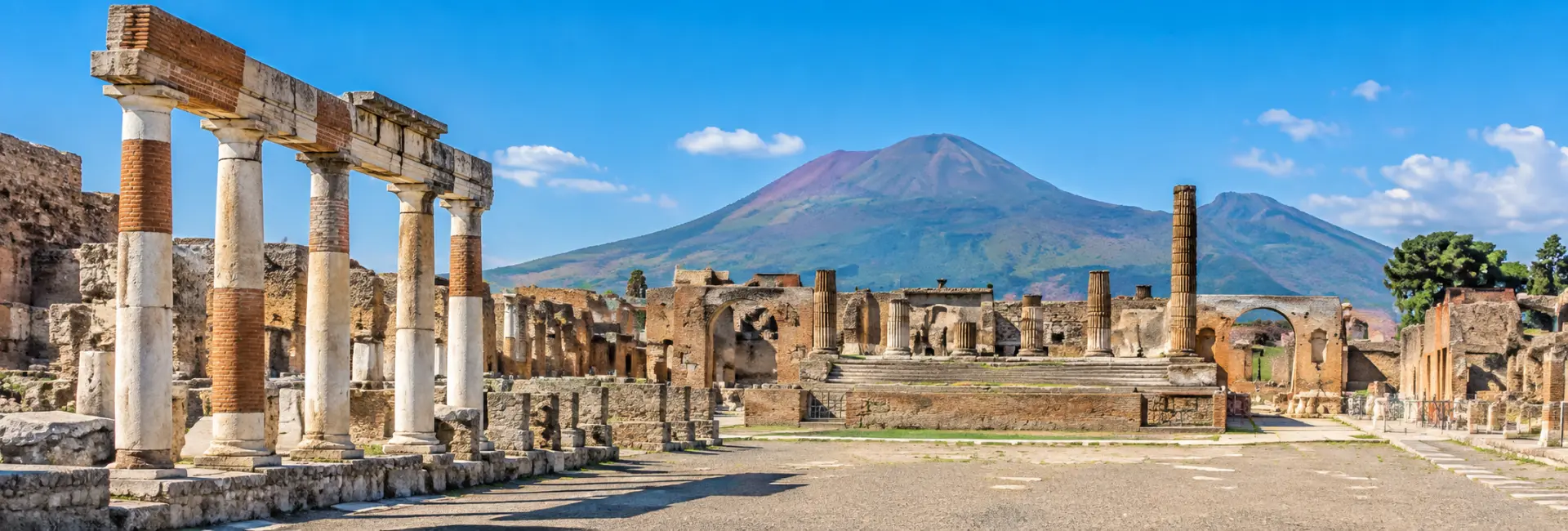
The Forum was the civic heart of Pompeii, a long open square lined with colonnades. At its northern end stood the Capitolium, a temple to Jupiter, Juno and Minerva, with Vesuvius looming behind it. Around the square were the Basilica, which served as law court and business hall, the Temple of Apollo, a covered food market and the large building funded by a priestess named Eumachia.
Amphitheatre and Theatres
Built around 70 BC, the amphitheatre is one of the oldest surviving Roman stone amphitheatres and could seat about 20,000 people, far more than the town's residents. It hosted gladiator shows, and a violent brawl in AD 59 with fans from nearby Nuceria led to a ban on games.
Two theatres stand close together: the large open-air theatre built into a hillside in Greek style, and the smaller roofed Odeon, used for music and recitals.
Public Baths
Pompeii had several bathhouses, including the Stabian Baths, among the oldest, and the well-preserved Forum Baths. Visitors can still see changing rooms with wall niches, heated rooms, plunge pools and decorated ceilings. Bathing was a social habit as much as a hygienic one.
Via dell'Abbondanza and the Commercial Streets
Via dell'Abbondanza is the main east-west shopping street, lined with bakeries, workshops, laundries and bars. Nearby stands the Lupanar, a small two-storey brothel with stone beds in tiny cells and graffiti on the walls, one of the most talked-about buildings on the site.
Garden of the Fugitives and the Plaster Casts
In the southern part of the town, the Garden of the Fugitives holds casts of thirteen victims, some huddled together as they died. The casts were made by pouring plaster into the hollows that decayed bodies left in the hardened ash. The park has recently added a permanent exhibition explaining how they are made and what they reveal.
Famous Houses and Villas
Only some houses are open on any given day, because the park rotates access to protect fragile interiors and make room for conservation work. Check the official list of open buildings before you go, and treat the following as highlights rather than guarantees.
- House of the Faun: one of the largest private residences in town, filling an entire city block and named after a bronze statue of a dancing faun. The famous Alexander Mosaic found here is now displayed in the National Archaeological Museum of Naples.
- House of the Vettii: home of two wealthy former slaves turned merchants, known for richly painted rooms, a lovely garden and a well-known painting of the fertility god Priapus.
- House of the Tragic Poet: famous for the "cave canem" mosaic warning visitors to beware of the dog.
- House of Menander: a large residence with an elegant colonnaded garden, where a hoard of silver tableware was discovered.
Just outside the town walls, the Villa of the Mysteries is celebrated for a large fresco cycle that many scholars read as an initiation into the cult of Dionysus. It has often been covered by a separate or extended ticket, so check when booking.
Ways to Experience It
You can explore independently with the free official map, available in paper form at the entrances and as a download online, or add structure with a guide.
- Self-guided visit: follow the map through the Forum, baths, theatres and main streets at your own pace.
- Audio guides: a useful add-on when you want context without joining a group.
- Guided tours: professional guides help decode frescoes, street layouts and small details that are easy to miss, and smaller groups tend to work best.
- Extended routes: a wider ticket option adds outlying villas and other areas, reached by a short walk or shuttle.
- Special openings and exhibitions: the park occasionally opens new excavation areas or hosts events, so check its news page before you go.
Many visitors combine Pompeii with Herculaneum, Vesuvius or a day on the Sorrento and Amalfi coasts, either by train or on an organised tour.
Best Time to Visit
Pompeii is open most of the year, and each season gives a different experience.
- Spring (April to early June): warm and comfortable, with the most pleasant walking weather. It is also busy, so book ahead.
- Summer (late June to August): very hot, with little shade on the open streets. Aim for the first hours of the morning or the late afternoon.
- Autumn (September to October): usually the best balance of mild temperatures, softer light and thinner crowds.
- Winter (November to March): the quietest season, with shorter days and occasional rain that can make the ancient paving slippery.
In any season, the first entry of the day and the last couple of hours before closing tend to be calmer than midday. Some houses close earlier than the main gates, so do not leave the buildings you most want to see until the very end.
Visitor Tips
- Book online: tickets are issued in the visitor's name, a daily visitor limit applies, and entry is divided into time slots during the busy season. Carry photo ID in case it is requested.
- Pack light: only small bags, up to 30 x 30 x 15 cm, are allowed inside the park.
- Wear sturdy, comfortable shoes: the lava paving is uneven, and you will walk several kilometres.
- Protect yourself from the sun: bring water, a hat and sunscreen, since shade is scarce.
- Allow enough time: about three to four hours covers the highlights, and a full day suits a thorough visit.
- Respect the ruins: do not touch frescoes, climb on walls or remove anything from the site.
- Check accessibility: the park has developed accessible routes and sensory supports, but the ancient surfaces remain challenging, so review the official accessibility information in advance.
- Confirm current details: hours, prices, open buildings and closures change, so check the official Pompeii Sites website before you travel.
Nearby Attractions
Pompeii is well placed for other archaeological and scenic stops in the area, most of them reachable by train or short transfer.
- Herculaneum: a smaller Roman town buried by the same eruption, known for its well-preserved upper floors and wooden fittings.
- Villa Poppaea at Oplontis: a grand seaside-style Roman villa with impressive wall paintings, in Torre Annunziata.
- Mount Vesuvius: the volcano itself, with a crater walk and wide views over the bay.
- National Archaeological Museum of Naples: home to many of Pompeii's finest mosaics, statues and frescoes.
- Boscoreale and Stabiae: more Roman villas and rural buildings, looked after by the same archaeological park.
FAQs about visiting Pompeii Archaeological Park
What is Pompeii and why is it so famous? +
Pompeii was a thriving Roman town buried by the eruption of Mount Vesuvius in AD 79. The volcanic deposits sealed its streets, homes, shops and artworks in place, so it now offers one of the most complete views of everyday Roman life anywhere.
How long should I spend at Pompeii? +
Plan on about three to four hours for the main highlights, and a full day if you want to explore slowly, add outlying villas or join a guided tour. The site is large and mostly outdoors, so pacing yourself matters.
Do I need to book tickets in advance? +
Yes, it is strongly advisable. Tickets are issued in the visitor's name, a daily visitor limit applies, and entry is split into time slots during the busiest months. Buying through the official ticketing system helps you avoid queues and reseller markups.
How do I get to Pompeii from Naples? +
The easiest option is the Circumvesuviana train towards Sorrento, getting off at Pompei Scavi - Villa dei Misteri, which takes roughly 35 to 40 minutes from central Naples. The Porta Marina entrance is a short walk from the station.
Which entrance should I use? +
Porta Marina is the most popular gate and is closest to the Circumvesuviana station, with Piazza Esedra nearby as a second option. Piazza Anfiteatro sits at the far end of the site near the amphitheatre and can be a calmer starting point, especially if you arrive at Pompei Santuario station or by car.
Is Pompeii suitable for children and visitors with limited mobility? +
Children often enjoy the open spaces, the amphitheatre and the stories of daily life, though heat and distances can tire them quickly. The ancient paving is uneven, which can be difficult for wheelchairs and walking aids, but the park has developed accessible routes and support for visitors with disabilities, so check the official accessibility page before you go.
Can I see the plaster casts of the victims? +
Yes. Casts are displayed at several points in the park, most famously in the Garden of the Fugitives, and a permanent exhibition explains how they are made. Some visitors find them very moving, so parents may want to prepare younger children.
Is it worth combining Pompeii with Herculaneum or Vesuvius? +
Herculaneum is smaller and can be seen in two to three hours, with better-preserved upper floors and wooden elements. Vesuvius offers a crater walk and panoramic views. With an early start you can pair Pompeii with one of them in a day, but adding both can be tiring.
