
Table of Contents
Overview
The Historic Centre of Naples is one of the most layered urban landscapes in Europe, a dense maze of narrow streets, tall tenements, church domes and busy piazzas that has been lived in without a break for around 2,500 years. Its street plan still follows the grid laid out by Greek settlers, so as you walk between shopfronts, shrines and washing lines, you are following routes that ancient Neapolitans would recognise.
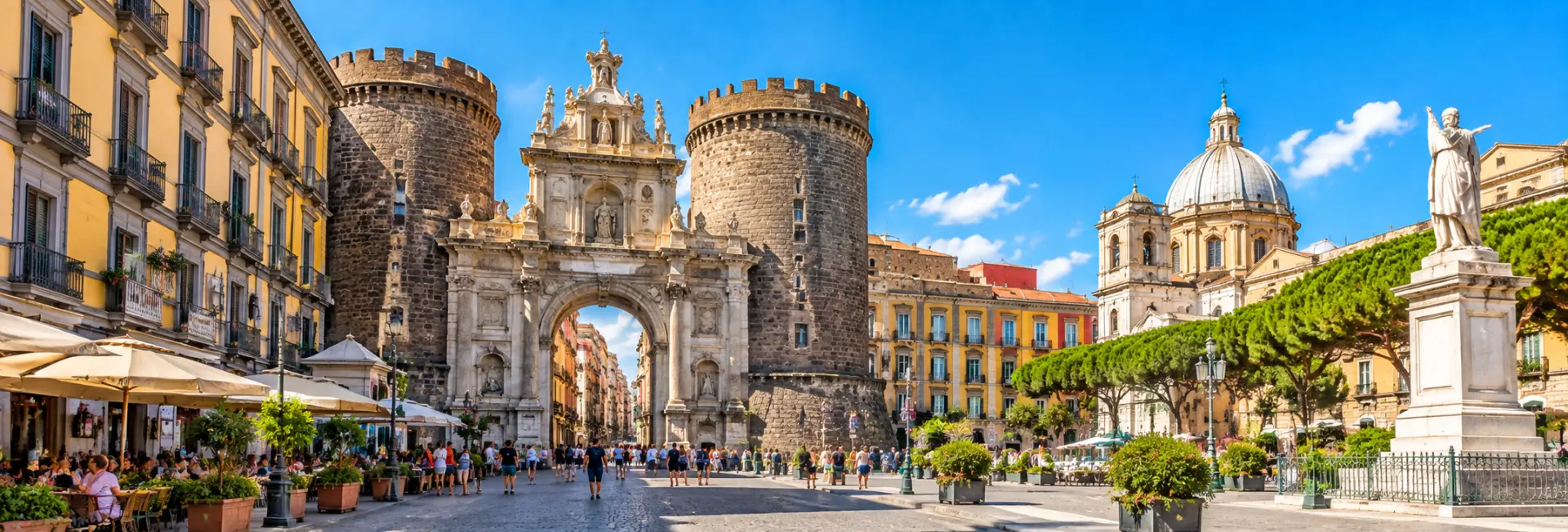
This is not a preserved museum district. Families live above the workshops, scooters thread through alleys, and the smell of coffee and fried pizza drifts from doorways beside Baroque churches and medieval cloisters. The mix of grandeur and everyday chaos is precisely what gives the old town its character.
Most of the main sights lie within a compact, walkable area, so a day or two on foot is enough to see art by Caravaggio, a legendary marble sculpture, Greek walls, royal palaces and an opera house, all while eating very well along the way.
History
Greek Foundations
Greek settlers first occupied the coastal heights around the bay in the eighth century BC, and the city was later refounded a little inland as Neapolis, meaning the new city. UNESCO dates that foundation to around 470 BC. Sections of the fourth-century BC defensive walls survive today, and their large tuff blocks can be seen in Piazza Bellini, where they were uncovered in 1954.
Roman, Medieval and Angevin Naples
The Romans absorbed the city but kept its Greek layout and much of its Greek-speaking culture. In later centuries Naples passed through Byzantine, Norman and Angevin hands, and each era added churches, fortifications and palaces. Charles I of Anjou began the castle known as Castel Nuovo in 1266, and it remains one of the city's defining silhouettes.
Spanish and Bourbon Naples
Under Spanish rule the city expanded westward, gaining the long avenue of Via Toledo and the tightly packed Spanish Quarters. In the eighteenth century the Bourbon monarchy made Naples a royal capital of ambition and spectacle, commissioning the Teatro di San Carlo in 1737 and a wave of Baroque and neoclassical building. This chapter of growth ended with Italian unification in 1860, and UNESCO uses that year to frame the period reflected in the historic urban fabric.
Recognition / Status
The Historic Centre of Naples was inscribed on the UNESCO World Heritage List in 1995 under criteria (ii) and (iv). The listing covers a large part of the old city, more than 1,000 hectares, and recognises its urban fabric as a record of about twenty-five centuries of growth, from the Greek town to the era of unification.
UNESCO's assessment highlights the way Naples keeps traces of many phases of history in a single street pattern, with Greek and Roman remains, Norman religious and military buildings, Renaissance and classical monuments, and later suburbs all readable in the city plan. Among its outstanding monuments, the listing names the Church of Santa Chiara and Castel Nuovo.
Naples has another link with UNESCO through food: the art of the Neapolitan pizzaiuolo, the pizza maker's craft, was added to UNESCO's list of intangible cultural heritage in 2017, which fits neatly with a district where pizza is served in nearly every street.
Architecture and Streetscape
The Greek Grid
The old town is organised around three long, straight east-west streets known as decumani, crossed by narrower side streets. The lowest is the famous Spaccanapoli, whose name refers to how it seems to split the city in two, while Via dei Tribunali was the main decumanus of ancient Neapolis. Looking along these streets from either end, you can see the ancient plan still at work.
A Mix of Styles
Naples is a city of accumulation rather than a single architectural period. Gothic Angevin churches stand near Renaissance palaces, and Baroque interiors of extraordinary richness sit behind plain, weathered street facades. Many of the churches hide gilded ceilings, marble altars and painted domes that are entirely unexpected from outside.
Life at Street Level
Much of the appeal lies in the small details: tall shuttered windows, balconies strung with washing, votive shrines on street corners, artisan workshops and tiny courtyards glimpsed through open gateways. The streets are narrow and often shaded, giving the district a tightly packed, intimate feel even in the middle of a big city.
Key Areas
Spaccanapoli and the Decumani
Spaccanapoli runs in a nearly perfect straight line through the heart of the old town, passing some of its most important squares and churches. It is lined with shops, cafes and small workshops, and it is one of the best streets in the city for people-watching. The narrow lanes leading off it are worth exploring for their local character.
Via dei Tribunali and the Cathedral Quarter
Via dei Tribunali follows the ancient main decumanus and is known for its historic pizzerias, Baroque churches and the cathedral of Naples, which is devoted to the city's patron saint, San Gennaro. The street has a lively evening atmosphere and links several major sights within a few minutes on foot.
San Gregorio Armeno
This short, crowded lane is famous for its craftsmen who make nativity scenes and figurines, a Neapolitan tradition. The workshops display everything from traditional shepherds to satirical figures of public personalities, and the street is especially busy in the weeks before Christmas.
Piazza Bellini and the University Quarter
Piazza Bellini combines exposed Greek walls with a relaxed cafe scene, and it is surrounded by universities, the Academy of Fine Arts and a conservatory. It is popular with students and locals in the evening, when the square fills with people meeting for a drink.
Via Toledo, Piazza del Plebiscito and the Royal Quarter
On the western edge of the old town, the busy shopping street of Via Toledo leads towards the grand Piazza del Plebiscito, the Royal Palace and the Teatro di San Carlo. The scale here is very different from the alleys of the older core, with broad spaces and formal monuments.
Notable Landmarks
Sacred Landmarks
- Naples Cathedral: the seat of the archbishop and home to the relics of San Gennaro, whose blood is said to liquefy in a public ceremony three times a year.
- Santa Chiara: a large monastic complex with a peaceful cloister decorated with painted majolica tiles, a bright and surprising contrast to the surrounding streets.
- Cappella Sansevero: a small private chapel best known for the Veiled Christ, an eighteenth-century marble sculpture by Giuseppe Sanmartino in which the delicate veil seems to cling to the body.
- Pio Monte della Misericordia: a church that still displays Caravaggio's Seven Works of Mercy, painted for it in 1607.
- Gesu Nuovo, San Domenico Maggiore and San Lorenzo Maggiore: three more major churches within a short walk of each other, each with a distinct architectural character and history.
Royal and Civic Landmarks
- Greek walls at Piazza Bellini: an open-air view of fourth-century BC fortifications in the middle of a modern square.
- Castel Nuovo: a medieval and Renaissance fortress by the port, begun by the Angevin rulers in 1266.
- Teatro di San Carlo: opened in 1737 and regarded as the oldest continuously active opera house in Europe, with a six-tier auditorium of red, blue and gold.
- Royal Palace and Piazza del Plebiscito: the former seat of the Bourbon court and the vast semicircular square in front of it.
- Galleria Umberto I: a glass-roofed shopping arcade from the late nineteenth century, close to the theatre.
Ways to Experience It
Exploring on Foot
Walking is the best way to understand the old town. A rewarding self-guided route begins at Piazza Bellini, follows Via dei Tribunali to the cathedral, returns along Spaccanapoli past the great churches, and finishes at Piazza del Plebiscito, with stops at a pizzeria or pastry shop along the way. Allow a full day if you plan to go inside several churches and museums.
Guided and Themed Tours
Guided walks add a great deal of context, especially for the layers of history that are easy to miss without explanation. Many tours combine the streets with entry to Cappella Sansevero, and others descend into the tunnels and cisterns carved in the tuff beneath the streets, which give a sense of how the city was built and supplied over the centuries.
Eating Your Way Through
Food is part of the experience here. Traditional pizzerias, small fried-food counters, coffee bars and pastry shops are found on almost every block, and stopping for a meal is a natural part of any visit.
Getting There and Around
The area is compact enough to cover on foot once you arrive. Metro Line 1 stops at Dante, Toledo and Universita, all close to the main sights, and the central station at Garibaldi is a short ride away. Many visitors also use the historic centre as a base for day trips to Pompeii, Herculaneum and Mount Vesuvius.
Best Time to Visit
Spring, from April to June, and early autumn, from September to October, are usually the most pleasant seasons, with mild weather that suits long walks between sights. Summer can be hot and humid in the narrow streets, and the busiest tourist period, although the shade and the late evening buzz help.
Winter is milder than in much of Europe but can be rainy, and it is quieter. The weeks before Christmas bring a special atmosphere to San Gregorio Armeno, though the lane becomes very crowded. The feast days of San Gennaro, including his main feast in September, are also a chance to see local devotion at its most intense.
By time of day, mornings are generally calmer for visiting churches and museums, while early evening is when the squares, bars and pizzerias fill up. Many churches close for a break in the middle of the day, so it is worth planning indoor visits around that.
Visitor Tips
- Wear comfortable shoes, as the paving stones are uneven and you will walk a lot.
- Keep bags closed and phones out of sight in crowded areas, since petty theft can happen anywhere popular with visitors.
- Dress modestly for churches, with shoulders and knees covered, and expect some to close at midday.
- Book timed tickets in advance for popular sights such as Cappella Sansevero, especially in high season.
- Check the current opening hours and prices with each site, as they change and vary by season.
- Watch for scooters in narrow streets and stay aware of your surroundings when crossing.
- Walking the streets is free, so you can build a day around the outdoor atmosphere and pick and choose which paid sights to enter.
FAQs about visiting the Historic Centre of Naples
Is the Historic Centre of Naples a UNESCO World Heritage Site? +
Yes. It was inscribed in 1995 and covers a large part of the old city, recognised for its long history and preserved urban layout.
How much time do I need in the historic centre? +
One full day covers the main streets and a few highlights, but two days lets you enter several churches, visit a museum and enjoy meals without rushing.
Is it free to visit? +
Walking through the streets and piazzas costs nothing. Individual sights such as Cappella Sansevero, the cloister of Santa Chiara and the Royal Palace have their own entry arrangements, while many churches are free or ask for a small donation.
Is the historic centre safe for tourists? +
It is busy and generally welcoming, but like any crowded tourist area it has petty theft. Keep valuables secure, be alert on crowded streets and use normal city precautions, especially in the evening.
What should I see if I only have a few hours? +
Focus on the area between Piazza Bellini, Via dei Tribunali and Spaccanapoli, taking in the cathedral, one or two churches and a pizza stop. Add Piazza del Plebiscito if you have time.
How do I get around the old town? +
Most sights are within walking distance of each other. Metro Line 1 serves the edges of the area, and buses or taxis help if you are tired or heading to another part of the city.
Is it suitable for children and visitors with limited mobility? +
Children usually enjoy the atmosphere and the food, though narrow pavements and crowds need attention. The uneven cobbles, steps into some churches and occasional slopes can be difficult for people with limited mobility or wheelchairs.
Can I combine the historic centre with Pompeii or Mount Vesuvius? +
Yes, the old town works well as a base for both. Trains from Naples reach the Pompeii and Herculaneum area, so you can spend a morning at the ruins or the volcano and return for an evening in the old streets.
