
Table of Contents
Overview
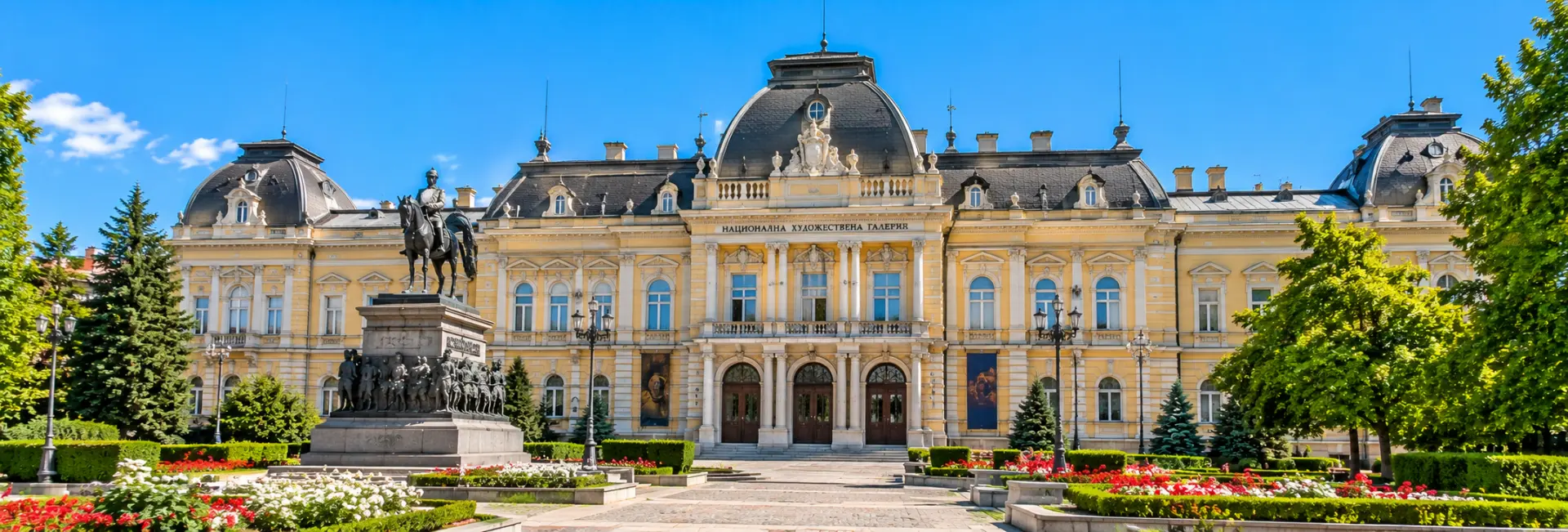
The National Art Gallery occupies the former Royal Palace on the north side of Battenberg Square, one of the most recognizable buildings in central Sofia. With its pale facades, ornate east wing and formal symmetry, it looks more like a Central European residence than a Balkan one, and that is no accident. Austrian architects shaped it for Bulgaria's first princes at the end of the nineteenth century.
Inside, the gallery tells the story of Bulgarian art, from medieval icons and National Revival portraits to twentieth-century modernism, alongside a smaller but rewarding selection of European and world art. The institution is bigger than any single address, though. Its collections are shown across several venues, and knowing which building holds what makes the difference between a smooth visit and a frustrating one.
The palace itself is the headline stop for most travelers, because the building has a story as rich as the art. It has been a princely home, a royal court, a seat of government and a party school before it finally became a place for paintings.
History of the Gallery
From a Museum Department to a National Institution
The gallery traces its roots to 1892, when an art department was created inside the National Archaeological Museum. It was the first national body in the country to collect art in an organized way, and it gathered National Revival works, foreign pieces and paintings by the first generation of artists who worked after Bulgaria's liberation in 1878.
In 1934 the collection became the State Art Gallery and gained a separate home. A purpose-built gallery designed by Victoria Angelova, described as Bulgaria's first female architect, went up between 1934 and 1941 and opened in 1942. It did not last long, because bombing raids in 1944 destroyed it completely.
A Palace Becomes a Museum
With its own building lost, the gallery needed new space. In 1953 the state handed the former Royal Palace over to the National Art Gallery and the National Ethnographic Museum, and the gallery has remained here ever since. Paintings from the royal collection also became part of the gallery's holdings.
Growing Into a Network
Over the following decades the gallery branched out. A medieval art department was formed in 1965 and later found its home in the crypt of the Alexander Nevsky Cathedral. In the 1980s the foreign art collection became its own institution in a rebuilt former printing house nearby. The most recent chapter came in 2015, when the old printing house and a neighboring building were transformed into Kvadrat 500, a large new complex that finally allowed Bulgarian and foreign art to be shown together in one place.
The Royal Palace Building
From Ottoman Konak to Princely Residence
The site has served rulers for centuries. From the sixteenth century it held an Ottoman konak, an administrative and residential compound for the local governor. A fire destroyed it in 1816, and a new two-story building went up between 1873 and 1875. During the Russo-Turkish War of 1877 and 1878 it was used as a hospital.
After liberation, the building became the residence of Prince Alexander I of Battenberg. It proved unsuitable for a head of state, so the Austrian architect Viktor Rumpelmayer rebuilt it between 1880 and 1882, reusing the old foundations and part of the main facade. The new palace was given Second Empire styling and opened on 26 December 1882.
A Royal Home Expanded
Prince Ferdinand, who took power in 1887, wanted more room. The Viennese architect Friedrich Grünanger designed a new east wing, built from 1894 to 1896 with Neo-Baroque touches and sculptural decoration by Andreas Greiss. It held the royal family's apartments, a library, reception rooms and winter gardens, and it even had a lift. After Ferdinand declared independence in 1908 and took the title of tsar, the building became known as the Tsar's Palace.
After the Monarchy
The monarchy was abolished in 1946, and the palace took on a very different life. It housed the Council of Ministers and the Higher Party School, and much of its royal decoration was stripped away or whitewashed. In 1949 the square in front of it was reshaped to make room for the Georgi Dimitrov Mausoleum, which stood there until it was demolished in 1999.
Since 1953 the palace has been a cultural space, and in 1978 it was declared a cultural monument. The gallery occupies the central building and one wing, while the Ethnographic Museum uses the royal family's wing, so a single trip can easily cover two museums.
What to Notice Inside
The upper floor of the original palace once contained the throne room, ballrooms, a reception hall, a dining room and a winter garden, while the ground floor held the offices of the court. Even though many interiors were altered, the proportions of the rooms still give a sense of how the palace was meant to impress visitors.
Collections & Exhibits
Bulgarian Art
The heart of the collection is Bulgarian art, beginning in the mid-nineteenth century and running through the twentieth. It includes icons and church art, portraits from the National Revival period, and a wide range of modern painting and sculpture. Landmark names include Zahari Zograf, a pivotal painter of the Revival era, and Vladimir Dimitrov, known as the Master, whose vivid, earthy canvases are among the most beloved in the country. The gallery also holds works by artists such as Stoyan Venev, Kiril Petrov and Ivan Lazarov, as well as early student paintings by Christo Yavashev, who later became internationally famous as Christo.
European and World Art
The foreign collection was formed mostly in the 1980s and covers European art from the fifteenth to the nineteenth century. Halls devoted to the Renaissance include two of the oldest paintings owned by the Bulgarian state. The gallery also keeps selections from Asia, Africa and the Americas, and these are often hung next to Bulgarian works so that visitors can see how styles and ideas moved across borders.
Medieval Icons and Church Art
Bulgaria's medieval art is a particular strength. The gallery holds the country's largest collection of medieval painting, with several thousand icons, and a branch in the crypt of the Alexander Nevsky Cathedral presents Christian art from the Bulgarian lands. Its holdings range from icons and fresco fragments to manuscripts and church plate, and they include pieces from monasteries such as Rila and Bachkovo.
Temporary Exhibitions at the Palace
Here is the detail that surprises many visitors. The palace is used mainly for rotating exhibitions of Bulgarian and international art, including solo retrospectives and themed shows, while the large permanent display is located at Kvadrat 500. Checking the current program before you go is the best way to know what you will actually see inside the palace.
Must-See Highlights
The gallery's own list of highlights from its permanent display gives a good sense of its range. These works are shown at Kvadrat 500, and displays can rotate, so treat them as a starting point rather than a guarantee.
- Ivan Mrkvička, Portrait of Princess Maria Louisa (1900): an elegant society portrait by the Czech painter who worked in Bulgaria and helped shape its early art scene.
- Nicholas Roerich, Hill of Tara (1932): a luminous landscape by the Russian-born painter, quite different from the usual Balkan subject matter.
- Albert Marquet, The Port of Algiers: a calm harbor scene by the French painter associated with the Fauves.
- Vera Nedkova, Summer (1941): a lyrical work by one of Bulgaria's best-known women painters.
- Marko Markov, Patriarch Evtimiy (1936): a dramatic image of the medieval Bulgarian church leader.
- Assen Peikov, Head of Giorgio de Chirico (1946): a sculpted portrait of the Italian painter, made by one of Bulgaria's leading postwar sculptors.
- African figures, including a Dogon figure and an Akua-Ba figure: striking sculptures that add a global perspective to the collection.
Beyond this short list, look for the work of Zahari Zograf and Vladimir Dimitrov, whose paintings tend to stay in memory long after the visit ends.
Ways to Experience It
The gallery works best when you think of it as a small network of venues rather than a single building. Each one offers a different experience.
- The Palace: located on Knyaz Alexander I Square, this is the historic building with the temporary exhibitions and the royal architecture. It suits a visit of an hour or so.
- Kvadrat 500: found near Alexander Nevsky Square on 19th February Street, this is the large permanent display, with 28 halls spread over four levels and roughly 1,700 works on show. Plan on at least two hours.
- Museum of Christian Art: set in the crypt of the Alexander Nevsky Cathedral, this is the place for icons, fresco fragments and church treasures.
- Other branches: the gallery also runs the Museum of the Art from the Socialist Period and the Sofia Arsenal, a museum of contemporary art, for visitors who want to go further.
Combined tickets covering two or three venues have been offered, and guided tours in Bulgarian and English can be arranged in advance. The Palace and Kvadrat 500 are roughly a quarter of an hour apart on foot, so visiting both in one day is realistic, especially if you break for lunch in between.
Best Time to Visit
Seasons
Because the art is indoors, the gallery is a good choice in any season. Winter and rainy days are ideal for a long, unhurried visit, while hot summer afternoons are a good excuse to step out of the sun. In spring and early autumn, the walk across Battenberg Square and through the nearby City Garden makes the trip more pleasant.
Time of Day
Early in the day or late in the afternoon tends to be quieter, and the rooms feel calmer with fewer people. Weekday mornings are especially good for photographing the palace exterior in soft light. If you want to see both the Palace and Kvadrat 500, start with the one you care about most, because the second visit is when energy tends to fade.
Visitor Tips
- Check the official website for current exhibitions before you go, since the Palace changes its program regularly.
- Confirm opening days and ticket prices ahead of time. The gallery has historically closed on Mondays and on major public holidays, and discounts and combined tickets change from year to year.
- Reduced or free admission has been available for several groups, including children, students and visitors with physical disabilities, so bring ID if you think you qualify.
- Photography without flash is generally permitted, but rules can differ between exhibitions, so look for signs at the entrance to each hall.
- Book a guided tour in advance if you want an expert introduction, as these are arranged by appointment.
- Wear comfortable shoes. Between the palace halls and the walk to Kvadrat 500, you will cover more ground than you expect.
- Ask staff about step-free routes if you have mobility needs, since access can vary between venues.
Nearby Attractions
The Palace sits in the middle of Sofia's cultural quarter, so you will rarely need more than a short walk to reach the next stop.
- National Ethnographic Museum: it shares the same building and focuses on Bulgarian folk traditions, costumes and crafts.
- City Garden: the leafy park behind the palace is one of the city's favorite places for a break.
- Ivan Vazov National Theatre: the elegant Neoclassical theatre faces the garden and is a landmark in its own right.
- Alexander Nevsky Cathedral: Sofia's grandest church is nearby and holds the gallery's Museum of Christian Art in its crypt.
- Russian Church: the green-roofed, gold-domed church on Tsar Osvoboditel Boulevard is only a few minutes away.
- Banya Bashi Mosque and TZUM: both are within walking distance if you want to continue exploring the center.
FAQs about visiting the National Art Gallery in Sofia
Where is the permanent collection? +
Most of the permanent display is at Kvadrat 500, near Alexander Nevsky Square. The Palace on Battenberg Square is mainly used for temporary exhibitions.
Why is the gallery in a palace? +
The gallery lost its own building to bombing in 1944, and the state gave it the former Royal Palace in 1953. It has used the building ever since.
How long should I allow? +
Plan on about an hour for the Palace and at least two hours for Kvadrat 500. If you add the Museum of Christian Art, a full day is a comfortable fit.
Do I need to buy tickets in advance? +
Tickets are usually bought on arrival, though guided tours should be arranged ahead. Check the official website for current prices and combined ticket options.
Is the gallery open every day? +
It has traditionally been closed on Mondays and on major public holidays. Confirm the schedule before you set out, as it can change.
Can I take photographs? +
Photography without flash is generally allowed, but some exhibitions have their own restrictions. Look for signs in each hall.
Is it suitable for children? +
Yes, children are welcome and have had free admission in the past. The African sculptures and large portraits tend to catch younger visitors' attention.
How do I get there? +
The Palace is in the city center on Knyaz Alexander I Square, a short walk from the Serdika metro station. Trams also stop nearby, and many visitors simply walk over from Alexander Nevsky Cathedral.
