
Table of Contents
Overview
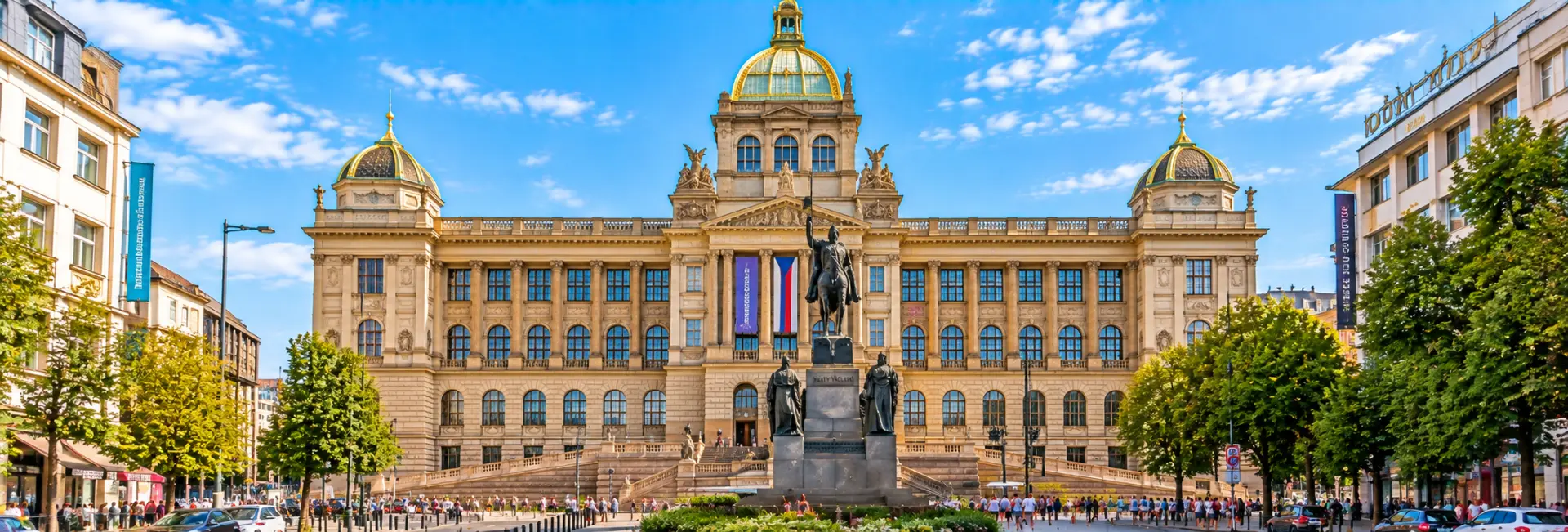
Closing the view down the length of Wenceslas Square, the National Museum is the oldest and largest museum institution in the Czech Republic, tracing its origins back to 1818. Its grand neo-Renaissance main building, completed in 1891, houses collections spanning natural history, geology, and Czech history, while a second site nearby, the New Building, adds further exhibition space connected by an underground passage.
Beyond its exhibits, the museum's main building carries its own scars of 20th-century history, having survived stray wartime bombing and later gunfire during the 1968 Soviet-led invasion, damage that remained visible on its facade for decades. A lengthy renovation completed in 2018 restored the building for its bicentennial year, giving Prague one of its most historically layered museum experiences.
History of the Museum
Founding as the Patriotic Museum
The museum was founded on 15 April 1818 as the Patriotic Museum in Bohemia, established by Count Kašpar Maria von Sternberg, a naturalist and paleontologist, with significant involvement from historian František Palacký. Its early focus reflected Sternberg's own scientific interests, concentrating heavily on natural history collections such as minerals, fossils, and botanical specimens.
A Home on Wenceslas Square
After occupying several earlier locations, including the Sternberg Palace and the Nostitz Palace, the museum's collections eventually found a permanent home in a purpose-built structure at the upper end of Wenceslas Square, designed by architect Josef Schulz and constructed between 1885 and 1891. The museum took its current name in 1922, by which point it had grown into a major European institution encompassing natural science, history, and eventually art and music collections.
Wartime Damage and Cold War Scars
The building survived the Second World War, though it sustained damage in May 1945 when unexploded bombs struck it during the final days of the conflict, with its most valuable collections having already been moved to safer storage. A far more visible wound came in August 1968, when Soviet-led Warsaw Pact forces invading Czechoslovakia sprayed the facade with machine-gun fire, apparently mistaking the grand building for a government or parliamentary structure; the bullet-scarred stonework became an enduring, visible symbol of the occupation for decades afterward.
A Bicentennial Restoration
By the early 21st century, more than a century of pollution, subway construction beneath the building, and unresolved wartime damage had left the historic building in serious need of repair. A major renovation began in 2011 and concluded in 2018, timed to mark both the museum's bicentennial and the centenary of Czechoslovak independence, restoring the facade, interiors, and long-damaged stonework, including the contested repair of the 1968 bullet marks.
Architecture & Building
The Historical Building
Josef Schulz's neo-Renaissance design gives the museum's main building a palatial presence at the head of Wenceslas Square, with a central dome, monumental staircases, and a richly decorated Pantheon hall lined with busts and statues of notable figures from Czech history and culture. The building's exterior sculpture and interior lunettes celebrate milestones in Czech history, from the medieval founding of Charles University to more recent national figures.
The New Building
A short walk away on Vinohradská Street, the museum's New Building occupies a structure originally built in 1937 as the Prague Stock Exchange and later used as the seat of the Czechoslovak, and later federal, parliament. The National Museum took over the building in 2009, after the broadcaster Radio Free Europe/Radio Liberty relocated, and later connected it to the historic building via an underground passage, allowing visitors to move between the two sites without going back outside.
Collections & Exhibits
The National Museum's holdings run into the tens of millions of items, though only a small fraction is on public display at any time, with the remainder supporting ongoing scientific research across departments including mineralogy, paleontology, botany, entomology, zoology, and anthropology. The historical building's exhibitions cover the natural history of Bohemia, Moravia, and Slovakia alongside displays of rocks, minerals, fossils, and mounted animal specimens, including a well-known stuffed elephant and a complete whale skeleton.
The New Building complements this with an interactive natural history exhibition known as Noah's Ark, opened in 2015, which relocated a large portion of the museum's animal displays while the historic building underwent restoration.
Must-See Highlights
- The Pantheon, with its busts and statues of notable Czech historical figures
- The building's central dome and grand staircases
- Restored facade stonework, including the site of the 1968 bullet damage
- Paleontology and mineralogy collections in the historical building
- Noah's Ark, the interactive natural history exhibition in the New Building
Ways to Experience It
Most visitors explore the National Museum independently, moving between the historical building's permanent exhibitions and the New Building's natural history displays via the connecting underground passage. Temporary exhibitions rotate regularly across both sites, often covering topics in natural science, archaeology, or Czech cultural history.
- Buy a combined ticket covering both the historical building and the New Building
- Walk the underground passage between the two sites rather than crossing Wenceslas Square outdoors
- Join a guided tour for deeper context on the building's architecture and history
- Visit the Noah's Ark exhibition in the New Building for a more interactive, family-friendly stop
- Check current listings for temporary exhibitions before visiting
Best Time to Visit
Weekday mornings tend to be quieter than weekends and school holiday periods, when the museum draws larger numbers of families and tour groups. Because the exhibitions are almost entirely indoors, the National Museum works well as a stop regardless of weather, making it a useful option on a rainy day in Prague.
Special anniversary events, particularly around the museum's founding date in April, sometimes bring extended hours or additional programming worth checking for in advance.
Visitor Tips
A little planning helps visitors get the most out of a museum this large, spread across two connected buildings.
- Check current opening hours and ticket options before visiting, since these can vary between the historical building and the New Building
- Use the underground passage to move between buildings without needing a second outdoor entry
- Set aside at least two to three hours to see both buildings without rushing
- Look closely at the restored facade stonework for a physical reminder of the building's 20th-century history
- Consider the Noah's Ark exhibition in the New Building if travelling with children, as it is more interactive than the historical building's classic display cases
Nearby Attractions
The National Museum's position at the head of Wenceslas Square puts it within easy reach of several other central Prague sights.
- Wenceslas Square and the Statue of Saint Wenceslas, directly in front of the museum
- The State Opera, a short walk away
- Old Town Square and the Astronomical Clock, reachable on foot through the New Town
- The New Building's former role as the Federal Assembly, worth noting while inside
- Náměstí Míru and Vinohrady, a walkable neighborhood beyond the New Building
FAQs about visiting the National Museum
What is the National Museum in Prague? +
It is the oldest and largest museum institution in the Czech Republic, founded in 1818, with collections spanning natural history, geology, and Czech cultural history housed across two connected buildings.
Why does the museum's facade have marks on it? +
The building's stonework was damaged by unexploded bombs in May 1945 and later riddled with bullets during the 1968 Soviet-led invasion of Czechoslovakia, damage that remained partly visible for decades until a major restoration completed in 2018.
How many buildings make up the National Museum? +
The main historical building on Wenceslas Square and the New Building on Vinohradská Street are connected by an underground passage and can be visited on a single combined ticket.
What was the New Building used for before it was a museum? +
It was built in 1937 as the Prague Stock Exchange and later served as the seat of the Czechoslovak and federal Czechoslovak parliaments before the National Museum took it over in 2009.
What can you see inside the National Museum? +
Highlights include the Pantheon hall of historical busts and statues, extensive mineral and paleontology collections, mounted animal specimens, and the interactive Noah's Ark natural history exhibition in the New Building.
How long does a visit take? +
Most visitors spend two to three hours to see both buildings at a comfortable pace, though a shorter visit is possible if focusing on just one site.
Is the National Museum good for children? +
Yes, particularly the Noah's Ark exhibition in the New Building, which is designed to be more interactive than the historical building's traditional display cases.
Where is the National Museum located? +
It stands at the upper end of Wenceslas Square in Prague's New Town, with its New Building a short walk away on Vinohradská Street.
