
Table of Contents
Overview
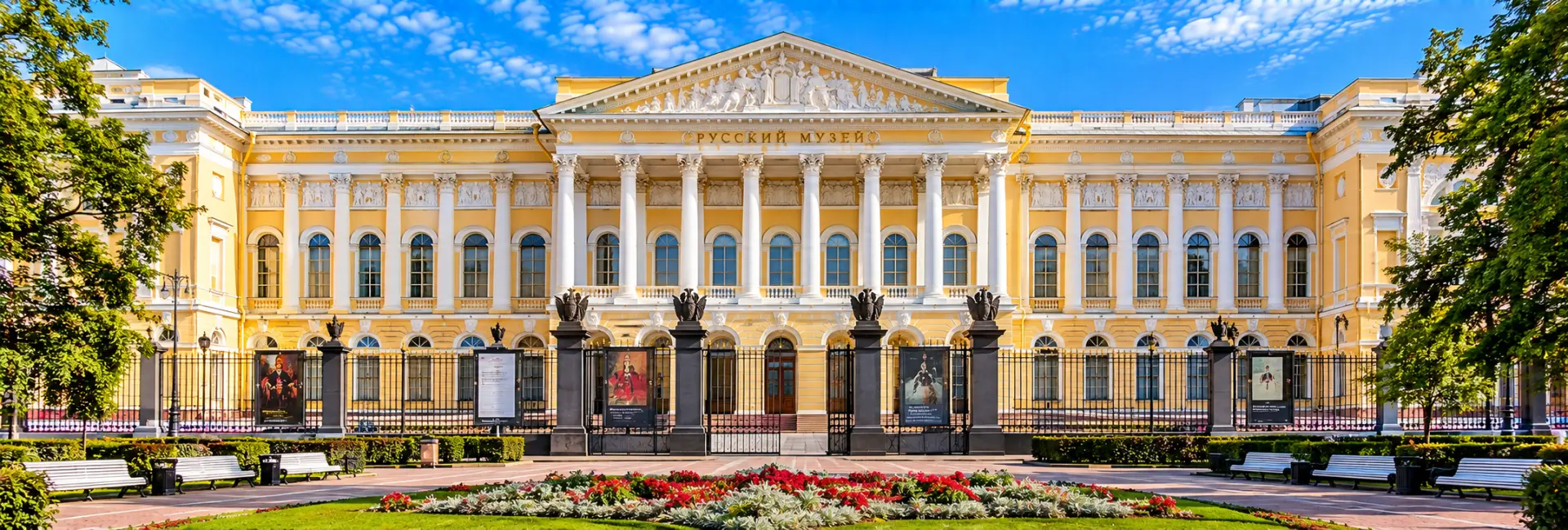
The State Russian Museum is the largest collection of Russian art anywhere in the world, and the best single place to follow the story of the country's painting, sculpture and decorative arts from medieval icons to the experiments of the twentieth century. Its main home is the Mikhailovsky Palace, a Neoclassical mansion facing Arts Square in the historic center of Saint Petersburg.
The holdings run past 450,000 works dating from the tenth to the twenty-first century. Those numbers sound daunting, but the museum is organized so that visitors can follow a clear thread: sacred art first, then the Petrine and imperial eras, then the great realist painters, and finally the avant-garde. The result is less a pile of treasures than a narrative of how Russian artists saw their country and the wider world.
The Russian Museum is also not a single building. Over the years it has grown into a complex of palaces, a castle, a pavilion-style wing and two historic gardens, which means a visit can be as short or as ambitious as you like. It is one of the most visited art museums in the world, drawing more than 3.6 million people in 2024.
History of the Museum
An Imperial Decision
The idea of a national museum devoted to Russian art was approved by Emperor Alexander III, but it was his son Nicholas II who carried it out after his father's death. In 1895 Nicholas signed a decree creating the Russian Museum of Emperor Alexander III and assigning the recently acquired Mikhailovsky Palace, with its wings and garden, to house it. Architect Vasily Svinin was put in charge of adapting the interiors for display.
The First Collection
The museum opened its doors to the public in March 1898. Its first holdings were drawn from the Hermitage, the Winter Palace, the palaces at Gatchina and Alexander Park, the Imperial Academy of Arts and various private collections. Members of the imperial family also bought works to expand the display, since state funding alone was not enough to build up the collection.
After the Revolution
After 1917, many private collections were nationalized and moved into the museum, which dramatically broadened what it could show. The early twentieth century also saw the creation of an ethnographic department, which became an independent museum of its own in 1934, and the addition of further buildings to the complex as the decades passed.
A Growing Complex
Today the museum looks after the Mikhailovsky Palace, the Benois Wing, the Marble Palace, the Stroganov Palace, St Michael's Castle with its two pavilions, the Cabin of Peter the Great and the Summer Palace of Peter the Great, along with the Summer Garden and the Mikhailovsky Garden. In 2024 it received the national "Museum of the Year" title from the Likhachev Prize.
Architecture & Buildings
The Mikhailovsky Palace
The main building was designed by the Italian-Russian architect Carlo Rossi and built between 1819 and 1825 as the residence of Grand Duke Michael Pavlovich, a younger brother of Alexander I. A pair of stone lions guards the entrance, and the long, columned facade looks out over a square that Rossi shaped as part of a unified ensemble of streets and buildings.
After the Grand Duke's death the palace became associated with his widow, Grand Duchess Elena Pavlovna, whose receptions and theatrical evenings made it a center of social and cultural life. A number of the halls still preserve their rich, Italianate interiors from that period, so walking through the museum often means admiring the setting as much as the art.
The Benois Wing
Beside the palace stands a later addition, designed by Leon Benois between 1910 and 1912. Construction began in 1914, was interrupted by the First World War, and was completed in 1919. The wing's larger and more flexible halls make it a natural home for major temporary exhibitions.
Other Landmarks in the Complex
- The Stroganov Palace on Nevsky Prospect, a Baroque landmark of the 1750s
- The Marble Palace, built in the late eighteenth century for Count Orlov
- St Michael's Castle, the fortress-like residence of Emperor Paul built around 1800
- The Summer Palace and Cabin of Peter the Great, among the oldest buildings in the city
Collections & Exhibits
The collection spans more than a thousand years of Russian creativity. Its strength lies in its sweep: very few other museums let you move from a medieval icon to a Soviet-era canvas within a single visit, in a single country's artistic voice.
Old Russian Art
The museum's collection of Old Russian painting is among the largest in the country and includes around 6,000 icons from the twelfth to the seventeenth century. These are not merely religious objects but a record of changing styles, regional schools and workshop traditions across the centuries.
Eighteenth and Nineteenth Century Painting
The eighteenth-century rooms trace the emergence of secular portraiture, history painting and landscape under the influence of Western Europe, while the nineteenth-century halls follow the rise of Romanticism and then Realism. Many of the most famous names in Russian art are represented in depth, including Karl Bryullov, Ivan Aivazovsky, Ilya Repin, Vasily Surikov, Arkhip Kuindzhi and Viktor Vasnetsov.
The Avant-Garde and Beyond
The museum is one of the great repositories of early twentieth-century experimentation, with works by Kazimir Malevich, Pavel Filonov, Kuzma Petrov-Vodkin, Mikhail Vrubel and Nicholas Roerich among others. The permanent display on the avant-garde presents the period as a bold artistic experiment rather than an isolated moment.
Folk, Decorative and Applied Art
- Folk art from the seventeenth to the twenty-first century, including textiles, ceramics and carving
- Sculpture, decorative and applied arts from the imperial and Soviet eras
- The gift of Peter and Irene Ludwig, a collection of later twentieth-century art
- A portrait gallery of historical figures in the state rooms of St Michael's Castle
Must-See Highlights
Medieval and Early Modern Treasures
Look for The Angel with Golden Hair, a twelfth-century icon admired for its calm, luminous face, and for the work of Dionisius, one of the great masters of Old Russian painting. Together they show why icon painting is considered a major pillar of the country's visual culture.
Great Canvases of the Nineteenth Century
- The Last Day of Pompeii by Karl Bryullov (1830-33), a vast, dramatic scene that made the artist an international celebrity
- The Ninth Wave by Ivan Aivazovsky (1850), a famous seascape of survivors clinging to wreckage at sunrise
- Reply of the Zaporozhian Cossacks by Ilya Repin (1880-91), a lively and humorous group scene that rewards close looking
- Taking a Snow Town by Vasily Surikov (1891), a joyful winter festival full of movement and color
The Avant-Garde
Kazimir Malevich's Black Square (the 1923 version) is a landmark of abstract art, and standing before it helps explain how radically Russian artists were rethinking painting a century ago. Nearby works by Filonov and others show how varied the movement really was.
Portraits and Everyday Life
The eighteenth-century portraits, including those by Dmitry Levitsky, capture the elegance of the imperial court, while Boris Kustodiev's lively, colorful scenes bring a lighter, more affectionate view of Russian life. Taken together, they are a good reminder that the museum is as much about people as about grand statements.
Ways to Experience It
Choosing Your Route
Most first-time visitors begin in the Mikhailovsky Palace, which holds the main chronological display. If time allows, add the Benois Wing for a major temporary show, or the Stroganov and Marble Palaces for a different atmosphere and more specialized exhibitions.
Tours and Guides
Guided tours are available in several of the museum's buildings in both Russian and English, and some sites also offer audio guides. A guide is especially useful here because the collection is so large and a good one can connect icons, portraits and avant-garde works into a single story.
Other Ways In
- Temporary exhibitions, which often focus on a single leading artist and attract long queues
- Lectures, concerts and festivals held in the palaces and gardens throughout the year
- A virtual version of the museum that lets you explore buildings and digitized works online before you go
- Stroll the Mikhailovsky Garden and the Summer Garden, both part of the museum complex
Best Time to Visit
Time of Year
The museum works in every season. Winter is quieter and a natural choice for lingering in warm palace halls, while summer brings the city's long white nights and the chance to combine the museum with its gardens. Major temporary exhibitions can raise attendance sharply at any time, so it is worth checking what is on before you plan your dates.
Time of Day
Arriving soon after opening usually gives the most breathing room in the central halls. Weekdays are generally calmer than weekends. Because the museum has historically kept one closing day each week and keeps different hours at different buildings, confirm the schedule for the specific building you plan to visit.
Visitor Tips
- Check opening hours, ticket options and current exhibitions on the museum's official website, because these change and are not fixed here
- Do not confuse the Mikhailovsky Palace, the main building at Inzhenernaya Street 4, with Mikhailovsky Castle (also called St Michael's or the Engineers' Castle), which is a separate branch
- Tickets are often sold by building or exhibition, so check whether you need separate admission for each site
- Plan two to three hours for the main permanent display, and more if you want to see a large temporary exhibition as well
- The museum publishes accessibility information, and the entrance to the Mikhailovsky Palace has a ramp; contact the staff in advance if you have specific needs
- Review the visitor guidelines, including rules on photography and bags, before you arrive
- Confirm current travel advisories from your own government and how payments and ticket booking work for foreign visitors, as arrangements for international travelers to Russia can change
The palace sits a short walk from Nevsky Prospect, so the metro stations along that avenue are the easiest way to reach it. The main entrance faces Arts Square.
Nearby Attractions
The Russian Museum is at the heart of one of the city's richest sightseeing areas, so it is easy to build a full day around it.
- Church of the Savior on Spilled Blood: a colorful, mosaic-covered church just across the canal from the Benois Wing
- Mikhailovsky Garden and the Summer Garden: leafy, historic gardens that belong to the museum complex
- St Michael's Castle: the former residence of Emperor Paul, now part of the museum
- Arts Square: a handsome Rossi-designed square lined with theaters and cultural institutions
- Nevsky Prospect: the city's grand main avenue, with shops, cafes and landmarks
- Fabergé Museum: a longer walk away on the Fontanka River, ideal for a decorative-arts contrast
FAQs about visiting the Russian Museum
What is the Russian Museum famous for? +
It is the world's largest museum of Russian art, with more than 450,000 works from the tenth century to the present, including icons, great nineteenth-century paintings and major avant-garde pieces.
Where is the main building? +
The main building is the Mikhailovsky Palace at Inzhenernaya Street 4, facing Arts Square in central Saint Petersburg, a short walk from Nevsky Prospect.
How long should I plan for a visit? +
Allow about two to three hours for the permanent display in the Mikhailovsky Palace, and add more time if you want to see a temporary exhibition or another branch.
Is the Russian Museum the same as the Hermitage? +
No. The Hermitage is a separate museum with a broad international collection, while the Russian Museum focuses specifically on Russian art. Many visitors see both for a fuller picture.
What is the difference between Mikhailovsky Palace and Mikhailovsky Castle? +
The Mikhailovsky Palace is the main building of the Russian Museum, built in the 1820s for Grand Duke Michael Pavlovich. Mikhailovsky Castle, also known as St Michael's or the Engineers' Castle, is a separate eighteenth-century residence of Emperor Paul that now serves as one of the museum's branches.
Which artworks should I not miss? +
Highlights include the twelfth-century icon The Angel with Golden Hair, Bryullov's The Last Day of Pompeii, Aivazovsky's The Ninth Wave, Repin's Reply of the Zaporozhian Cossacks and Malevich's Black Square.
Do I need to book tickets in advance? +
Tickets are available through the museum's official channels, and booking ahead is sensible for busy periods or large temporary exhibitions. Prices and options change, so check the official website for current details.
Is the museum accessible for visitors with disabilities? +
The museum publishes accessibility information for its buildings, and the Mikhailovsky Palace entrance has a ramp. It is wise to contact the staff before your visit to confirm arrangements for your needs.
What else can I see nearby? +
You can combine the museum with the Church of the Savior on Spilled Blood, the Mikhailovsky and Summer Gardens, Nevsky Prospect and St Michael's Castle, all within a short walk.
