Table of Contents
Overview
The Nordic Museum, or Nordiska museet, is Sweden's largest museum of cultural history, tracing everyday Swedish and Nordic life from the 16th century through to the present day. Housed inside a vast, castle-like building on Djurgården island, it holds more than 1.5 million objects, from folk costumes and bridal crowns to fashion, furniture, and photography.
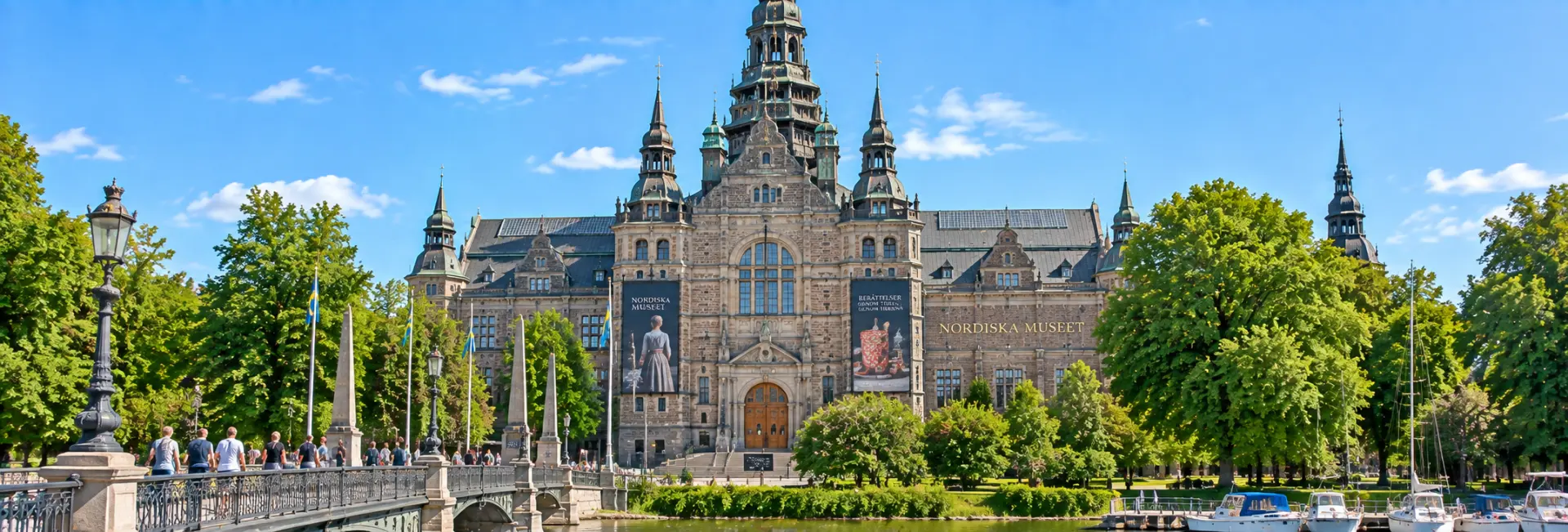
The building itself is as much a draw as what's inside it: a Renaissance-inspired landmark visible for miles around Stockholm, built to house what its founder hoped would become a national monument to Swedish and Nordic identity. Even visitors who only glance through the main hall come away with a sense of the ambition behind the project.
History of the Museum
A Collector's Mission
The museum traces its origins to 1872, when the teacher and folklorist Artur Hazelius began traveling the Swedish countryside to gather objects from a rural culture he feared was disappearing under industrialization. The following year, on October 24, 1873, his collection opened to the public as the Scandinavian Ethnographic Collection at Drottninggatan 71 in central Stockholm.
From Collection to National Museum
The collection grew quickly, and by 1880 Hazelius had established the Nordiska museet foundation to give the project a permanent institutional home. Hazelius envisioned a building grand enough to match the ambition of the collection, describing his hope that a visit to the future museum would evoke a powerful, almost sacred atmosphere. Neither Hazelius nor his wife Sofi, who supported the project in its early years, lived to see it completed: Sofi died in 1874, and Artur passed away in 1901, six years before the museum's inauguration.
Nearly Twenty Years to Build
Construction began in 1888 on land donated on Djurgården, but funding constraints meant the building went up in stages: the northern section was completed in 1897, the southern part and central section by 1904, and the central tower and portal last of all. The finished museum was formally inaugurated on a rainy day in June 1907, though it was ultimately built at a fraction of the size Hazelius had originally envisioned, which called for a structure three times as large.
Architecture & Building
The museum building was designed by the Swedish architect Isak Gustaf Clason in a Nordic Renaissance style, drawing direct inspiration from Danish royal castles, particularly Kronborg and Frederiksborg. Its exterior stretches 153 meters long, with a central tower rising 81 meters, giving the building a fortress-like silhouette that remains visible from across Stockholm's waterways.
Inside, the building's Great Hall is one of the largest non-religious rooms in Sweden, running 126.5 meters long, 24 meters high, and 15 meters wide. The materials reflect a similarly national ambition: granite from Sundbyberg forms the foundation, the frame is built from brick, and the walls are faced with sandstone from Roslagen, with window surrounds and pilasters carved from limestone quarried in Öland, Gotland, and Västmanland. A statue of King Karl X Gustav stands outside the main entrance, added in 1917, a decade after the building opened. Since 2008, the museum has been formally protected as a cultural heritage site under Swedish law.
Collections & Exhibits
A Collection Spanning Five Centuries
The museum's holdings cover Swedish and Nordic life from the 16th century onward, spanning furniture and interiors, fashion and jewelry, glass and porcelain, folk art, and photography. The very first object Hazelius collected, a wool skirt from Dalarna gathered in 1872, remains part of the collection today, a modest starting point for what has grown into more than 1.5 million objects.
Sami Culture and the Arctic
A dedicated exhibition explores the culture, history, and present-day identity of the Sami, the indigenous people of the Nordic region, an area of interest Hazelius pursued from the museum's earliest years. A related exhibition, built around a walk-through mock-up of a giant iceberg, examines life and change across the wider Arctic through objects, film, and art.
Everyday Life in Miniature and in Full Scale
The Great Hall displays a collection of historic dolls' houses spanning from a rococo-style example built in 1760 to a mass-produced house from the 1990s, offering a scaled-down view of how domestic life and taste changed across two centuries. Alongside them sits a full-scale reconstructed 1940s flat and a realistic 1890s farmhouse used as a children's playhouse.
- Sami cultural and historical objects, including bridal crowns and ceremonial silver
- Historic dolls' houses spanning the 18th to 20th centuries
- Fashion and textile collections, including archives of historic fashion magazines
- Photography holdings running to roughly seven million images
Must-See Highlights
The Great Hall itself is worth pausing in regardless of which temporary exhibition is running, both for its sheer scale and for smaller architectural details easy to miss on a quick pass through, such as a carved sleeping bear worked into the balustrade and peasant figures depicted on one of the stairwell's pillars.
A monumental statue of King Gustav Vasa, founder of the modern Swedish state, dominates the far end of the Great Hall, anchoring the building's original ambition to serve as a monument to Swedish national identity. For those interested in Swedish literature, the museum also holds the world's largest collection of paintings by August Strindberg, alongside a number of his personal possessions.
Ways to Experience It
Most visitors explore the museum independently, moving between the Great Hall and the surrounding galleries at their own pace. A thorough visit, taking in several exhibitions rather than just the highlights, typically takes at least two hours.
- Free audio guides, available in eleven languages, downloadable directly to a visitor's phone
- Guided tours for a more structured introduction to the building and collection
- A children's playhouse built as a realistic 1890s farmhouse, with an additional fee
- A museum restaurant serving traditional Swedish food and fika alongside the exhibitions
- A museum shop offering both classic and contemporary Swedish gifts and souvenirs
Best Time to Visit
The museum keeps longer hours on Wednesdays, open until around 8pm rather than its usual early evening closing time, making it a practical choice for an after-work or late-afternoon visit. Weekday mornings tend to be quieter than weekend afternoons, particularly during the busy summer tourist season.
Because Djurgården is home to several other major museums, including the Vasa Museum directly nearby, timing a visit for earlier in the day can help avoid the crowds that build up around the island's most popular attractions as the afternoon goes on.
Visitor Tips
Children under 18 are admitted free, making the museum a practical stop for families, though the separate children's playhouse carries its own small fee. The building is wheelchair accessible, with an accessible entrance to the right of the main entrance on Djurgårdsvägen, elevators to the exhibition floors, and accessible restrooms near the museum shop.
- Download the free audio guide in advance if possible, since it adds significant context to the exhibits
- Budget at least two hours to see more than a quick highlights pass
- Combine a visit with the neighboring Vasa Museum, since both sit within a short walk of each other on Djurgården
- Parking near the museum is limited, so public transport, the Djurgården ferry, or the tram line are generally more practical
- Note that Djurgårdsbron, the bridge onto the island, is occasionally closed to cars, which can affect driving routes
Nearby Attractions
The museum's location on Djurgården places it within easy walking distance of several of Stockholm's other leading museums and attractions.
- Vasa Museum - directly nearby, home to the salvaged 17th-century warship Vasa
- Skansen - the open-air museum and zoo originally founded by the same collector, Artur Hazelius
- ABBA The Museum - a short walk away, dedicated to Sweden's best-known pop group
- Biologiska museet - a small museum of taxidermied Nordic wildlife dioramas nearby on Djurgården
FAQs about visiting the Nordic Museum
What is the Nordic Museum known for? +
It's Sweden's largest museum of cultural history, known for its collection of more than 1.5 million objects spanning Swedish and Nordic life from the 16th century to today, housed inside a grand Renaissance-style building.
Who founded the Nordic Museum? +
It was founded by Artur Hazelius, a Swedish teacher and folklorist who also founded the open-air museum Skansen nearby.
How long should I plan for a visit? +
Most visitors spend at least two hours to see the main exhibitions properly, though the building and collection are large enough to fill a full afternoon.
Is the Nordic Museum free to visit? +
Children under 18 are admitted free, though adult admission carries a standard ticket price; the separate children's playhouse has its own small fee.
Is the museum accessible for visitors with mobility needs? +
Yes - it has an accessible entrance, elevators to the exhibition floors, accessible restrooms, and wheelchairs available to borrow on request.
How do I get to the Nordic Museum? +
It's reachable by bus, the Djurgården tram line, or ferry, and it's a short walk from Karlaplan metro station or from the Djurgårdsbron bridge.
What's the connection between the Nordic Museum and Skansen? +
Both were founded by Artur Hazelius and were originally run as a single institution, before becoming independent museums in 1963.
What's nearby if I want to see more of Djurgården? +
The Vasa Museum, Skansen, and ABBA The Museum are all within easy walking distance, making it simple to combine a Nordic Museum visit with other Djurgården attractions.