
Table of Contents
Overview
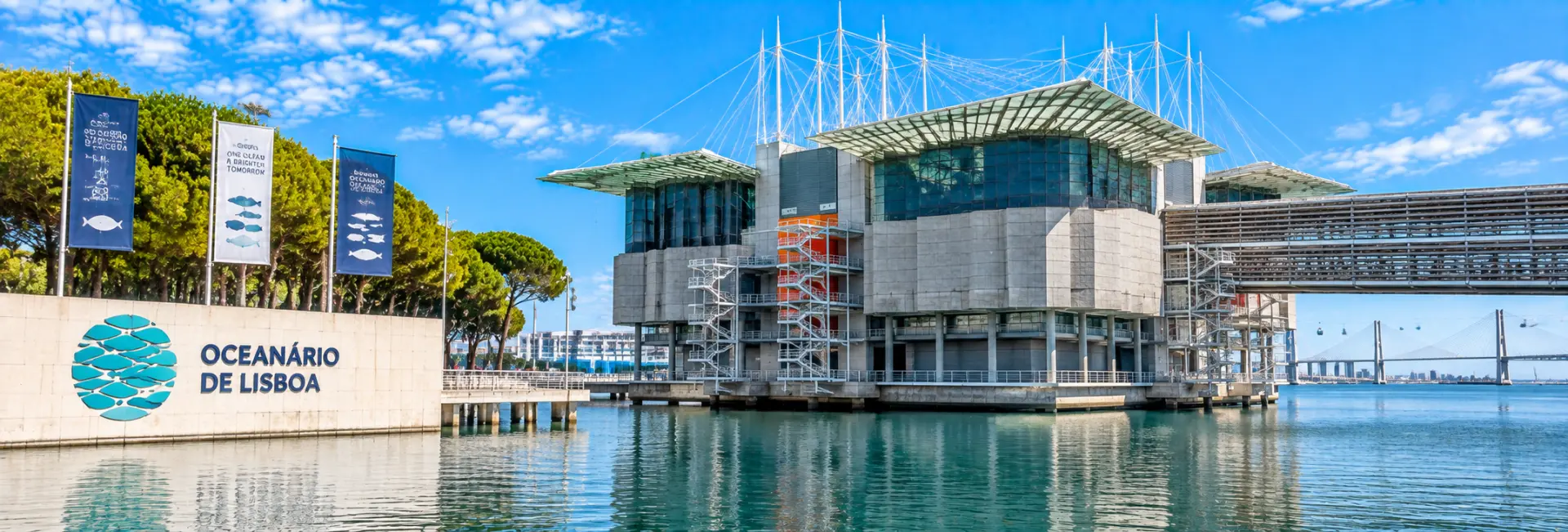
The Oceanário de Lisboa is the city's aquarium and one of the most visited paid attractions in Portugal. It sits out on the water in Parque das Nações, the riverside district north-east of the centre, in a building that appears to float in its own dock and is reached by a footbridge.
What sets it apart is its layout. Rather than a corridor of separate tanks, the whole building is organised around one enormous central tank of open ocean, with four recreated coastal habitats arranged around it. Because the dividing acrylic panels are nearly invisible from certain angles, the effect is of a single continuous sea shading from Antarctic rock into tropical reef.
The collection runs to many thousands of animals and plants across more than 450 species, from sharks and rays down to seahorses, jellyfish and garden eels. Penguins, sea otters and the resident sunfish are the crowd favourites. It is a reliably good destination in bad weather, which matters in a city where most sights are outdoors, and it works equally well for families and for adults with no particular interest in fish.
History
Built for Expo '98
The Oceanário was created as the centrepiece of Expo '98, the world exposition Lisbon hosted in 1998 on the theme of the oceans, timed to mark five centuries since Vasco da Gama's sea route to India. The exposition was deliberately sited on a derelict industrial stretch of riverfront, and the aquarium was the anchor building of the whole regeneration scheme.
Life after the exposition
Many world's fair pavilions are dismantled once the crowds go home. The Oceanário was designed from the outset to outlive the event, and it reopened as a permanent public attraction, becoming the reason many visitors travel out to Parque das Nações at all. The surrounding grounds were converted into a residential and business district, with the aquarium as its best-known landmark.
Growth and recognition
A second building opened alongside the original in 2011 to house temporary exhibitions, roughly doubling the institution's exhibition space. Over the decades since opening, the Oceanário has drawn tens of millions of visitors and has repeatedly been ranked among the world's leading aquariums in traveller surveys. Alongside display, it runs marine conservation programmes, education work for schools, and research partnerships focused on ocean habitats and endangered species.
Architecture & Building
The original building was designed by the American architect Peter Chermayeff, a specialist in aquarium design. It stands on piles in the Doca dos Olivais, surrounded by water on all sides and linked to the promenade by a bridge, so arriving already feels like going out to sea. The exterior is sharp and geometric, with pale cladding and angular roof planes that read from a distance as something between a ship and an offshore platform.
Inside, the organisation is unusually clear for a building of this scale. Visitors move on two levels around the central tank:
- The upper level presents the habitats at and above the waterline, with air, rock, vegetation and the animals that live between sea and land.
- The lower level takes the same habitats underwater, so each environment is seen twice from two completely different perspectives.
The route is a loop, which means there is no backtracking and no sense of being funnelled. The second building, added in 2011, sits beside the first and is used for temporary exhibitions; it has a very different character, with a green, planted exterior designed to contrast with the original structure rather than imitate it.
The Global Ocean Tank
The heart of the aquarium is a single vast tank representing the open ocean. It holds roughly five million litres of seawater, covering about a thousand square metres, and it is deep enough that the animals in it behave much as they would at sea rather than circling a small enclosure.
Species you are likely to see here include:
- Sharks, including large rays cruising near the glass
- Shoals of barracuda and tuna moving in tight formation
- Ocean sunfish, the strange disc-shaped mola that is one of the aquarium's signature residents
- Smaller schooling fish that concentrate and scatter as predators pass through
The design trick that makes the whole visit work is the way this tank is viewed. Acrylic panels separate it from the surrounding habitats, but the joins are engineered to be as invisible as possible, so a visitor standing in the Antarctic section looks past the penguins into open blue water full of sharks. The intended message is straightforward: the ocean is one connected body of water, not a set of separate seas.
Benches face the largest viewing windows, and most people end up sitting longer than they planned.
The Four Habitats
Four coastal environments are recreated in the corners around the central tank, each with its own temperature, light and animal life, and each visible from both the upper and lower floors.
North Atlantic rocky coast
Cold, grey and splashed by a wave machine, this section recreates a northern shoreline with rock pools, seabirds and the kind of hardy species found along Europe's exposed western coasts. It is the habitat closest to Portugal's own waters.
Antarctic coastline
The Antarctic section is usually the loudest, thanks to its colony of penguins moving between ice-coloured rock and the water below. Watching them from the lower level, transformed from clumsy on land to fast and precise underwater, is one of the sharpest contrasts in the building.
Temperate Pacific kelp forest
Here tall strands of kelp sway in an engineered current, forming a dim, shifting forest. This is the home of the sea otters, which are reliably the most popular animals in the aquarium and among the most active.
Tropical Indian Ocean coral reef
The warmest and most colourful of the four, dense with coral, anemones and small reef fish. It is the section where the difference between the upper and lower viewpoints is most striking, moving from a planted tropical shore to a crowded reef wall below.
Other Highlights and Temporary Exhibitions
Beyond the main circuit, a series of smaller displays are arranged along the route, and these are easy to rush past if you are heading straight for the big tank.
- Seahorses and sea dragons, displayed in dim, quiet tanks that reward patience
- Jellyfish cylinders lit to show their movement, usually a highlight for children
- Garden eels standing upright out of the sand and retracting as people approach
- Tropical species including lionfish and brightly patterned reef dwellers
The separate exhibition building hosts changing shows that are typically included in the standard ticket. Its best-known occupant was "Forests Underwater by Takashi Amano", installed in 2015 by the Japanese aquascaping master and described as the world's largest nature aquarium: a forty-metre freshwater tank of tropical plants, driftwood and volcanic rock, with a commissioned soundtrack, which ran far beyond its planned three years and drew millions of visitors before closing.
Because this building's programme rotates, it is worth checking what is currently on show before booking, as the temporary exhibition can meaningfully change the character of a visit.
Ways to Experience It
The standard visit is self-guided along the fixed loop, and most people cover it comfortably in around ninety minutes to two hours, though it is easy to spend longer.
- Standard admission, covering the permanent circuit and usually the current temporary exhibition
- Audio guides in several languages, useful for context on individual species and habitats
- Guided and behind-the-scenes tours, booked in advance, which take small groups above the tanks to see filtration, feeding preparation and daily maintenance
- Sleepovers and children's programmes, where groups spend a night beside the central tank
- Marine biology workshops and school sessions run by the education team
Feeding times are posted at the entrance and are worth planning around, particularly for the otters and penguins, when keepers often explain what visitors are watching.
The Oceanário is included on the Lisboa Card, and combination tickets are frequently sold with nearby attractions and with the cable car that runs along the waterfront. Current hours, ticket prices, exhibition programme and any timed-entry requirements should be confirmed on the official site before travelling, as these are adjusted seasonally.
Best Time to Visit
Time of day
The first hour after opening is by a clear margin the quietest. School groups and family traffic build through the late morning, and mid-afternoon on a weekend or a rainy day is the busiest the building gets. The last two hours before closing are a good alternative if mornings do not suit, since day-trippers tend to have moved on.
Day and season
Weekdays outside Portuguese school holidays are calmer than weekends. Summer brings the largest numbers, with the aquarium doubling as a refuge from the heat, and wet winter days produce similar surges for the opposite reason. Spring and autumn weekday mornings are close to ideal.
Unlike most Lisbon attractions, the Oceanário is entirely weatherproof, which makes it the obvious thing to reschedule into a day the forecast has ruined. Booking a timed slot online in advance is strongly advisable in peak season, when the ticket queue outside can be long even though the building absorbs crowds well once you are inside.
Visitor Tips
- Allow roughly two hours, and more if you are travelling with children who will stop at every tank.
- Do the full upper loop before descending. Seeing each habitat above water first makes the underwater level far more interesting, and the route is designed to be walked in that order.
- The building is fully accessible, with lifts between levels and step-free routes throughout, including the bridge from the promenade.
- Lighting is deliberately low and flash photography is discouraged, so a phone in night mode will do better than a flash.
- Strollers are manageable but the viewing windows get crowded; a carrier can be easier at peak times.
- There is a café and a large shop on site, and plenty of restaurants a few minutes away in the Vasco da Gama centre if you would rather eat outside.
- Getting there is simple: take the metro red line to Oriente, then walk about ten minutes through the park or along the riverfront promenade. Numerous bus routes and suburban trains also serve Oriente station.
Nearby Attractions
Parque das Nações is compact and pedestrian-friendly, so the aquarium pairs easily with the rest of the district in a single half-day or full day.
- Pavilhão do Conhecimento: a hands-on science museum a short walk away, the natural companion visit for families.
- Telecabine Lisboa: the cable car running along the waterfront above the park, giving views over the Tagus and the aquarium itself.
- Vasco da Gama Bridge: visible from the promenade, one of the longest bridges in Europe, best seen at dusk.
- Gare do Oriente: Santiago Calatrava's dramatic station, worth five minutes on the way in or out for its canopy of branching steel columns.
- Jardim Garcia de Orta: riverside gardens planted with species from Portugal's former overseas territories.
- Centro Vasco da Gama: a large shopping centre next to the station, useful for meals and shelter.
A practical plan is to reach Oriente early, do the Oceanário first while it is quiet, then spend the rest of the day working slowly along the waterfront.
FAQs about visiting the Oceanário de Lisboa
What is the Oceanário de Lisboa? +
It is Lisbon's aquarium, built in Parque das Nações as the centrepiece of the 1998 world exposition and kept as a permanent attraction. It is organised around one enormous central ocean tank ringed by four recreated coastal habitats.
How long does a visit take? +
Most visitors spend between ninety minutes and two hours on the main circuit. Families, or anyone who sits down in front of the central tank, can easily stretch that to three.
Do I need to book tickets in advance? +
Tickets are sold at the door, but booking online is worth it in summer, at weekends and on rainy days, when queues at the entrance build. Online booking also lets you pick a time slot.
Is it suitable for young children? +
Very much so. The scale of the tanks holds children's attention, the otters and penguins are consistently popular, and the loop route means no backtracking with tired legs. Strollers are fine, though the viewing windows get crowded at peak times.
Is the aquarium accessible for wheelchair users? +
Yes. Lifts connect the two levels and the route is step-free throughout, including the bridge from the promenade.
What is the best time of day to go? +
As soon as it opens is the quietest by a wide margin. Late afternoon is the next best option, once school groups and day-trippers have moved on.
How do I get there by public transport? +
Take the metro red line to Oriente, then walk roughly ten minutes through Parque das Nações or along the river. Oriente is also a major bus and suburban rail hub.
Is it worth visiting in bad weather? +
It is one of the best wet-weather options in Lisbon, since the entire visit is indoors. That also makes it busier than usual when it rains, so arrive early if you can.
What else is there to do nearby? +
Parque das Nações has the Pavilhão do Conhecimento science museum, the waterfront cable car, views of the Vasco da Gama Bridge, riverside gardens and the Gare do Oriente station, all within walking distance.
Are there guided or behind-the-scenes options? +
Yes. Pre-booked guided tours and behind-the-scenes sessions take small groups above the tanks to see how the animals are fed and the water systems are maintained, and the aquarium also runs sleepovers and workshops.
