
Table of Contents
Overview
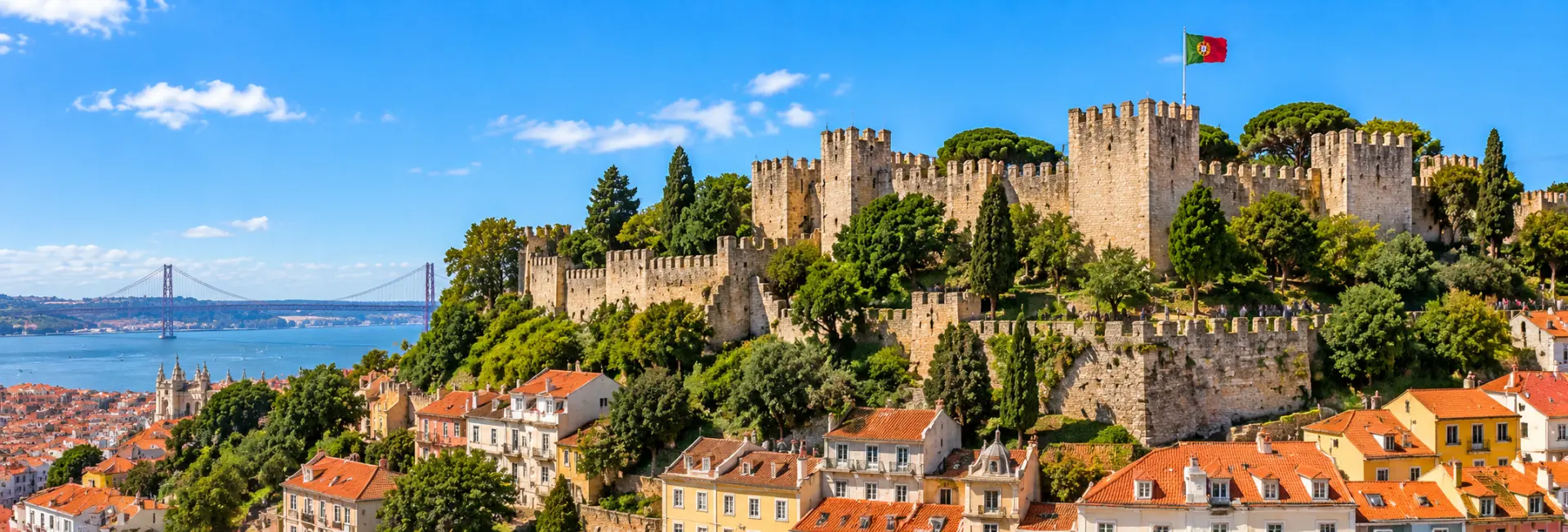
São Jorge Castle crowns the highest hill in central Lisbon, looking out over the Alfama district, the Baixa grid, and the Tagus River beyond. Long before it took its present form, the hilltop had already served as a defensive point for a string of different rulers, and the fortress visitors walk through today reflects that layered history as much as any single building period.
Rather than a polished medieval showpiece, the castle is best understood as a walkable archaeological site: sections of Moorish-era wall, a rebuilt royal residence, and open courtyards where peacocks now roam sit alongside sweeping viewpoints that make it one of the most visited spots in Lisbon.
History
From Iron Age Hilltop to Moorish Citadel
People have occupied this hill for millennia, with fortified structures on the site dating back roughly to the 2nd century BC, built and reused in turn by Phoenicians, Carthaginians, Romans, and Visigoths. The fortress took on a more defined citadel form under Moorish rule, when a defensive circuit sometimes called the Moorish encirclement was raised around the hilltop, forming the core that later medieval builders would adapt and expand.
Conquest and Royal Residence
In 1147, King Afonso Henriques, Portugal's first king, captured the fortress from the Moors after a siege lasting several months, with support from northern European crusaders passing through on their way to the Holy Land. The victory was a turning point in the broader Reconquista and gave Lisbon's new Christian rulers a stronghold at the heart of the city. When Lisbon became the kingdom's capital in 1255, the castle was adapted into the alcáçova, a fortified royal residence, and later Portuguese kings expanded it further, adding a grand royal palace that housed the monarchy until the early 16th century.
Decline, Earthquake, and Restoration
As royal life shifted elsewhere in Lisbon in the 16th century, the castle's role changed too, serving over the following centuries as a military barracks, a prison, and briefly the home of Portugal's national archive. The catastrophic 1755 Lisbon earthquake left much of the site in ruins, and for a long stretch afterward the castle stood only partially rebuilt. Serious restoration did not begin until the 20th century, when a major government project between 1938 and 1940 removed later additions, reconstructed damaged sections, and gave the castle much of the appearance visitors see today. It was declared a Portuguese national monument in 1910, and responsibility for the site later passed to Lisbon's municipal government.
Architecture & Layout
Walls, Towers, and Courtyards
The castle follows a roughly quadrangular layout typical of medieval Iberian fortresses, with thick stone walls, an elbow-shaped gateway designed to slow attackers, and a series of towers spaced along the perimeter. Much of what stands today is the product of the 20th-century restoration rather than untouched medieval fabric, which means the walls and battlements are best understood as a careful reconstruction of the castle's historical form rather than an unbroken original structure.
The Alcáçova and Archaeological Remains
Within the walls lie the remains of the Paço da Alcáçova, the royal residence expanded by successive kings and largely lost after the 1755 earthquake. Ongoing archaeological work on the site has uncovered layers of occupation stretching from the Iron Age through the Moorish and medieval periods, with finds displayed near the excavation areas so visitors can see the different eras stacked on top of one another.
Notable Features
The castle rewards slow exploration, and a few features stand out from the rest of the grounds.
- The keep and towers - eleven towers dot the perimeter walls, several open for visitors to climb for wider views
- The ramparts walk - a walkway along the walls with sweeping views over the Alfama rooftops and the Tagus River
- Peacocks and gardens - resident peacocks wander the shaded courtyards, a detail that has become part of the castle's identity for visiting families
- Archaeological site - excavated remains near the old royal palace, showing traces of the hill's earlier occupants
- Statue of Afonso Henriques - a bronze monument near the main gate honoring the king who conquered the castle in 1147
Recognition & Status
São Jorge Castle was declared a Portuguese national monument in 1910, recognizing its long role in the city's defense and its place in the story of Lisbon's founding as a Christian capital. Unlike some of Lisbon's other major monuments, it is not part of a UNESCO World Heritage inscription, though it remains one of the most visited historic sites in the city.
- Portuguese National Monument, designated 1910
- Managed today by Lisbon's municipal government
- One of the most visited attractions in the city, drawing well over a million visitors a year
Ways to Experience It
Most visitors spend a couple of hours wandering the grounds at their own pace, moving between the towers, the archaeological site, and the viewpoints along the walls.
- Self-guided visit - explore the towers, ramparts, gardens, and archaeological remains freely with an entry ticket
- Guided tours - available in several languages for visitors who want more context on the site's layered history
- Audio guides - a self-paced option that covers the castle's main points of interest
- Exterior and grounds - the surrounding Castelo and Alfama neighborhoods offer castle views without an entry ticket, for visitors short on time
Best Time to Visit
The castle sits high above the city, so both the crowds and the light change noticeably through the day and across the seasons.
- Early morning, close to opening, tends to have the shortest lines and the coolest temperatures
- Late afternoon brings softer light for photographs over the rooftops of Alfama
- Summer midday draws the largest crowds, especially on weekends
- Spring and autumn offer milder weather with somewhat thinner crowds than peak summer
Visitor Tips
The castle grounds are large and uneven in places, so a little preparation makes the visit more comfortable.
- Wear comfortable, sturdy shoes, since the ramparts and archaeological areas involve stairs and uneven surfaces
- Book tickets online in advance during peak season to cut down on time spent queuing
- Bring water and sun protection, as much of the site is open with little shade
- Accessibility is mixed - the gardens and main courtyard are easier to reach, while the towers and ramparts require stairs
- Check current opening hours and ticket prices before visiting, since these can change seasonally
Nearby Attractions
São Jorge Castle sits at the heart of the historic Alfama and Castelo neighborhoods, within easy reach of several of Lisbon's other landmarks.
- Lisbon Cathedral (Sé de Lisboa) - a short walk downhill, one of the city's oldest churches
- Alfama district - Lisbon's oldest neighborhood, known for its narrow lanes and fado music
- Miradouro de Santa Luzia - a nearby viewpoint over the rooftops and river
- Praça do Comércio - the grand riverside square in central Lisbon, a walk or tram ride away
- Tram 28 route - the historic tram line that passes near the castle through several of Lisbon's oldest districts
FAQs about visiting São Jorge Castle
What is São Jorge Castle and why is it famous? +
It's a historic hilltop fortress in central Lisbon with roots going back to antiquity, best known as the site where King Afonso Henriques captured the city from the Moors in 1147. It's famous today for its sweeping views over Lisbon and the Tagus River as much as for its long history.
How much time do I need to visit? +
Most visitors spend one and a half to two hours exploring the towers, gardens, and archaeological areas at a relaxed pace.
Do I need to book tickets in advance? +
It's a good idea, especially in peak season, since the castle is one of Lisbon's most visited attractions and queues can build up by mid-morning.
Is São Jorge Castle suitable for kids? +
Yes - the open courtyards, towers to climb, resident peacocks, and archaeological site tend to appeal to children, though some areas involve stairs and uneven ground.
Is the castle accessible for visitors with mobility issues? +
Only partly. The gardens and main courtyard are relatively accessible, but the ramparts and towers involve stairs and uneven surfaces with no elevator alternative.
What's nearby that's worth combining with a visit? +
Lisbon Cathedral, the Alfama district, and the Miradouro de Santa Luzia viewpoint are all within easy walking distance, and the historic Tram 28 route passes close by.
Is São Jorge Castle open every day? +
Yes, it's generally open daily, though hours shift between summer and winter, so it's worth checking the current schedule before visiting.
