
Table of Contents
Overview
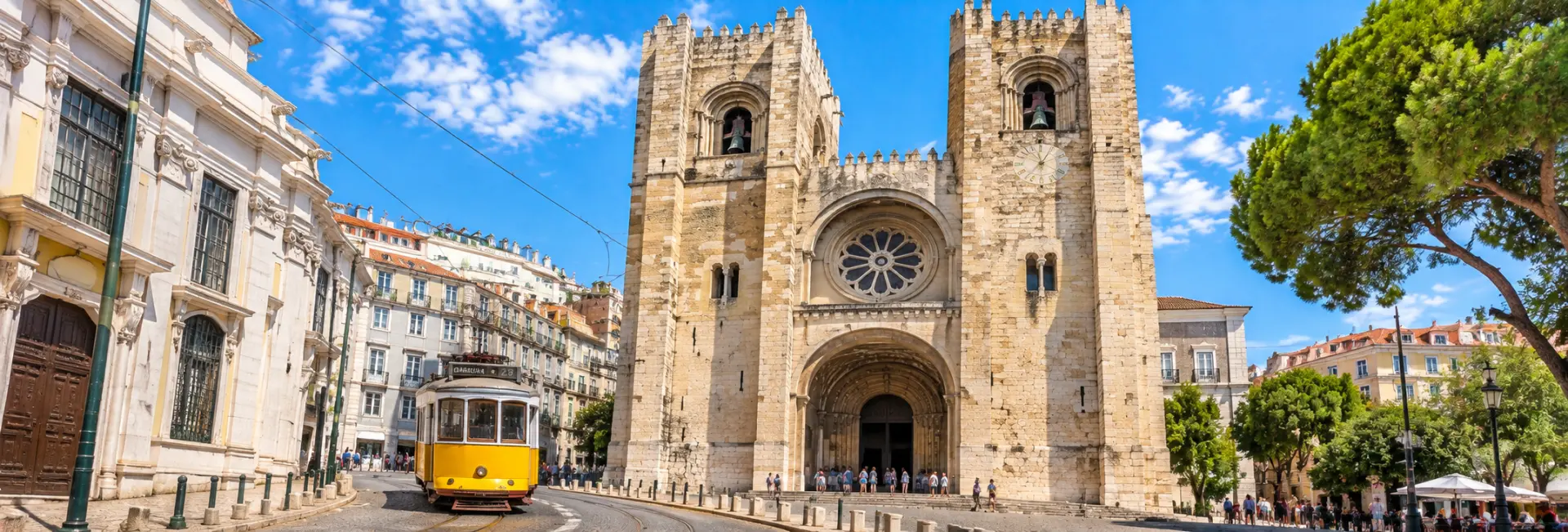
Lisbon Cathedral, known locally as the Sé, is the oldest church in the city, its fortress-like Romanesque towers rising over the narrow streets at the edge of Alfama. It was founded in 1147, in the same year a Christian army captured Lisbon from Moorish rule, and it has stood on the site ever since, through repeated earthquakes, rebuildings, and changes in style.
Part active church, part layered archaeological site, the Sé combines a solemn Romanesque nave with a Gothic cloister built over the remains of an earlier mosque, and it remains the seat of the Patriarchate of Lisbon to this day.
History
Built on Sacred Ground
The cathedral stands on a site with a long religious history: archaeological work beneath the building has revealed traces of a Visigothic-era Christian temple, later replaced by a mosque built during the centuries of Moorish rule in Lisbon. When King Afonso Henriques captured the city in 1147 with the support of crusaders passing through on their way to the Holy Land, construction of a new cathedral began almost immediately on the same spot, overseen by Gilbert of Hastings, an English crusader appointed the city's first bishop. The original Romanesque church, credited to the master builder Roberto, took its fortress-like form in the following decades.
Gothic Additions and a Royal Pantheon
Over the following two centuries, the cathedral grew and changed. King Denis commissioned a Gothic cloister in the late 13th century, built directly over the ruins of the earlier mosque. In the 14th century, King Afonso IV added a Gothic apse and ambulatory to receive pilgrims and to serve as a royal pantheon for his family, work that continued into the reign of King João I. A Mannerist sacristy followed in the 17th century, layering yet another architectural style onto the building.
Earthquakes and Restoration
The cathedral has been damaged by earthquakes more than once, including tremors in 1344 and 1356, but the 1755 Lisbon earthquake caused the most severe destruction, collapsing the Gothic chancel, part of the nave roof, and one of the facade's towers. Reconstruction stretched over subsequent decades, and in the early 20th century a further restoration deliberately stripped away several later Baroque additions in an effort to recover the cathedral's older Romanesque and Gothic character. It was declared a Portuguese national monument in 1910.
Architecture & Design
The cathedral's west facade is famously fortress-like, flanked by two crenellated towers that give it a defensive silhouette more typical of a castle than a church, a style shared with other cathedrals built in Portugal soon after the Reconquista. Rounded Romanesque arches and sculpted column capitals soften the severity of the facade on closer inspection, and a large rose window, carefully rebuilt in the 20th century using surviving fragments after the original was destroyed in 1755, dominates the entrance.
Inside, the nave keeps much of its original Romanesque character, with barrel vaulting and a solid, weighty feel, while the later Gothic apse and ambulatory add a lighter, more open architectural language toward the rear of the building. The result is a structure that visibly layers Romanesque, Gothic, and Baroque work across nearly nine centuries of construction and repair.
Notable Features
A visit to the Sé takes in both the working church and the archaeological remains uncovered around it.
- The baptismal font - traditionally said to be where Saint Anthony of Padua, born nearby in 1195, was baptized
- Relics of Saint Vincent - the remains of Lisbon's patron saint, brought to the cathedral in the 12th century and still kept here
- The Gothic cloister - built over the ruins of the earlier mosque, with ongoing archaeological excavations visible in the courtyard
- The rose window - a large Romanesque-style window on the west facade, reconstructed after the 1755 earthquake
- The Treasury - a small museum housing ecclesiastical artifacts, vestments, and sacred art collected over the centuries
Recognition & Status
Lisbon Cathedral has been formally protected as a Portuguese national monument since 1910, in recognition of its role as the city's oldest church and one of the most significant examples of Romanesque architecture on the Iberian Peninsula. It remains an active place of worship and the seat of the Patriarchate of Lisbon.
- Portuguese National Monument, designated 1910
- The oldest church in Lisbon, founded in 1147
- Seat of the Patriarchate of Lisbon and an active Roman Catholic cathedral
Visiting Etiquette & Tips
As an active place of worship, the Sé calls for a slightly different approach than a purely secular monument.
- Dress modestly, covering shoulders and knees, as is customary when visiting a working cathedral
- Keep voices low and be mindful during services, which take priority over sightseeing
- Entry to the main nave is generally free, while the cloister and treasury typically require a separate, modestly priced ticket
- Photography is usually allowed in the nave, but flash and photography during services should be avoided
- Check current opening hours before visiting, since these differ between weekdays and Sundays
Best Time to Visit
The cathedral can be visited year-round, and its relatively small size means crowding is less of an issue than at some of Lisbon's larger monuments.
- Weekday mornings tend to be the quietest time to visit
- Midday light works well for viewing the rose window from inside the nave
- Sundays have more limited visiting hours due to services, so plan accordingly
- Pairing a visit with an early exploration of the nearby Alfama streets avoids the busiest midday tourist flow
Nearby Attractions
The Sé sits at the edge of Alfama, Lisbon's oldest neighborhood, and within easy reach of several other major sights.
- São Jorge Castle - a walk uphill through Alfama's narrow streets
- Alfama district - Lisbon's oldest neighborhood, known for its winding lanes and fado music
- Igreja de Santo António - a small church built near Saint Anthony's birthplace, close to the cathedral
- Praça do Comércio - Lisbon's grand riverside square, a short walk downhill
- Miradouro das Portas do Sol - a nearby viewpoint over the Alfama rooftops and the river
FAQs about visiting Lisbon Cathedral
What is Lisbon Cathedral and why is it famous? +
It's the oldest church in Lisbon, founded in 1147 on the site of an earlier mosque shortly after the city's conquest from Moorish rule. It's known for its fortress-like Romanesque facade, its relics of Saint Vincent, and its layered history spanning nearly nine centuries.
Is entry to the cathedral free? +
The main nave is generally free to enter, while the cloister and treasury usually require a separate ticket.
How much time do I need to visit? +
Most visitors spend 30 to 45 minutes in the nave, cloister, and treasury combined, though a quick look at the nave alone can take much less time.
Is it true Saint Anthony was baptized here? +
Tradition holds that the cathedral's baptismal font was used to baptize Saint Anthony of Padua in 1195, since he was born just a short distance away.
What happened to the cathedral in the 1755 earthquake? +
The earthquake destroyed part of the Gothic chancel, the roof of the nave, and one of the facade's towers. Much of what is visible today reflects reconstruction carried out in the following decades and a further restoration in the early 20th century.
What's nearby that's worth combining with a visit? +
São Jorge Castle, the Alfama district, and the Miradouro das Portas do Sol viewpoint are all within easy walking distance, and Praça do Comércio is a short walk downhill.
Is Lisbon Cathedral still an active church? +
Yes, it remains the seat of the Patriarchate of Lisbon and holds regular religious services, which take priority over sightseeing during visiting hours.
