
Table of Contents
Overview
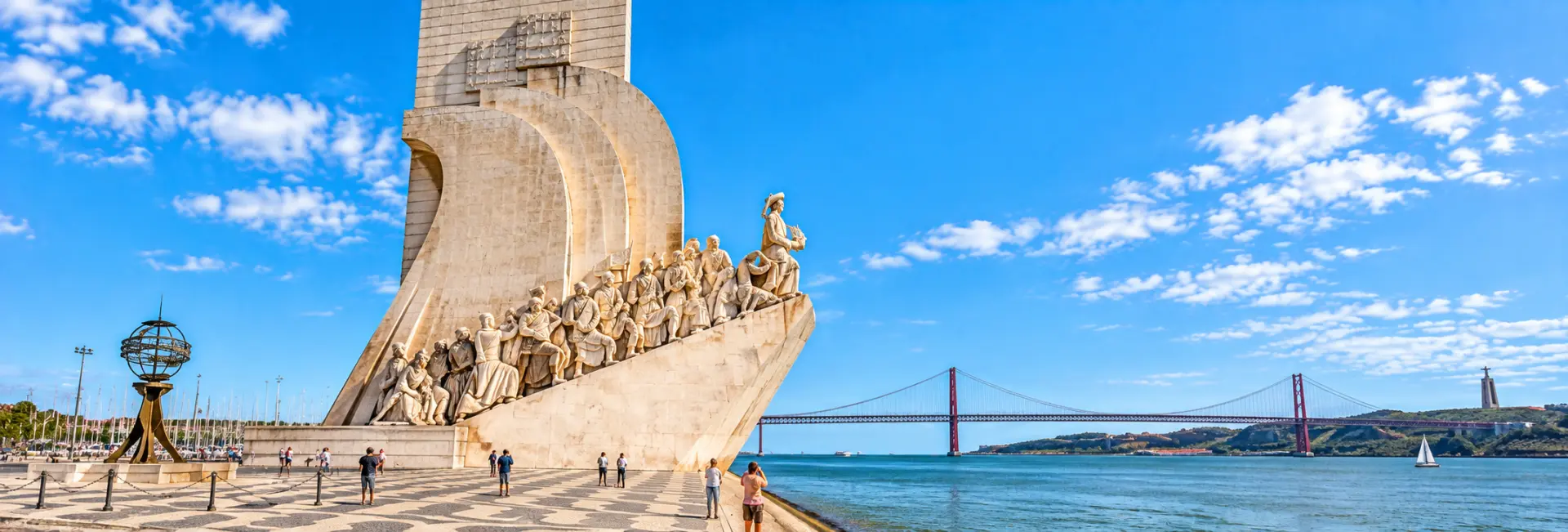
The Monument to the Discoveries rises from the Belém waterfront in the shape of a stylized caravel, its stone prow pointed toward the mouth of the Tagus and the Atlantic beyond. A procession of carved figures lines both sides of the structure, led by Prince Henry the Navigator, commemorating the Portuguese sailors, cartographers, and monarchs associated with the country's 15th and 16th-century voyages of exploration.
Rather than a centuries-old relic, the monument in its permanent form dates only to 1960, making it one of the newer major landmarks in an area otherwise dominated by 16th-century buildings. It remains one of the most photographed sights in Belém, both for its dramatic silhouette and for the panoramic view from its rooftop terrace.
History
A Temporary Centerpiece for the 1940 Exhibition
The monument's design originated in 1939, when architect Cottinelli Telmo and sculptor Leopoldo de Almeida were commissioned to create a landmark for the Portuguese World Exhibition, a major event staged in Belém in 1940 to showcase the country's history under the Estado Novo regime of António de Oliveira Salazar. The first version of the monument was built from plaster, gypsum, and timber over a light iron frame, never intended to last beyond the exhibition, and it was dismantled in 1943.
Rebuilding in Stone
The site stood empty for more than a decade before the Portuguese government approved a permanent monument in 1958 to mark the upcoming 500th anniversary of the death of Prince Henry the Navigator. Following Cottinelli Telmo's death in 1948, architect António Pardal Monteiro adapted the original design for reconstruction in concrete, pink Leiria stone, and Sintra limestone sculptures. The rebuilt monument was officially inaugurated on 9 August 1960.
From Monument to Cultural Center
In 1985, the interior was remodeled to create the Centro Cultural das Descobertas, adding an exhibition hall, auditorium, and public access to the rooftop viewing platform. Because the monument was conceived under an authoritarian regime that used the Age of Discovery to promote a romanticized national narrative, it has drawn ongoing debate in recent decades over how it frames Portugal's colonial history and whose perspectives it leaves out, discussions that continue to shape how the site is presented today.
Architecture & Design
The monument takes the form of a caravel under sail, roughly 52 meters tall, with two long ramps of carved figures rising along its eastern and western sides as if walking toward the bow. At the front stands Prince Henry the Navigator, facing the river, followed by a procession of some 30 figures representing navigators, monarchs, cartographers, missionaries, and chroniclers associated with Portugal's maritime expansion.
In front of the monument, set into the pavement, is a large compass rose made of colored stone and marble, a gift from South Africa, with a map at its center tracing the routes of Portuguese explorers. The structure's straight lines and monumental scale reflect the modern classicist style favored for major public works during the period of its design.
Notable Features
A visit typically takes in both the exterior sculpture and the interior spaces added during later renovations.
- The bow and figures - the carved procession of historical figures along both sides of the monument, led by Prince Henry the Navigator
- The compass rose - a large stone and marble mosaic in the plaza in front of the monument, mapping the routes of Portuguese exploration
- The rooftop viewpoint - reached by elevator, offering panoramic views over Belém, the Tagus River, and Jerónimos Monastery
- Exhibition spaces - temporary exhibitions and displays housed inside the monument's interior
Recognition & Status
The Monument to the Discoveries is not a UNESCO World Heritage Site and does not carry the same national monument status as some of its Belém neighbors, but it is one of the most recognized symbols of the city and a major point of reference for the Age of Discovery in Portuguese public memory. It also remains one of the more openly debated monuments in Lisbon because of its origins under the Estado Novo regime.
- Permanent structure inaugurated in 1960, on the 500th anniversary of Prince Henry the Navigator's death
- Managed today as a cultural center with exhibition spaces and a public viewpoint
- One of the most visited landmarks in the Belém district
Ways to Experience It
Most visitors combine a walk around the monument's exterior with a ride to the rooftop viewpoint.
- Exterior view - the monument, its sculptures, and the compass rose can be appreciated from the plaza without a ticket
- Rooftop viewpoint - a paid elevator ride to the top for panoramic views over Belém and the Tagus River
- Exhibitions - temporary exhibitions inside the monument are included with the viewpoint ticket or accessible separately, depending on the current program
- River view - the monument can also be seen from the water on a Tagus river cruise, which shows off its full caravel-like silhouette
Best Time to Visit
The monument's riverside setting means both light and crowd levels shift noticeably through the day.
- Morning light works well for photographing the monument's eastern side
- Late afternoon brings warmer light across the compass rose and river
- Sunset from the rooftop viewpoint is a popular time, with views back over Belém as the light fades
- Midday in summer tends to draw the largest crowds around the base of the monument
Visitor Tips
A few practical points help make a visit to the monument smoother.
- Book viewpoint tickets online in advance during peak season to reduce time spent queuing for the elevator
- Combine the visit with the nearby compass rose and riverside promenade, both free to explore
- Wear comfortable shoes, since the rooftop platform involves some open-air walking with limited shade
- Consider a Tagus river cruise for a different, water-level view of the monument's shape
- Check current opening hours and ticket prices before visiting, since these can change seasonally
Nearby Attractions
The Monument to the Discoveries sits within easy walking distance of several other major Belém landmarks.
- Jerónimos Monastery - a short walk inland from the riverfront
- Belém Tower - a walk along the river promenade toward the water
- MAAT (Museum of Art, Architecture and Technology) - a contemporary museum on the riverfront nearby
- Belém Palace - the official residence of Portugal's president, a short walk away
- Pastéis de Belém - the original bakery behind Lisbon's famous custard tarts, a short walk inland
FAQs about visiting the Monument to the Discoveries
What is the Monument to the Discoveries and why is it famous? +
It's a large riverside monument in Belém shaped like a caravel, honoring Portuguese explorers and monarchs associated with the Age of Discovery. It's known for its striking silhouette, its carved procession of historical figures, and the panoramic view from its rooftop.
Is the monument the original structure from the Age of Discovery? +
No - the version standing today dates only to 1960. An earlier, temporary version made of plaster and timber was built for a 1940 exhibition and demolished a few years later.
Do I need to pay to see the monument? +
The exterior and the compass rose in front of it are free to view. A ticket is required to ride the elevator up to the rooftop viewpoint and to access any interior exhibitions.
How much time do I need to visit? +
Seeing the exterior takes about 15 to 20 minutes, while adding the rooftop viewpoint typically brings a visit to around 45 minutes to an hour, including any queuing.
Why is the monument sometimes described as controversial? +
It was conceived under Portugal's Estado Novo regime as part of a broader effort to celebrate the country's colonial-era history, and in recent years it has drawn debate over how it frames that history and whose perspectives it leaves out.
What's nearby that's worth combining with a visit? +
Jerónimos Monastery, Belém Tower, and the MAAT museum are all within easy walking distance along the Belém riverfront.
Is the Monument to the Discoveries open every day? +
It's generally open daily, though hours shift between seasons, so it's worth checking the current schedule before visiting.
