
Table of Contents
Overview
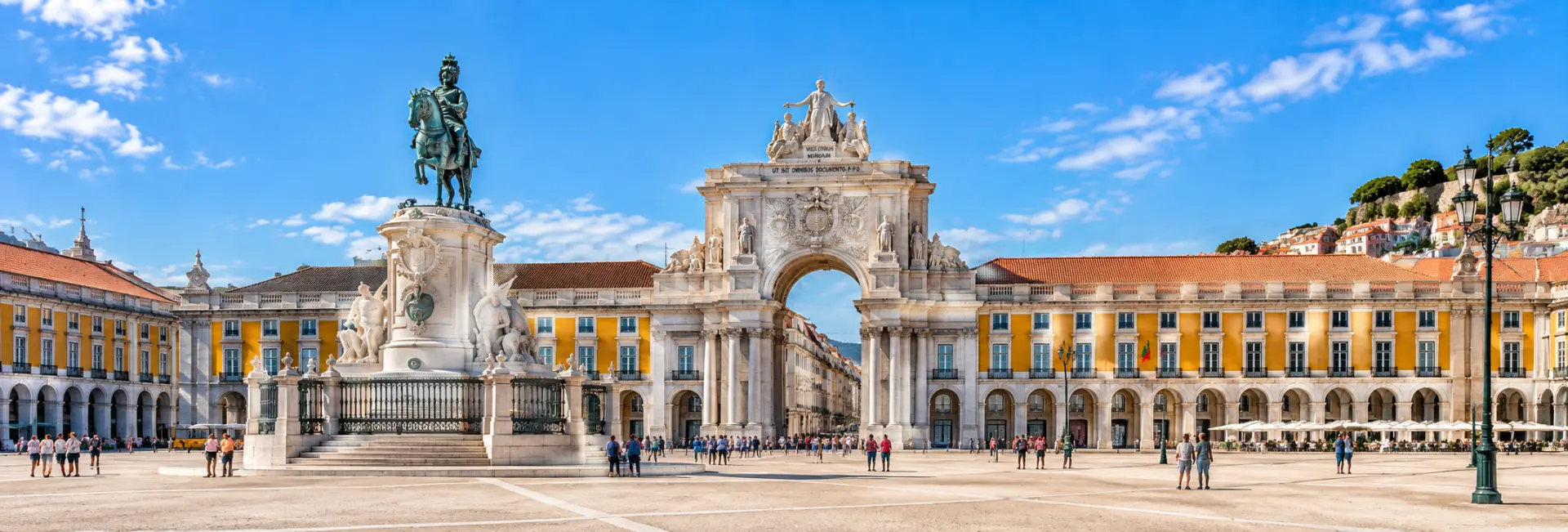
Praça do Comércio opens onto the Tagus River at the southern edge of Lisbon's Baixa district, its yellow arcaded buildings forming a wide U around one of the largest public squares in Europe. Locals still call it Terreiro do Paço, Palace Square, a name that recalls the royal residence that once stood here before it was destroyed in 1755.
Rebuilt in the decades that followed as a symbol of the city's recovery, the square has since served as government offices, a stage for major national events, and today, a gathering point ringed with cafés, shops, and a triumphal arch leading into downtown Lisbon.
History
The Ribeira Palace and Its Destruction
For more than two centuries before 1755, this riverside site was occupied by the Paço da Ribeira, the main royal palace of Portugal, filled with art and a royal library said to hold tens of thousands of volumes. On the morning of 1 November 1755, a massive earthquake struck Lisbon, and the tsunami that followed devastated the palace along with much of the surrounding Baixa district. Tens of thousands of people died in the disaster, and the palace, along with its library and collections, was almost entirely lost.
Rebuilding Under the Marquis of Pombal
In the aftermath, Sebastião José de Carvalho e Melo, the Marquis of Pombal and chief minister to King José I, oversaw a sweeping rebuilding of downtown Lisbon. Rather than reconstruct a royal palace on the site, Pombal's architect Eugénio dos Santos designed a new civic square, U-shaped and opening toward the river, lined with government offices for customs and port authorities. This new commercial role gave the square its official name, Praça do Comércio, even as locals kept using the older name tied to the vanished palace.
A Stage for National History
The square has witnessed some of Portugal's most consequential public moments. On 1 February 1908, King Carlos I and his heir, Prince Luís Filipe, were assassinated here in an attack that helped precipitate the fall of the Portuguese monarchy just two years later. Decades afterward, in 1974, crowds gathered in the square during the Carnation Revolution that ended Portugal's dictatorship. A plaque near the site of the 1908 assassination still marks the spot today.
Architecture & Design
The square follows the Pombaline style developed for Lisbon's post-earthquake reconstruction: symmetrical, arcaded buildings in a restrained neoclassical idiom, designed as much for stability against future earthquakes as for visual grandeur. Two towers echoing the footprint of the old royal palace anchor the square's northern corners, while continuous ground-floor arcades once sheltered merchants and now house cafés and shops.
At its northern edge, the square opens into Rua Augusta through the Arco da Rua Augusta, a triumphal arch begun in 1759 to mark the city's swift recovery from the earthquake, though construction stalled for decades and it was not completed until the 1870s. The arch is topped with allegorical sculptures of Glory crowning Genius and Bravery, along with figures representing notable historical Portuguese figures below.
Key Landmarks
Several specific features draw most of the attention within the square itself.
- Statue of King José I - a bronze equestrian statue at the square's center, unveiled in 1775 and sculpted by Joaquim Machado de Castro to honor the king's role in Lisbon's reconstruction
- Arco da Rua Augusta - the triumphal arch on the square's north side, with a rooftop viewpoint reached by elevator
- Cais das Colunas - a riverside landing marked by two stone columns, traditionally used for ceremonial arrivals by water
- Lisboa Story Centre - a museum on the square dedicated to the history of Lisbon, including the 1755 earthquake
- Museu de Lisboa - Praça do Comércio - a branch of the city museum housed in the square's western tower
Recognition & Status
Praça do Comércio is one of the largest public squares in Europe and a defining symbol of Lisbon's post-earthquake reconstruction under the Marquis of Pombal. While it does not carry a UNESCO listing of its own, it sits at the heart of the Baixa Pombalina, the historic downtown district whose distinctive 18th-century urban planning is recognized as one of Lisbon's most significant architectural legacies.
- One of Europe's largest riverside public squares, roughly 30,600 square meters in area
- Centerpiece of the Pombaline reconstruction of downtown Lisbon following the 1755 earthquake
- Site of the 1908 assassination of King Carlos I, a turning point in Portuguese history
Ways to Experience It
The square itself is open public space with no entry fee and no closing time, making it easy to pass through as part of a wider walk around Baixa. A few individual sites within it are ticketed separately.
- Free wandering - the square, arcades, and riverside steps can all be explored without a ticket
- Arco da Rua Augusta viewpoint - a paid elevator ride to the rooftop of the triumphal arch for panoramic views over the square and the river
- Lisboa Story Centre - a ticketed museum experience covering Lisbon's history, including the 1755 earthquake
- Café stop - Martinho da Arcada, one of Lisbon's oldest cafés, sits under the square's arcades
Best Time to Visit
Praça do Comércio changes character throughout the day, from a quiet morning crossing point to a busy evening gathering spot.
- Early morning offers the emptiest square and the softest light for photographs
- Late afternoon and early evening bring a livelier atmosphere as cafés and terraces fill up
- Summer sees the largest crowds and warmest temperatures, especially around midday
- Sunset over the Tagus from the riverside steps is a popular time to visit
Visitor Tips
The square is simple to visit, but a few details help make the most of it.
- Climb the Arco da Rua Augusta for one of the best views over the square and the river, and book ahead in peak season
- Look for the assassination plaque near the statue of King José I for a quieter piece of the square's history
- Sit at the riverside Cais das Colunas steps for a break with open views of the Tagus
- The square connects directly to Rua Augusta, Lisbon's main pedestrian shopping street, making it an easy starting point for a walk into Baixa
- Check current hours and ticket prices for the arch and museums before visiting, since these can change
Nearby Attractions
Praça do Comércio sits at the gateway to Lisbon's historic downtown, within easy walking distance of several major sights.
- Rua Augusta - Lisbon's main pedestrianized shopping street, leading north from the square's triumphal arch
- Rossio Square - a lively historic square a short walk into Baixa
- Lisbon Cathedral (Sé de Lisboa) - a short walk east toward Alfama
- São Jorge Castle - visible on the hill above Alfama, a longer uphill walk or tram ride away
- Cais do Sodré - a riverside neighborhood with the Time Out Market, a short walk west along the water
FAQs about visiting Praça do Comércio
What is Praça do Comércio and why is it famous? +
It's a grand riverside square in central Lisbon, built on the site of the royal Ribeira Palace after it was destroyed in the 1755 earthquake. It's known for its scale, its Pombaline architecture, and its role as the setting for major events in Portuguese history, including the 1908 assassination of King Carlos I.
Is there an entry fee to visit the square? +
No, the square itself is free and open to the public at all times. Only specific attractions within it, such as the Arco da Rua Augusta viewpoint and the Lisboa Story Centre, charge admission.
How much time do I need to visit? +
Walking through the square and taking in its landmarks takes about 20 to 30 minutes, though visiting the arch viewpoint or a museum inside it will add more time.
Why is the square also called Terreiro do Paço? +
That's the older, still commonly used name, referring to the royal Ribeira Palace that stood on the site before the 1755 earthquake destroyed it.
What happened at Praça do Comércio in 1908? +
King Carlos I and his heir, Prince Luís Filipe, were assassinated in the square on 1 February 1908, an event that helped lead to the end of the Portuguese monarchy two years later.
What's nearby that's worth combining with a visit? +
Rua Augusta and Rossio Square are just a short walk into Baixa, and Lisbon Cathedral and São Jorge Castle are both within reach for a longer walk toward Alfama.
Is the Arco da Rua Augusta worth climbing? +
Many visitors find it worthwhile for the panoramic views over the square, the river, and Rua Augusta, though it does involve a separate ticket and can have queues in peak season.
