
Table of Contents
Overview
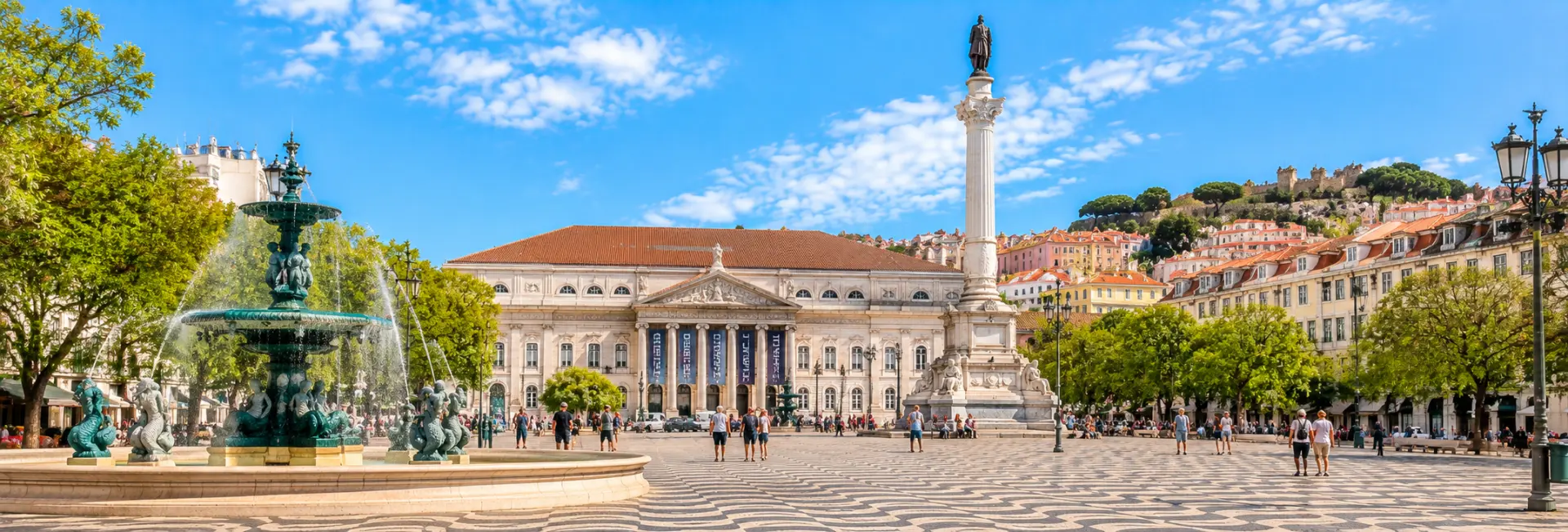
Rossio Square sits at the heart of Lisbon's Baixa district, a wide pedestrian plaza paved in swirling black-and-white stone and framed by cafés, theaters, and the domed silhouette of the Rossio railway station. Officially named Praça Dom Pedro IV after the monarch whose column stands at its center, the square is almost universally known by its older name, Rossio, meaning roughly "common land."
Lisbon's civic life has centered on this spot since the Middle Ages, through public spectacles, executions, revolts, and, today, a constant flow of locals and visitors crossing between the city's oldest neighborhoods.
History
From Common Land to City Center
Rossio has served as one of Lisbon's main public spaces since at least the 13th century, when the site functioned as open common land used for markets, tournaments, and royal proclamations. By the 15th century, the Estaus Palace had been built on the square's northern side to host visiting dignitaries, a building that would later take on a far darker role.
The Inquisition and Public Spectacle
After the Portuguese Inquisition was established, the Estaus Palace became its headquarters, and Rossio itself became the setting for public trials and executions, including the country's first auto-da-fé, a ritual act of public penance, held in 1540. For centuries the square also hosted bullfights, festivals, and other large public gatherings, cementing its role as the city's central stage.
Rebuilding and the 19th-Century Square
The 1755 earthquake reshaped much of Lisbon, including the buildings around Rossio, which were rebuilt as part of the wider Pombaline reconstruction of the Baixa district. The Estaus Palace, badly damaged, was eventually replaced in the 1840s by the neoclassical Teatro Nacional D. Maria II. Later in the 19th century the square took on much of its present appearance: a bronze column honoring King Pedro IV was erected at its center in the 1870s, two ornate bronze fountains imported from France followed in 1889, and the distinctive wave-pattern stone pavement was laid down around the same period, a style that would go on to be copied across Portugal and its former colonies.
Architecture & Design
Rossio's most recognizable feature underfoot is its calçada portuguesa, a black-and-white mosaic pavement laid in sweeping wave patterns that has since become one of Portugal's signature design exports. At the square's center rises a column roughly 23 meters tall, topped with a bronze statue and surrounded at its base by four female figures representing Justice, Wisdom, Strength, and Moderation.
The square's northern edge is closed off by the neoclassical facade of the Teatro Nacional D. Maria II, its pediment crowned by a statue of the Portuguese playwright Gil Vicente. To one side stands the Rossio railway station, notable for its ornate Neo-Manueline facade and a pair of horseshoe-shaped doorways that give it an unusually decorative entrance for a working train station.
Key Landmarks
Several specific features are worth seeking out within and around the square.
- Column of Pedro IV - the bronze statue at the square's center, long the subject of a popular but debunked legend that it actually depicts Emperor Maximilian I of Mexico
- The twin bronze fountains - matching 19th-century Baroque fountains imported from France, flanking the column on either side
- Teatro Nacional D. Maria II - the neoclassical national theater on the square's northern side, built on the site of the former Estaus Palace
- Rossio railway station - the Neo-Manueline train station just off the square, departure point for trains to Sintra
- Café Nicola - a historic café on the square with an Art Deco facade, long a meeting point for writers and intellectuals
Recognition & Status
Rossio does not carry a UNESCO listing of its own, but it sits within the Baixa Pombalina, Lisbon's historic downtown, and its wave-pattern pavement design is recognized as a distinctly Portuguese contribution to public space design that has been replicated in cities across the former Portuguese-speaking world.
- One of Lisbon's principal public squares since at least the 13th century
- Site of Portugal's first Inquisition auto-da-fé, in 1540
- Origin point of the calçada portuguesa wave-pattern pavement style, later exported to Brazil, Macau, and beyond
Ways to Experience It
Rossio is a free, open public square, most often experienced as a stop along a longer walk through central Lisbon.
- Free wandering - the square, column, and fountains can all be explored at any time with no ticket required
- Café stop - outdoor terraces around the square's edge offer a classic spot for people-watching
- Transit hub - Rossio metro and railway stations make the square a natural starting or ending point for a day of sightseeing
- Evening visit - the fountains and theater facade are lit up after dark, giving the square a different atmosphere at night
Best Time to Visit
Rossio is busy at nearly all hours, but its character shifts noticeably through the day.
- Early morning offers the quietest crossing, before the cafés and crowds fill in
- Midday and early evening are the liveliest times, with street performers and heavy foot traffic
- Evenings bring a livelier café and nightlife scene around the square's edges
- Weekends tend to be busier than weekdays, especially around the surrounding restaurants and bars
Visitor Tips
A few practical notes help make a stop at Rossio easier.
- Watch your footing on the wave-pattern pavement, which can be slippery when wet
- Be alert for pickpockets and street scams, as with any busy central square in a major tourist city
- Use Rossio as an easy reference point for orienting a walk through the Baixa district and toward Rua Augusta
- Visit Café Nicola or a nearby terrace for a break with a direct view of the column and fountains
- Check the Rossio railway station schedule if planning a day trip to Sintra, since trains depart from just beside the square
Nearby Attractions
Rossio sits in the middle of Lisbon's historic downtown, within easy walking distance of several other major sights.
- Rua Augusta - Lisbon's main pedestrian shopping street, running south from Rossio toward the river
- Praça do Comércio - Lisbon's grand riverside square, a short walk south through Baixa
- Santa Justa Lift - the ornate iron elevator connecting Baixa to Chiado, a short walk away
- Restauradores Square - a neighboring square just north of Rossio, marking the start of Avenida da Liberdade
- Alfama and São Jorge Castle - Lisbon's oldest district and its hilltop castle, a longer walk east
FAQs about visiting Rossio Square
What is Rossio Square and why is it famous? +
It's Lisbon's central public square, in use since at least the 13th century, known for its wave-pattern stone pavement, its bronze fountains, and its history as the site of the city's first Inquisition auto-da-fé in 1540.
Is there an entry fee to visit the square? +
No, Rossio is a free public space, open at all times with no admission charge.
Is the statue at the center really of Emperor Maximilian of Mexico? +
No - this is a popular legend that historians have debunked. The statue depicts King Pedro IV of Portugal, with distinctly Portuguese details including the national coat of arms and the Constitutional Charter of 1826 in his hand.
How much time do I need to visit? +
Walking through the square and taking in its landmarks takes about 15 to 20 minutes, though many visitors linger longer at a café terrace.
What's nearby that's worth combining with a visit? +
Rua Augusta, Praça do Comércio, and the Santa Justa Lift are all within a short walk, and Rossio railway station is the departure point for day trips to Sintra.
Why is the square's pavement so distinctive? +
Its black-and-white wave-pattern paving, known as calçada portuguesa, was laid in the mid-19th century and went on to inspire similar pavement designs across Portugal and in former Portuguese colonies, including Brazil and Macau.
Is Rossio Square safe to visit? +
Generally yes, as it's a busy, well-trafficked central square, though visitors should stay alert for pickpockets and common street scams, as in any crowded tourist area.
