
Table of Contents
Overview
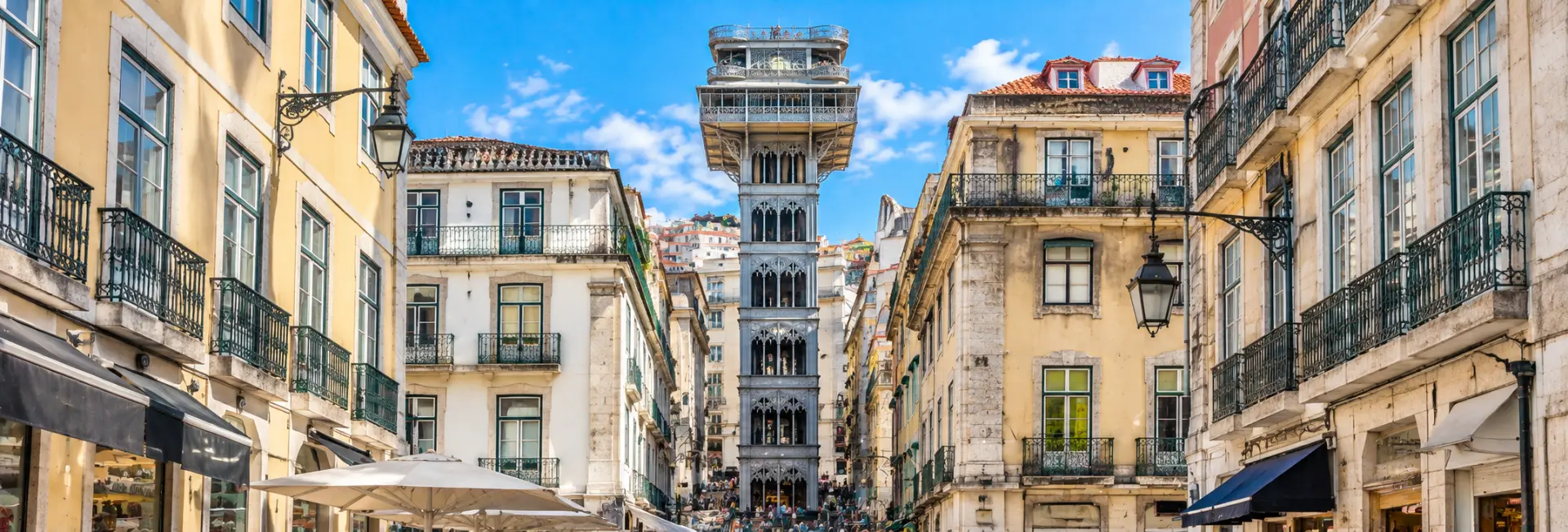
The Santa Justa Lift rises 45 meters above Lisbon's Baixa district, an ornate iron elevator that looks more like a small Eiffel-style tower than a piece of public transport. Built in the early 20th century to carry residents up one of Lisbon's steepest hills, it remains the only vertical public lift left in a city otherwise known for its funiculars and tram lines.
Today it is as much a sightseeing stop as a shortcut, prized for its filigree ironwork and for the panoramic viewing platform at the top, which looks out over the rooftops of Baixa toward São Jorge Castle and the Tagus River.
History
Solving Lisbon's Steepest Hill
By the late 19th century, Lisbon's expanding downtown badly needed a faster way to connect the flat streets of Baixa with the hillside neighborhoods above, including Chiado and Carmo Square. The city had already built a handful of funiculars to tackle its hills, but the stretch near Rua de Santa Justa called for something different: a straight, vertical lift. Engineer Raoul Mesnier de Ponsard, who had trained in France and was influenced by the work of Gustave Eiffel, was commissioned to design it. Construction began around 1900, and the lift opened to the public on 10 July 1902 under its original name, Elevador do Carmo.
From Everyday Transport to Landmark
Demand was immediate. On its opening day alone, some 3,000 tickets were sold despite each of the lift's two cabins holding only around two dozen passengers at a time. For decades it served as a genuine piece of public transport, helping residents avoid the steep climb between Baixa and the hillside districts above. As Lisbon's transport network modernized, the lift's practical role gave way to its role as a tourist attraction, though it is still formally operated as part of the city's public transit system. It was designated a Portuguese national monument in 2002, recognizing its place in the city's industrial and architectural history.
Architecture & Design
The Santa Justa Lift is built almost entirely of iron in a neo-Gothic style, its structure covered in filigree ironwork, pointed arches, and geometric patterns that give it an unusually decorative look for a piece of transport infrastructure. The resemblance to the work of Gustave Eiffel is not a coincidence: Mesnier de Ponsard is said to have trained under Eiffel and drawn direct inspiration from his structural ironwork.
Passengers ride in one of two original wood-paneled cabins, fitted with brass dials and small mirrors that recall the lift's early 20th-century origins. The car rises through roughly seven stories inside the iron shaft before opening onto a walkway that leads to an observation platform above the surrounding rooftops.
What to See There
A visit combines a short ride with a walk around the upper platform and connecting walkway.
- The iron shaft and cabins - a close look at the neo-Gothic ironwork and the original wooden lift cars
- The upper walkway - a metal footbridge connecting the lift to the hillside near Carmo Square
- The observation deck - a viewing platform above the lift shaft with panoramic views over Baixa
- Views toward São Jorge Castle and the Tagus River - visible from the platform on a clear day
The lift's small cabins carry only a limited number of passengers at a time, so waits can build up quickly during busy periods.
Recognition & Status
The Santa Justa Lift was designated a Portuguese national monument in 2002, recognizing its architectural and historical value as a rare piece of surviving 19th-century industrial infrastructure in the middle of Lisbon's historic center. It sits within the Baixa Pombalina, the downtown district rebuilt after the 1755 earthquake, though the lift itself dates from decades later.
- Portuguese National Monument, designated 2002
- The only remaining vertical public lift among Lisbon's historic hillside transport
- Still operated by Carris, Lisbon's public transport company, as route 54E
Ways to Experience It
There are two main ways to take in the lift, depending on whether the goal is the ride itself or just the view from the top.
- Riding the lift - a return ticket carries passengers up through the iron shaft to the viewing platform
- Walking up for free - the observation platform can also be reached on foot via the stairs and streets around Carmo Square, avoiding both the fare and the queue
- Public transport pass - Lisbon transit cards can be used for a one-way fare, since the lift is officially part of the city's public transport network
- Viewpoint-only ticket - a separate, lower-priced ticket is available for visitors who just want access to the top platform
Best Time to Visit
Because the lift's cabins are small, timing a visit well makes a real difference to how long it takes.
- Early morning tends to have the shortest queues for the lift itself
- Midday and early afternoon are usually the busiest, especially in summer
- Late afternoon light is well suited to photographs from the observation platform
- Evenings offer a quieter, more atmospheric view once the lift is lit up after dark
Visitor Tips
A few practical details help make a visit smoother.
- Consider walking up to Carmo Square and riding the lift down instead, since queues for the upward ride tend to be longer
- Lisboa Card holders can use the lift and access the viewpoint at no extra cost
- The small cabin capacity means waits can stretch out at peak times, so plan some flexibility into a visit
- Combine the stop with a walk to the nearby Carmo Convent ruins, just a short walk from the upper platform
- Check current opening hours and ticket prices before visiting, since these can change seasonally
Nearby Attractions
The Santa Justa Lift sits right at the boundary between Lisbon's Baixa and Chiado districts, making it a natural stop on a walk between the two.
- Carmo Convent - a ruined Gothic church just steps from the lift's upper platform, left roofless since the 1755 earthquake
- Rossio Square - a lively historic square a short walk downhill in Baixa
- Praça do Comércio - Lisbon's grand riverside square, a short walk south through Baixa
- Chiado district - a shopping and café district just above the lift's upper entrance
- Rua Augusta - Lisbon's main pedestrian street, running through central Baixa nearby
FAQs about visiting the Santa Justa Lift
What is the Santa Justa Lift and why is it famous? +
It's a neo-Gothic iron elevator built in 1902 to connect Lisbon's Baixa district with the hillside above. It's known for its ornate ironwork, its resemblance to the work of Gustave Eiffel, and the panoramic viewing platform at the top.
Do I need to ride the lift to see the view? +
No - the observation platform can also be reached for free by walking up the streets and stairs around Carmo Square, which avoids both the fare and the queue for the lift itself.
How much time do I need to visit? +
The ride itself only takes a couple of minutes, but queuing at busy times can add anywhere from a few minutes to half an hour or more.
Is the Santa Justa Lift part of Lisbon's public transport system? +
Yes - it's operated by Carris, the city's public transport company, and can be used with standard transit passes for a one-way fare.
What's nearby that's worth combining with a visit? +
The ruined Carmo Convent is just steps from the upper platform, and Rossio Square, Praça do Comércio, and the Chiado district are all within easy walking distance.
Is the lift always crowded? +
It can be, especially at midday during peak season, since each cabin holds only a small number of passengers. Early mornings and evenings tend to be quieter.
Is the Santa Justa Lift accessible for visitors with mobility issues? +
The lift itself is accessible, though the connecting walkway and observation platform involve some stairs, so visitors with significant mobility limitations may want to check current accessibility details before visiting.
