
Table of Contents
Overview
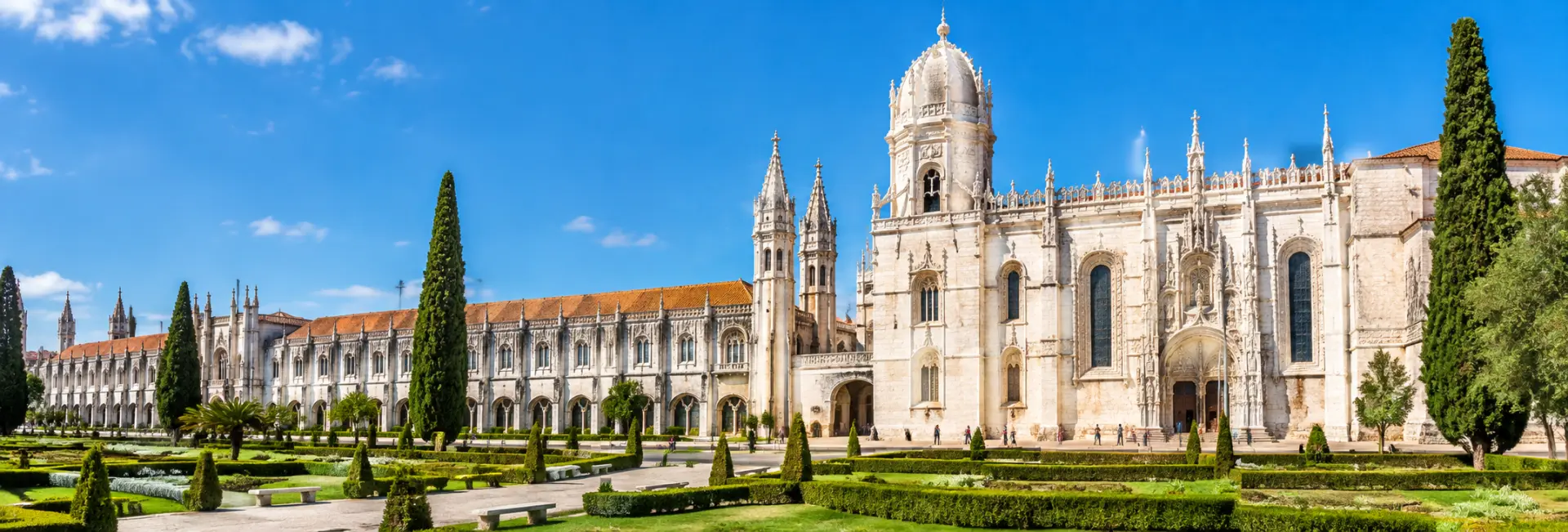
Jerónimos Monastery stretches along the Belém riverfront as one of the largest and most elaborate monastic buildings ever raised in Portugal. Commissioned by King Manuel I in the early 16th century, it was built to give thanks for the success of Vasco da Gama's sea route to India and paid for, in large part, by taxing the very spice trade that voyage opened up.
The result is a building generally considered the finest expression of Manueline architecture, Portugal's own decorative style from the Age of Discovery. It now stands alongside Belém Tower as a joint UNESCO World Heritage Site, and its church, cloisters, and adjoining museums make it one of the most visited monuments in Lisbon.
History
Building a Monument to the Discoveries
The site had long held a small chapel where sailors, including Vasco da Gama's crew, prayed before setting out on their voyages. King Manuel I chose the spot for a much grander monastery, and construction began in 1501, funded largely by a 5 percent levy on trade with Africa and Asia, sometimes called the pepper tax. Architect Diogo de Boitaca laid out the original plan and oversaw the earliest work, establishing the emerging Manueline style that would define the building. He was followed from 1517 by João de Castilho, who completed the south portal and much of the cloister, and later by architects including Diogo de Torralva and Jerónimo de Ruão as the project stretched on for close to a century.
From Royal Pantheon to Public Monument
Once finished, the monastery housed monks of the Order of Saint Jerome, who were tasked with praying for the souls of sailors and for the Portuguese crown. It also became a pantheon for the House of Aviz, and the church holds the tombs of King Manuel I and other members of the royal family alongside those of Vasco da Gama and the poet Luís de Camões. The monastery survived the devastating 1755 Lisbon earthquake with only minor damage. It was secularized in 1833, when its religious community was dissolved and ownership passed to the Portuguese state, which later placed the National Archaeology Museum and the Maritime Museum of Portugal in its west wing.
Architecture & Design
Manueline Style at Its Fullest
Jerónimos Monastery is widely regarded as the high point of Manueline architecture, a Portuguese style that layers Late Gothic structure with maritime and naturalistic ornament. Its limestone façades are carved with twisted ropes, armillary spheres, coral and exotic plant forms, and the cross of the Order of Christ, all drawing on imagery from Portugal's overseas voyages. The main south portal alone rises more than 30 meters and is crowded with sculpted saints and royal figures, while the west portal leads directly into the church.
The Cloister
At the heart of the complex is a two-story cloister roughly 55 meters on each side, widely considered one of the most beautiful in Europe. Its lower level, designed under Boitaca, keeps to a pure Manueline vocabulary, while the upper level, finished under Castilho, introduces more restrained Renaissance detailing. An unusual open-corner design lets a double row of arches meet without the heavy corner piers typical of earlier cloisters, giving the whole space an unusually light, airy feel.
Notable Features
Beyond its scale and carving, several specific spaces and details draw most of the attention during a visit.
- Tomb of Vasco da Gama - positioned just inside the church's west portal, marking the explorer as the monastery's most famous occupant
- Tomb of Luís de Camões - facing Vasco da Gama's tomb, honoring the poet whose epic "The Lusiads" tells the story of the Portuguese voyages
- The nave - a single wide hall supported by six slender pillars, with a ribbed stone ceiling often compared to palm fronds
- Royal tombs - in the choir at the east end, including King Manuel I and King João III
- The Chapter House - which holds the tomb of the poet Fernando Pessoa, moved here in the 20th century
Recognition & Status
Jerónimos Monastery has been formally protected since 1907, when it was classified as a Portuguese national monument. In 1983 it was inscribed on the UNESCO World Heritage List jointly with Belém Tower, under the listing "Monastery of the Hieronymites and Tower of Belém," recognized for its outstanding architectural achievement and its role as a symbol of Portugal's Age of Discovery.
- Portuguese National Monument, designated 1907
- UNESCO World Heritage Site, inscribed 1983, jointly with Belém Tower
- Widely considered the finest surviving example of Manueline architecture
Ways to Experience It
A visit can be as short as a look inside the free church or extended into a longer exploration of the cloister and museums. Each part of the complex has its own access rules, so it's worth deciding in advance how much time to set aside.
- The church - free to enter through the west portal, home to the tombs of Vasco da Gama and Luís de Camões
- The cloister - ticketed separately, with both the lower and upper galleries open to visitors
- Combined tickets - some passes bundle entry to the cloister with Belém Tower or other Belém-area sites
- Adjoining museums - the National Archaeology Museum and the Maritime Museum of Portugal, housed in the monastery's west wing, are ticketed independently
Best Time to Visit
Jerónimos Monastery is open year-round, but conditions vary a lot with the season and time of day. Midday in summer draws the largest crowds, while early mornings and late afternoons tend to be calmer at any time of year.
- Arriving close to opening time generally means shorter lines for the cloister
- Weekday afternoons are usually quieter than weekends
- Soft morning or late-afternoon light brings out the detail in the carved limestone façades
- The monastery is typically closed on Mondays, so plan a visit for another day of the week
Visitor Tips
The monastery is large, but a few of its spaces and rules are easy to overlook when planning a visit.
- Book cloister tickets online in advance during peak season to avoid the longest queues
- The church is free, so visitors on a tight budget or schedule can still see the tombs of Vasco da Gama and Camões
- Dress modestly, as is customary when visiting an active place of Catholic worship
- Check current opening hours, ticket prices, and any closures before you go, since these can change seasonally
- Allow separate time for the Maritime Museum or Archaeology Museum if you plan to visit them, as they are ticketed apart from the cloister
Nearby Attractions
Jerónimos Monastery sits in the heart of Lisbon's Belém district, surrounded by some of the city's other major monuments and museums, making it easy to build into a longer riverside itinerary.
- Belém Tower - the other half of the joint UNESCO listing, a short walk toward the river
- Padrão dos Descobrimentos (Monument to the Discoveries) - a riverside monument honoring Portugal's explorers
- MAAT (Museum of Art, Architecture and Technology) - a contemporary museum on the riverfront
- Belém Palace - the official residence of Portugal's president
- Pastéis de Belém - the original bakery behind Lisbon's famous custard tarts, said to have roots in recipes from the monastery itself
FAQs about visiting Jerónimos Monastery
What is Jerónimos Monastery and why is it famous? +
It's a 16th-century monastery in Lisbon's Belém district, built by King Manuel I to mark Vasco da Gama's sea route to India. It's famous for its Manueline architecture, widely considered the finest example of the style, and for housing the tombs of Vasco da Gama and the poet Luís de Camões.
Is entry to Jerónimos Monastery free? +
The church is free to enter. The cloister, which holds much of the monastery's most celebrated architecture, requires a separate paid ticket.
How much time do I need to visit? +
Plan on roughly 45 to 60 minutes for the cloister alone, or 75 to 90 minutes if you also take time in the church. Add more if you plan to visit the adjoining museums.
Do I need to book tickets in advance? +
It's advisable, especially in peak season, since the cloister can draw long queues and tickets are sometimes sold with a specific entry window.
Who is buried at Jerónimos Monastery? +
The church holds the tombs of explorer Vasco da Gama and poet Luís de Camões near the entrance, along with the royal tombs of King Manuel I and King João III in the choir. The Chapter House also holds the tomb of poet Fernando Pessoa.
What's nearby that's worth combining with a visit? +
Belém Tower, the Padrão dos Descobrimentos, the MAAT museum, and Belém Palace are all within easy walking distance, and the original Pastéis de Belém bakery is just around the corner.
Is Jerónimos Monastery open every day? +
No - it's typically closed on Mondays and on certain public holidays, so it's worth checking the current schedule before planning a visit.
