
Table of Contents
Overview
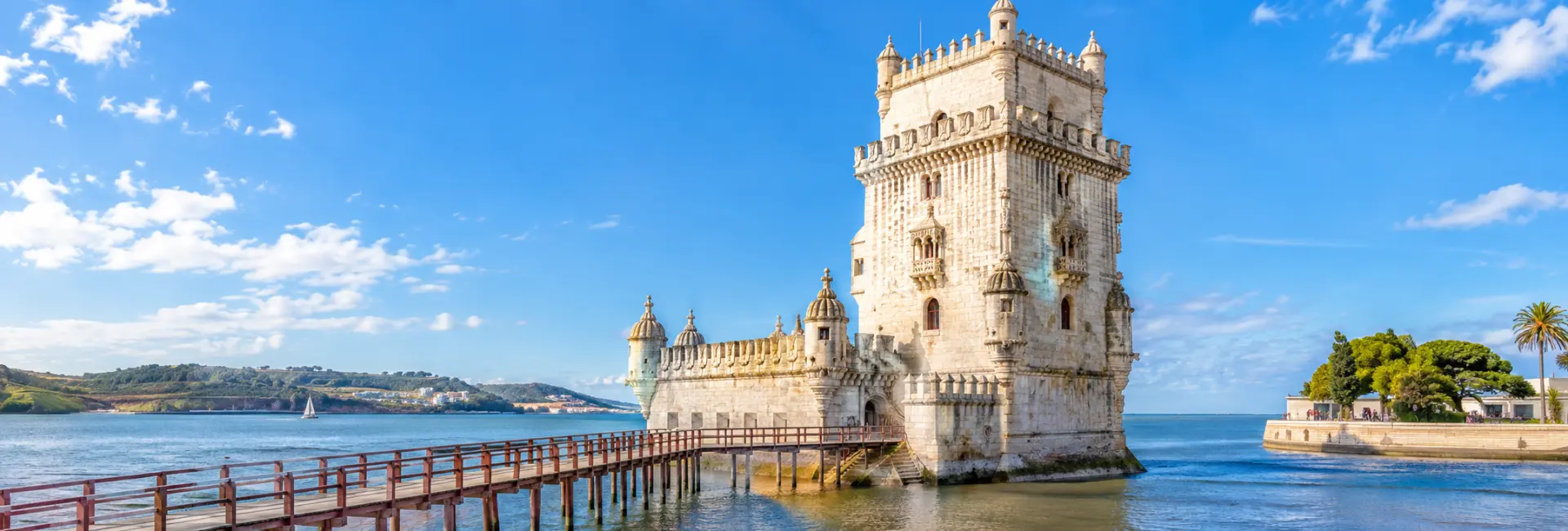
Belém Tower stands where the Tagus River meets the open Atlantic, on the spot that was once the last piece of Portuguese soil in view for ships departing on the great voyages of the 16th century. Built as both a working fortress and a ceremonial gateway, it pairs serious military engineering with the elaborately carved stonework of the Manueline style, Portugal's own architectural language from the height of the Age of Discovery.
Today it is one of the most photographed monuments in Lisbon and, together with the nearby Jerónimos Monastery, forms a single UNESCO World Heritage Site. It is a compact building, but a dense one: the carved detail on its façades rewards close attention just as much as the open river views from its upper terrace.
History
Building a Gateway to the Atlantic
King Manuel I ordered the tower's construction as part of a coordinated river-defense scheme intended to protect Lisbon's harbor from seaborne attack. Work began around 1514 under Francisco de Arruda, an architect who had already built fortifications for Portugal in North Africa and brought that military experience back to the Tagus. Arruda was formally named master of the works for the Belém stronghold, and building stone was delivered to the site through the following years as construction advanced. The tower was substantially finished by 1519, just two years before Manuel's death, making it one of the last major monuments raised in his reign.
From Fortress to Prison and Customs Post
For roughly its first two centuries, Belém Tower did what it was built to do: it guarded the river approach and marked the point of departure for ships bound for Africa, India, and Brazil. Its role shifted over time. Between the 17th and 19th centuries the lower level, originally designed to house artillery, was repurposed as a political prison, holding opponents of the crown, including during the unrest of Portugal's 19th-century Liberal Wars. In other stretches of its history it also served as a customs post and a signal station, part of a slow drift from military asset to civic monument.
Restoration and Recognition
The tower came through the catastrophic 1755 Lisbon earthquake with comparatively little structural damage, unlike much of the city around it. In the 19th century, as the monarchy looked back on the Age of Discovery with romantic pride, the tower was restored in a way that recovered much of its original Manueline detail and added some further carving to match. It was designated a Portuguese national monument in 1907, and in 1983 UNESCO inscribed it, jointly with the Jerónimos Monastery, as a World Heritage Site. More recently, the tower underwent an extended conservation project and reopened to visitors in 2026 with a timed-entry system in place to manage the number of people inside at once.
Architecture & Design
Manueline Style and Maritime Symbolism
Belém Tower is one of the defining works of Manueline architecture, a style unique to Portugal that flourished under Manuel I and merged late Gothic structural forms with the decorative language of a rising maritime empire. Its façades are carved with twisted rope motifs, armillary spheres representing Manuel I's personal emblem, shields bearing the cross of the Order of Christ, and imagery drawn from Portugal's overseas voyages, including a weathered stone head thought to be one of the earliest European sculptural depictions of a rhinoceros. The building was raised in lioz, a pale local limestone that gives the tower a warm, almost luminous color as the light over the river changes through the day.
Layout and Structure
The building has two distinct parts: a low hexagonal bastion at water level and a slender four-story tower rising behind it. The bastion originally carried a battery of cannon trained along the river and later held an open, cloister-like courtyard once its military role faded. The tower itself narrows as it climbs, capped with a ring of small domed watchtowers and battlements influenced by Moorish architecture, a detail that reflects Portugal's wider cultural contacts of the period.
- Originally built on a small island in the Tagus, now connected to the riverbank after centuries of land reclamation and silting
- Combines a defensive artillery platform with a ceremonial tower and residential chambers
- Built almost entirely from lioz limestone quarried locally in the Lisbon region
Recognition & Status
Belém Tower has carried formal heritage protection since 1907, when it was classified as a Portuguese national monument. In 1983 it was added to the UNESCO World Heritage List jointly with the Jerónimos Monastery, under the listing "Monastery of the Hieronymites and Tower of Belém in Lisbon," recognized for its architectural and historical significance as a monument to Portugal's Age of Discovery.
- Portuguese National Monument, designated 1907
- UNESCO World Heritage Site, inscribed 1983, jointly with the Jerónimos Monastery
- Widely regarded as one of the finest surviving examples of Manueline architecture
What to See Inside
The interior is small, but every level offers something different. A visit moves from the bastion at ground level up through the tower's four floors, ending on an open-air terrace with views over the river and the Belém district.
- The Bastion - the fortified lower platform, originally an artillery deck and later a prison, now an open courtyard-like space
- Sala do Governador (Governor's Room)- the first interior chamber of the tower proper
- Sala dos Reis (King's Hall)- a former audience hall beneath vaulted ceilings, once used for official functions
- The Chapel- a small devotional space near the top of the tower
- The Terrace- the uppermost level, circling the chapel with open views across the Tagus Estuary toward the south bank
The staircases connecting these levels are narrow and spiral tightly, and the number of visitors allowed inside at once is limited, which is part of why queues can build up outside during busy periods.
Ways to Experience It
Most visitors take a self-paced walk through the tower's interior and up to the terrace, a visit that generally takes somewhere between 45 minutes and an hour given the small floor plan and the narrow staircases. Because indoor capacity is limited, entry now runs on timed slots, particularly since the tower's 2026 reopening, so booking ahead is worth doing rather than counting on walking straight in.
- Self-guided visit - explore the bastion and tower floors at your own pace, following information panels along the route
- Combined tickets - some passes bundle entry with the nearby Jerónimos Monastery or other Belém-area sites
- Exterior view only- the tower and its riverside gardens can be appreciated without a ticket, which suits visitors short on time or unable to manage the stairs
Best Time to Visit
Belém Tower can be visited throughout the year, but the experience changes a lot with the season and time of day. Summer afternoons bring the biggest crowds and the warmest temperatures, while spring and autumn tend to offer milder weather with somewhat thinner queues.
- Arriving right at opening tends to mean the shortest wait for a timed slot
- Weekdays are generally quieter than weekends
- Late afternoon light on the river is especially good for photographs of the tower's exterior
- The tower is closed on Mondays, so plan a visit for another day of the week
Visitor Tips
The tower's small size and narrow stairways mean a little planning makes a real difference to how the visit feels.
- Book a timed-entry ticket online in advance, especially for summer visits, since walk-up availability can be limited
- Wear comfortable, grippy shoes- the spiral staircases are steep and the stone steps can be worn smooth
- Accessibility is limited inside; the upper floors are reachable only by stairs, though the exterior and gardens are easier to visit
- Check current opening hours, ticket prices, and any closures before you go, since these have changed following the tower's recent restoration
- Pair the visit with a walk through the riverside gardens, which offer good views of the tower without needing a ticket
Nearby Attractions
Belém Tower sits within Lisbon's Belém district, one of the city's densest concentrations of monuments and museums, which makes it easy to combine with a half-day or full-day itinerary.
- Jerónimos Monastery- the other half of the joint UNESCO listing, a short walk away
- Padrão dos Descobrimentos (Monument to the Discoveries)- a riverside monument honoring Portugal's explorers
- MAAT (Museum of Art, Architecture and Technology)- a contemporary museum on the riverfront
- Belém Palace- the official residence of Portugal's president
- Pastéis de Belém- the original bakery behind Lisbon's famous custard tarts, a short walk from the tower
FAQs about visiting Belém Tower
What is Belém Tower and why is it famous? +
It's a 16th-century fortified tower on the Tagus River in Lisbon, built as a defensive gateway to the city and a ceremonial point of departure for Portuguese ships during the Age of Discovery. It's famous for its Manueline architecture, a decorative style unique to Portugal, and for its status as a joint UNESCO World Heritage Site with the nearby Jerónimos Monastery.
How much time do I need to visit Belém Tower? +
Most people spend around 45 minutes to an hour inside, given the tower's small floor plan and narrow staircases, though queuing for a timed slot can add extra time, especially in peak season.
Do I need to book tickets in advance? +
It's strongly recommended, particularly in summer or around a recent reopening, since entry is limited to timed slots and walk-up availability can run out.
Is Belém Tower suitable for people with mobility issues? +
Not fully- the upper floors are only reachable via a narrow spiral staircase with no elevator, so visitors with significant mobility limitations may prefer to admire the tower and its gardens from outside.
When is the best time to visit? +
Early morning right at opening or later in the afternoon tend to be quieter, and weekdays generally have shorter waits than weekends. Spring and autumn offer milder weather than the peak summer months.
What's nearby that's worth combining with a visit? +
The Jerónimos Monastery, the Padrão dos Descobrimentos, the MAAT museum, and Belém Palace are all within easy walking distance, and the original Pastéis de Belém bakery is just down the road.
Is Belém Tower open every day? +
No- it's typically closed on Mondays and on certain public holidays, so it's worth checking the current schedule before planning a visit.
