Table of Contents
Overview
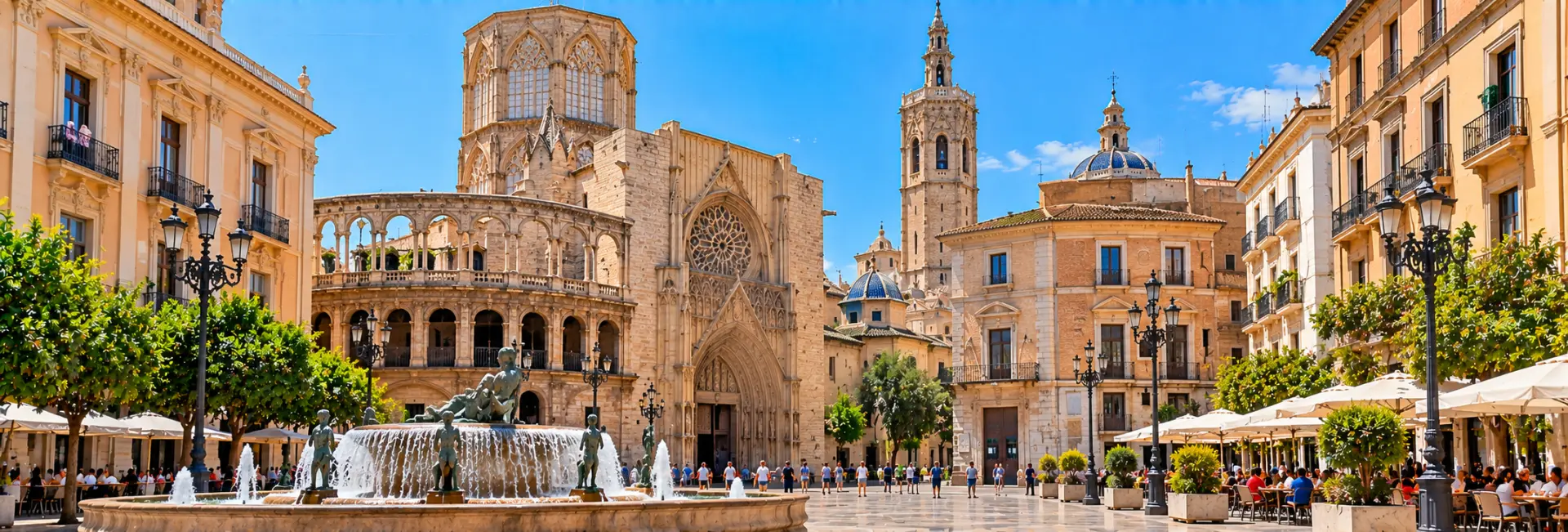
Ciutat Vella is Valencia's old town, the compact, walled heart from which the entire city grew. Its tangle of narrow lanes and sunlit plazas traces the outline of the medieval fortifications that once enclosed it, and within that footprint sits one of the largest and best-preserved historic centers in Spain. Roman foundations, Islamic-era street patterns, Gothic monuments and Baroque facades sit side by side here, layered over roughly two thousand years of continuous settlement.
For visitors, Ciutat Vella is less a single sight than a district to wander: a market, a cathedral, a silk exchange, and a string of squares that still function as everyday gathering spaces for Valencians rather than as museum pieces. It rewards slow exploration on foot more than any checklist of individual monuments, and it remains a genuinely lived-in part of the city, with residents, local shops and daily markets operating alongside the historic sites.
History
From Roman Colony to Medieval City
The site was founded as the Roman colony of Valentia in 138 BC, and the area now occupied by Plaza de la Virgen once served as the city's Roman forum. Following the fall of Roman authority, the settlement passed through Visigothic hands before the Moorish conquest, during which an existing church on the forum site was converted into a mosque. After King Jaume I of Aragon took the city in 1238, that same building was reconsecrated as a Christian place of worship, a sequence of religious transformations that still shapes the layout of the square today.
Growth Behind the Walls
Valencia expanded rapidly through the medieval period, and a new circuit of city walls was raised in the fourteenth century to enclose the growing settlement, roughly matching what is now recognized as Ciutat Vella's boundary. Trade, particularly in silk, brought the city considerable wealth in the fifteenth century, funding the construction of grand civic and commercial buildings such as La Lonja de la Seda. This period of prosperity is often described as Valencia's golden age, when the city ranked among the wealthiest and most influential trading ports on the Mediterranean.
By the nineteenth century, the medieval wall had become an obstacle to a growing city and was largely torn down to allow Valencia to expand beyond its old boundary. Its former line still defines the district's edge today, and two of its monumental gatehouses, spared from demolition, remain standing as reminders of the old fortified town.
Recognition and Heritage Status
The whole of Ciutat Vella is protected under Spanish heritage law as a Conjunto Histórico, a category of Bien de Interés Cultural (BIC) that safeguards the district's historic urban fabric as a single entity rather than protecting individual buildings in isolation.
Within the district, several elements carry international recognition. La Lonja de la Seda, the late-Gothic silk exchange, was inscribed as a UNESCO World Heritage Site in 1996 in recognition of its architectural importance and its role in Mediterranean trade. The Tribunal de las Aguas, the centuries-old water court that still meets weekly at the Apostles' Door of the Cathedral to resolve irrigation disputes for the farmland surrounding the city, has separately been recognized by UNESCO as an Intangible Cultural Heritage practice.
- Conjunto Histórico (BIC) protection covering the entire old town
- La Lonja de la Seda: UNESCO World Heritage Site since 1996
- Tribunal de las Aguas: UNESCO Intangible Cultural Heritage
Architecture and Streetscape
Ciutat Vella's streetscape is defined by its irregularity: narrow, winding lanes that follow medieval and even earlier Roman and Moorish property lines rather than any planned grid. Walking through neighborhoods like El Carmen, visitors move through tight residential streets that suddenly open onto broad, monument-lined plazas, a rhythm that has changed little in centuries.
Architecturally, the district is a layered mix rather than a single style. Gothic dominates the major civic and religious buildings from the city's medieval trading heyday, Baroque facades were added to several churches and palaces in the seventeenth and eighteenth centuries, and Renaissance and Moorish-influenced details appear in buildings such as the Palau de la Generalitat. Very little of the fourteenth-century defensive wall itself survives, but its two great gatehouses, the Torres de Serranos and the Torres de Quart, still stand at the district's northern and western edges and give a clear sense of scale for what the fortified town once looked like.
The Six Barrios
Ciutat Vella is formally divided into six smaller neighborhoods, each with a distinct character, and most visitor attention concentrates in a handful of them.
- La Seu – the oldest of the six, built around the Cathedral and Plaza de la Virgen, and the historic religious and civic core of the city.
- El Mercat – home to the Central Market and La Lonja de la Seda, reflecting the district's long commercial history.
- El Carmen – known for its dense medieval streets, street art, independent galleries and nightlife.
- Sant Francesc – the largest and most modern-feeling of the six, centered on Plaza del Ayuntamiento and the city hall.
- La Xerea – a quieter, greener quarter near the former riverbed.
- El Pilar – a calmer, largely residential neighborhood on the district's northern side.
Notable Landmarks
Several landmarks anchor a visit to Ciutat Vella, most within easy walking distance of one another.
- Valencia Cathedral – a Gothic cathedral built over the earlier mosque and Visigothic church, mixing Romanesque, Gothic and Baroque elements; its bell tower, El Miguelete, can be climbed for city views, and its museum displays a chalice traditionally associated with the Holy Grail.
- La Lonja de la Seda – the UNESCO-listed silk exchange built between 1482 and 1533, notable for its twisting stone columns and orange-tree courtyard.
- Mercado Central – one of Europe's oldest operating food markets, housed in an early twentieth-century modernist building.
- Plaza de la Virgen and the Basilica de la Virgen de los Desamparados – the city's Roman-era square, home to a Baroque basilica dedicated to Valencia's patron saint.
- Torres de Serranos and Torres de Quart – the two surviving gatehouses of the medieval city wall.
- Plaza del Ayuntamiento and the City Hall – the district's largest square, the focal point of the annual Fallas fireworks displays.
- IVAM (Institut Valencià d'Art Modern) – the city's principal modern art museum.
- Museo Nacional de Cerámica – housed in the Baroque Palacio del Marqués de Dosaguas, with an elaborately carved alabaster doorway and collections of ceramics and decorative arts.
- Plaza de la Reina – a busy square linking the Cathedral to Valencia's wider city center, lined with cafés and handicraft stalls.
Ways to Experience Ciutat Vella
The district is best explored on foot, since much of its historic core is pedestrianized and its scale makes walking the most practical way to move between sights.
- Join a walking tour focused on the Roman, Islamic or Gothic layers of the city's history.
- Climb El Miguelete tower at the Cathedral for panoramic views over the old town's rooftops.
- Browse the stalls at Mercado Central for local produce, cured meats and fresh seafood.
- Visit La Lonja de la Seda and the Museo Nacional de Cerámica for a deeper look at the city's trading and artistic history.
- Time a visit around Las Fallas in March to see the flower offering at Plaza de la Virgen and the daily mascletà fireworks at Plaza del Ayuntamiento.
- Linger over a coffee or horchata at one of the outdoor cafés surrounding Plaza de la Virgen or Plaza de la Reina.
- Step inside the Museo Nacional de Cerámica to see the Baroque interior of a former noble palace alongside its ceramics collection.
Best Time to Visit
Spring and autumn generally offer the most comfortable conditions for walking through Ciutat Vella, with mild temperatures and fewer crowds than the peak summer months, when the old town's narrow streets can feel notably hot and busy.
Mid-March brings Las Fallas, Valencia's best-known festival, when the district fills with elaborate sculptures, daily fireworks and the flower offering at Plaza de la Virgen; it is a spectacular time to visit but also the busiest and loudest, so it suits travelers looking for festival energy rather than a quiet stroll. For a calmer experience, early mornings any time of year are the best window to see the main squares and monuments before tour groups and midday crowds arrive.
Visitor Tips
A few practical points make a visit to Ciutat Vella easier to plan and enjoy.
- Wear comfortable shoes: the district's cobbled, pedestrianized streets are best covered on foot rather than by car or taxi.
- Book tickets for the Cathedral and its bell tower in advance during busy periods to avoid long queues.
- Central Market closes on Sundays and in the early afternoon on other days, so plan a visit for the morning.
- The district is largely flat and walkable, though some interior streets are narrow and cobbled, which is worth considering for visitors with mobility needs or strollers.
- Confirm current opening hours and ticket prices for individual sites before visiting, since these can change throughout the year.
- The district is compact enough to pair with other central Valencia sights, such as the Turia Gardens, in a single day without needing to rely on taxis or public transport between stops.
FAQs about visiting Ciutat Vella
What is Ciutat Vella? +
Ciutat Vella is Valencia's historic old town, the walled medieval core of the city that today contains many of its most important landmarks, including the Cathedral, La Lonja de la Seda and the Central Market.
Is it free to visit Ciutat Vella? +
Walking through the district's streets and squares is free. Individual sites within it, such as the Cathedral's bell tower or La Lonja de la Seda, charge separate entry fees.
How much time do you need to see Ciutat Vella? +
A focused visit covering the main landmarks takes roughly half a day, but a full day allows time to also explore the market, climb the bell tower and wander through quieter streets in neighborhoods like El Carmen.
What is the best time of year to visit? +
Spring and autumn offer the most comfortable weather for walking, while mid-March brings the Las Fallas festival, which transforms the district but also draws its largest crowds.
Is Ciutat Vella suitable for families and older visitors? +
The district is largely flat and pedestrian-friendly, making it manageable for most visitors, though some interior streets are narrow and cobbled, which is worth keeping in mind for strollers or those with limited mobility.
What's nearby that pairs well with a visit? +
The Turia Gardens, the former riverbed now converted into a long park, runs along the edge of Ciutat Vella and connects easily to the City of Arts and Sciences further east.
What do visitors often miss or wish they'd known? +
Many visitors focus only on the Cathedral and Central Market and overlook the Torres de Serranos and Torres de Quart, the two remaining medieval gates, which offer some of the clearest physical evidence of the old fortified city.