Table of Contents
Overview
Syntagma Square, known in Greek as Plateia Syntagmatos, is the central square of Athens and arguably the city's single busiest crossroads of history, politics, and daily life. It sits directly in front of the Hellenic Parliament, a former royal palace, and has served as the stage for everything from 19th-century uprisings to modern-day rallies.
For visitors, Syntagma is best known for the ceremonial changing of the guard performed by the Evzones outside the Tomb of the Unknown Soldier, but the square is also a major transport hub, a gateway to Athens' main shopping street, and simply a pleasant place to sit by the fountain and watch the city go by.
History
Palace Square to Constitution Square
The square was laid out in the early 19th century, shortly after King Otto moved the capital of the newly formed Greek Kingdom from Nafplio to Athens in 1834. Positioned in front of the king's newly built royal palace, it was initially known simply as Palace Square.
That changed on 3 September 1843, when Athenians and army officers gathered in front of the palace to demand that Otto grant the country a written constitution, limiting his previously absolute authority. Otto conceded, and the square was renamed Syntagma, meaning "Constitution," to commemorate the event.
From Royal Garden to Public Space
For much of the mid-19th century, the area functioned as part of the palace grounds under Queen Amalia, who maintained it as an exclusive garden closed to ordinary citizens. It was only after a change of monarch in 1862 that the square was reconstructed in white marble and formally opened to the public, taking on much of the layout still recognizable today.
A Stage for Modern Greek History
Since then, Syntagma has repeatedly served as the backdrop for major moments in Greek political life, from royal ceremonies and military parades to large-scale demonstrations. It became particularly prominent during the Greek financial crisis of the late 2000s and early 2010s, when the square filled with protesters for months at a time, cementing its role as the country's primary venue for public political expression.
That period, often referred to locally as the "Indignant Citizens" movement, saw tens of thousands of people camp in and around the square in protest of austerity measures, turning Syntagma into an internationally recognized symbol of the crisis. Even after the encampments ended, the square retained its reputation as the first place Athenians gather when they want their voices heard, a role it continues to play during elections, national holidays, and moments of public celebration or grief alike.
Layout & Notable Features
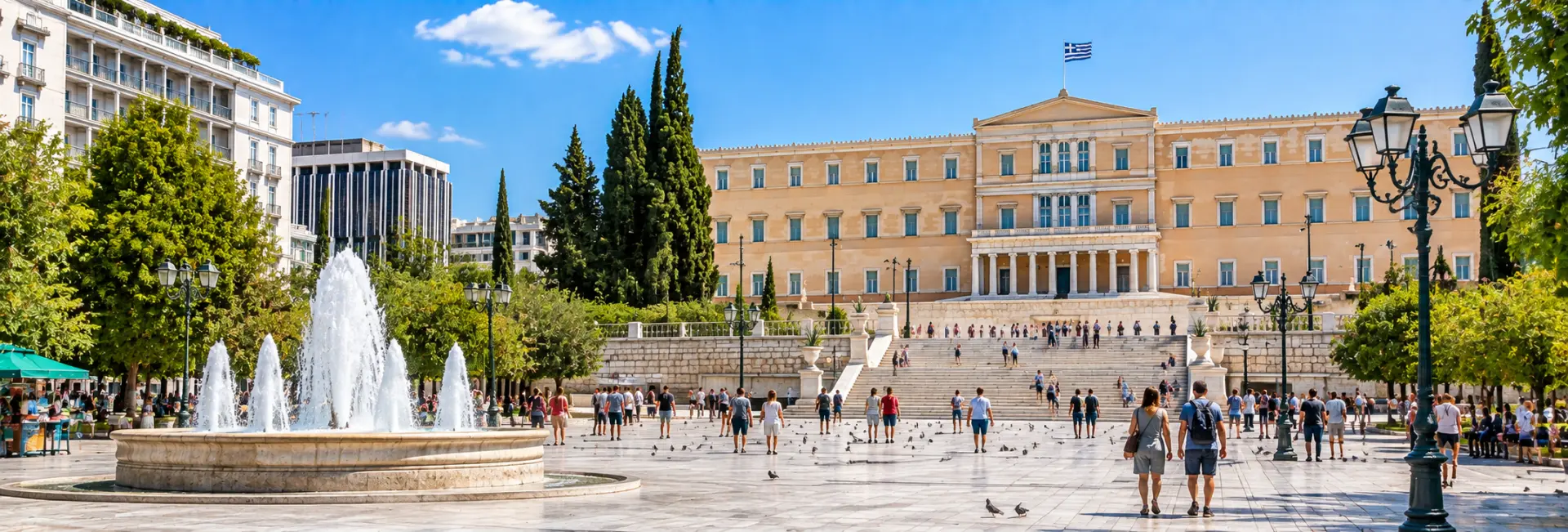
The square is bordered by Vasileos Georgiou A' Street to the north, Othonos Street to the south, Filellinon Street to the west, and Amalias Avenue to the east, with the Hellenic Parliament building standing just across Amalias Avenue. Two grassy areas planted with shade trees flank the square to the north and south, while a large marble fountain dating to the mid-19th century sits at its center.
A wide flight of marble steps on the eastern side descends toward Amalias Avenue, forming a popular gathering spot flanked by outdoor cafes. Beneath these steps lies Syntagma metro station, one of the busiest transit hubs in Greece, which doubles as a small archaeological exhibit: excavation work during construction uncovered ancient graves and sections of an old aqueduct, now displayed behind glass inside the station itself.
The square's western and southern boundaries connect almost seamlessly into the rest of central Athens, with Ermou Street beginning right at its edge and Filellinon Street running past a row of small hotels and consulates on the way toward Plaka. This central position, wedged between the Parliament, the shopping district, and the old town, is a large part of why so many visitors pass through Syntagma multiple times over the course of a single trip without necessarily planning to.
- Mid-19th century marble fountain at the center of the square
- Marble staircase and cafes on the eastern side, facing the Parliament
- Two shaded grassy areas to the north and south
- Archaeological finds from metro construction displayed inside Syntagma station
The Tomb of the Unknown Soldier and the Changing of the Guard
On the western front of the Parliament building, facing the square, stands the Tomb of the Unknown Soldier, a war memorial dedicated to Greek soldiers killed in battle. It was designed by architect Emmanuel Lazaridis and unveiled in 1932, with a relief of a fallen hoplite carved by sculptor Fokion Rok. Its marble surfaces are inscribed with extracts from Pericles' funeral oration alongside the names of key battles in Greek military history.
The tomb is guarded around the clock by the Evzones, ceremonial soldiers of the Presidential Guard dressed in a uniform derived from the clothing of the klephts, irregular fighters from the Greek War of Independence. Every hour, on the hour, two guards perform a slow, highly stylized changing routine, holding rigid poses between movements. On Sundays at 11am, the full guard, accompanied by a military band, performs an extended ceremony that draws considerably larger crowds than the standard hourly changeover.
Political & Cultural Significance
Because it sits directly across from the seat of the Greek Parliament, Syntagma Square has functioned for nearly two centuries as the country's default venue for political expression, whether celebratory or confrontational. Its role in the 1843 constitutional uprising set a precedent that has echoed through Greek history, from anti-monarchy demonstrations to the mass protests of the modern era.
At the same time, the square carries a quieter, more ceremonial significance through the Evzones and the Tomb of the Unknown Soldier, which serve as a formal expression of national memory and military tradition. The combination of an active political square and a solemn military memorial, side by side in the same public space, captures much of the tension and continuity in modern Greek civic life.
This dual identity, part protest ground and part national shrine, is not a contradiction so much as a reflection of how central Syntagma has been to Greek self-understanding since the country's earliest years as an independent kingdom. Few public spaces anywhere combine daily commuter traffic, tourist photography, formal military ritual, and the occasional mass demonstration quite as seamlessly as this one does.
Ways to Experience It
Most visitors experience Syntagma simply by passing through it on foot, since it functions as both a destination and a natural crossroads for walking around central Athens. Because so many tram, bus, and metro lines converge here, it also tends to be the point where a first-time visitor gets their initial impression of the city, whether arriving from the airport line or connecting between neighborhoods.
- Watch the hourly changing of the guard at the Tomb of the Unknown Soldier, or the larger Sunday 11am ceremony with full military band
- Sit at the marble steps or by the fountain to take in the square's constant flow of activity
- Step inside Syntagma metro station to view the archaeological finds uncovered during its construction
- Use the square as a starting point for Ermou Street, Athens' main pedestrian shopping street, which begins at its western edge
- Cross Amalias Avenue to explore the adjoining National Gardens, a shaded park behind the Parliament building
Best Time to Visit
Syntagma Square is technically a 24-hour space, but it is most engaging during the day and early evening, when cafes are busy and the changing of the guard draws steady crowds. The Sunday 11am ceremony, with the full Presidential Guard and military band, is the single best-attended and most photographed moment at the square, so arriving at least 20 to 30 minutes early is worth it for a good vantage point.
Because the square offers very little shade outside its two grassy corners, visiting in the morning or evening during the summer months is more comfortable than the midday heat. Evenings also bring dramatic building illumination around the square, adding a different atmosphere from the daytime bustle.
Visitor Tips
- Keep a respectful distance and stay quiet during the changing of the guard, as it is a formal military ceremony
- Bring sun protection, since the square has limited shade outside its two grassy areas
- Watch your belongings in the busy areas around the metro entrance and steps, as with any crowded transit hub
- Check ahead if a demonstration is planned, as the square is still a frequent gathering point for political rallies
- The square and metro station are wheelchair accessible, though individual cafes and restaurants nearby vary in accessibility
Nearby Attractions
- The Hellenic Parliament and Old Royal Palace, directly across Amalias Avenue
- The National Gardens of Athens, a shaded public park just behind the Parliament
- Ermou Street, the city's main pedestrian shopping street, beginning at the square's western edge
- Plaka, the historic old town of Athens, a short walk to the southwest
- The Temple of Olympian Zeus and Hadrian's Arch, roughly a 10 to 15 minute walk south
FAQs about visiting Syntagma Square
Why is it called Syntagma Square? +
The name means "Constitution Square" in Greek, commemorating the 1843 uprising in which citizens and army officers forced King Otto to grant the country its first constitution.
What time is the changing of the guard? +
The Evzones perform a changing ceremony at the Tomb of the Unknown Soldier every hour, on the hour, with a larger ceremony involving the full guard and a military band taking place every Sunday at 11am.
How long should I spend at Syntagma Square? +
Most visitors spend 20 to 40 minutes at the square itself, though watching the full Sunday guard ceremony or combining a visit with the nearby National Gardens can easily extend that to an hour or more.
Is Syntagma Square free to visit? +
Yes, the square, the fountain area, and the changing of the guard ceremony are all free and open to the public at any time.
Is Syntagma Square safe to visit? +
Generally yes, though as a busy transit hub it warrants normal city precautions around belongings, and it is worth checking ahead if a demonstration is scheduled, since the square remains a common site for political gatherings.
What is inside Syntagma metro station? +
Beneath the square, the metro station displays ancient graves and sections of an old aqueduct that were uncovered during its construction, visible behind glass as visitors pass through.
Is Syntagma Square wheelchair accessible? +
Yes, the square itself is flat and even, and Syntagma metro station is wheelchair accessible, though accessibility at individual surrounding cafes and restaurants varies.
What else is nearby? +
The Hellenic Parliament, National Gardens, Ermou shopping street, Plaka's old town, and the Temple of Olympian Zeus are all within easy walking distance of the square.