
Table of Contents
Overview
The Parc de la Colline du Château, usually called Castle Hill, is a green limestone hill rising about 93 meters between Old Nice and the harbor. There is no castle left to visit, but that is part of its charm. What you get instead is a shaded hilltop park of roughly 19 hectares with some of the best views on the French Riviera, a dramatic artificial waterfall, scattered medieval ruins and one of the most atmospheric cemeteries in the country.
It is also where the story of Nice begins. The hill was the site of the ancient Greek settlement, then of the medieval town and its mighty citadel, before the fortress was destroyed in 1706 and the rock was turned into a public garden. Today it is a favorite spot for locals who come to walk, picnic and watch the light change over the Baie des Anges.
Entry to the park is free, and you can reach it by a free public elevator or by climbing the stairs. Either way, it is one of the best-value outings in the city.
History of Castle Hill
The Cradle of Nice
The hill was first settled in antiquity, when Greek traders from Phocaea chose the rock as the site for a trading post. Over the following centuries the settlement grew, and by the early Middle Ages the top of the hill held a cathedral, churches and houses. In the 11th century a castle and a fortified town stood on the summit, and for roughly seven centuries the hill was the center of life in Nice.
A Mighty Citadel
After Nice came under the House of Savoy in 1388, the fortifications were strengthened, with major works recorded from 1436 onward. The citadel grew into one of the strongest fortresses on the Mediterranean coast and was besieged several times, notably in 1543, the year of the Franco-Ottoman siege linked to the local heroine Catherine Ségurane, and again in 1691.
Destruction and Rebirth
French troops took the fortress in 1705, and in 1706 Louis XIV ordered it razed, along with the cathedral, to make sure it could never be used against France. Only fragments of walls and foundations survived. In the 19th century the hill was transformed into a public garden in the spirit of the era's romantic landscaping, and the Bellanda Tower and the waterfall were added as ornamental features.
Park, Viewpoints & Waterfall
The park is laid out as a series of shaded paths, terraces and stairways that wind up the hill. Pines, Mediterranean shrubs and old trees give welcome shade, and there are lawns, a playground for children and a small kiosk selling drinks and light snacks.
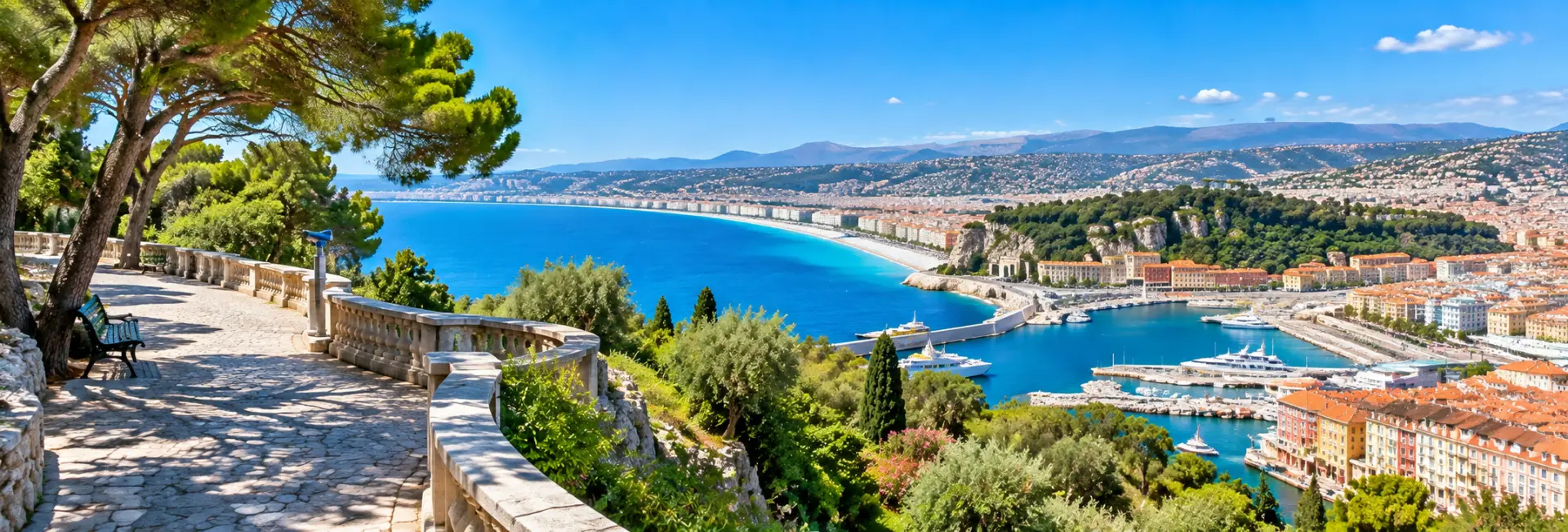
The views are the main reason people climb. From the terraces you look across the Baie des Anges and the sweep of the Promenade des Anglais, over the terracotta rooftops of Old Nice and out across the sea. On the other side of the hill, a second viewpoint looks over Port Lympia and the harbor, and on clear days you can make out mountains in the distance. The hill has been nicknamed the cradle of the sun, because you can watch the harbor catch the first light at sunrise and the promenade glow at sunset.
Near the top, a belvédère overlooks the artificial waterfall, which was built in 1885 as a decorative feature and also served as an overflow for Nice's first modern water supply. It tumbles down the rock face into a pool and gives the park a cool, green feel on hot days. The flow is not always active, so do not be surprised if it is quiet during dry periods.
Ruins & Archaeology
Very little of the old citadel survives above ground, but the park is dotted with archaeological remains. The most important are the ruins of the former Cathedral of Sainte-Marie, which stood here when the hill was the main inhabited part of the city. Excavations have also uncovered traces of a palace connected with the medieval counts, another early church dedicated to Saint John the Baptist and an associated clerical cemetery.
Information panels with reconstructed images show how the buildings looked and help you picture the medieval town that once covered the plateau. The site has been protected since the 18th century, and the ground below you still holds layers of earlier periods. If you enjoy imagining what stood in a place before you, the ruins make this a rewarding stroll rather than a quick photo stop.
Tour Bellanda & the Bellandarium
Halfway up the hill, near the elevator, the round Tour Bellanda stands guard over the Promenade des Anglais. It was built in the 19th century on the site of the old Saint-Elme tower, which had been part of the citadel's defenses until its destruction in 1706. Its purpose was not to defend but to evoke a romantic vision of the past, and it fits perfectly into the hill's landscaped design.
The tower is also linked to the composer Hector Berlioz, who stayed in Nice several times. He lodged at the Maison Clerissi near the tower in 1831, where he wrote his King Lear overture, and returned to stay in the tower itself in 1844. A plaque recalls his visits.
Today the tower houses the Bellandarium, a small museum telling the story of Nice through the history of its castle. Its terrace offers a closer, lower view of the Ponchettes and the seafront, and it is a good place to pause before or after the climb.
The Castle Hill Cemetery
On the northern side of the hill, the Castle Cemetery occupies the area once covered by the citadel and the medieval suburb. It is laid out in terraces and filled with elaborate tombs, sculptures and family chapels, making it one of the most beautiful cemeteries in Nice and often described as one of the finest in France. Several historic cemeteries are protected on the hill, and the site offers spectacular views over both the city and the mountains behind it.
The cemetery stays quiet even when the rest of the hill is busy, and its funerary architecture is a window into the city's cultural and religious diversity. A large war memorial also stands on the hill. Visitors are asked to be respectful, and the cemetery has more limited opening hours than the park, especially in winter.
Ways to Experience It
You can treat Castle Hill as a quick viewpoint stop or as a leisurely half-day outing:
- Ride the free elevator at the end of Quai des États-Unis, or climb the Lesage staircase for a more active approach
- Walk the shaded paths and linger at the Nietzsche terrace and the main viewpoints
- See the waterfall from the belvédère and stop for a drink at the kiosk
- Explore the ruins of the cathedral and read the panels that reconstruct the lost town
- Visit the Bellandarium and enjoy the tower terrace
- Walk through the cemetery for its monuments and its views
- Bring a picnic or let children use the playground
Plan for one to two hours, longer if you want to see the cemetery and ruins properly.
Best Time to Visit
By Season
Spring and autumn are ideal, with mild temperatures and clear air that make the views especially sharp. In summer the shade of the park makes it a cooler place than the beachfront, but the climb can be hot, so take water. Winter is quieter, and on clear days the light can be wonderful, though the park closes earlier.
By Time of Day
Early morning is peaceful and good for photographs of the harbor in soft light. Late afternoon is the classic time for views over the Promenade des Anglais, as the sun lowers and the bay turns golden. The park is open daily with longer hours in summer, but it generally closes in the evening, so check the schedule if you are aiming for sunset.
Visitor Tips
- Entry to the park is free, and the public elevator is free as well, though the lift does not run during rain, strikes or technical problems.
- The elevator is the step-free way up and works for wheelchairs and strollers, but the Bellanda Tower has stairs and some paths and ramps inside the park are steep or uneven.
- Wear comfortable shoes with good grip, as the stone steps and paths can be slippery when wet.
- Bring water, sun protection and a hat in warm months, because parts of the hill are exposed.
- Public toilets are available in the park, and some may charge a small fee.
- Check the opening hours for the park, the cemetery and the elevator, as they differ and change with the seasons.
- If you prefer to walk, you can climb from Old Nice via the streets and stairways that lead to the hill, then take the elevator back down to the seafront.
Nearby Attractions
Castle Hill sits at the meeting point of the old town, the harbor and the seafront, so there is plenty to see within an easy walk:
- Vieux Nice, the old town, with its markets, baroque churches and narrow streets just below the hill
- The Cours Saleya market, famous for flowers, produce and lively cafes
- The Promenade des Anglais and Quai des États-Unis, which lead straight to the elevator
- Cathédrale Sainte-Réparate, the main church of the old town
- Port Lympia, the colorful harbor on the other side of the hill
FAQs about visiting Castle Hill in Nice
Is there still a castle on Castle Hill? +
No. The medieval fortress was destroyed in 1706 on the orders of Louis XIV. Today you will find a park with a few ruins, a waterfall, a tower and a cemetery.
Is Castle Hill free to visit? +
Yes, the park and the public elevator are free to use. Check locally for the Bellandarium museum and any paid toilets.
How do I get to the top? +
The easiest route is the free elevator at the end of Quai des États-Unis near the Tour Bellanda. You can also climb the Lesage staircase or walk up from the old town via several streets and stairways.
How long should I spend there? +
Allow one to two hours for the viewpoints, waterfall and ruins. Add time if you want to visit the cemetery, the Bellandarium or have a picnic.
What is the best viewpoint? +
The terraces near the Tour Bellanda and the belvédère by the waterfall give the classic view over the Baie des Anges and Old Nice. A second viewpoint on the other side looks over the harbor.
Is it suitable for children? +
Yes. There is a playground, plenty of space to run around and a waterfall, and children usually enjoy the climb. Keep an eye on them near steep edges and stairs.
Is it open at night? +
The park generally closes in the evening, with later hours in summer. Check the posted schedule if you plan to see the sunset.
Can I visit with a wheelchair or stroller? +
The elevator gives step-free access to the park, but some paths are steep or uneven and the Bellanda Tower has stairs, so plan your route in advance.
