
Table of Contents
Overview
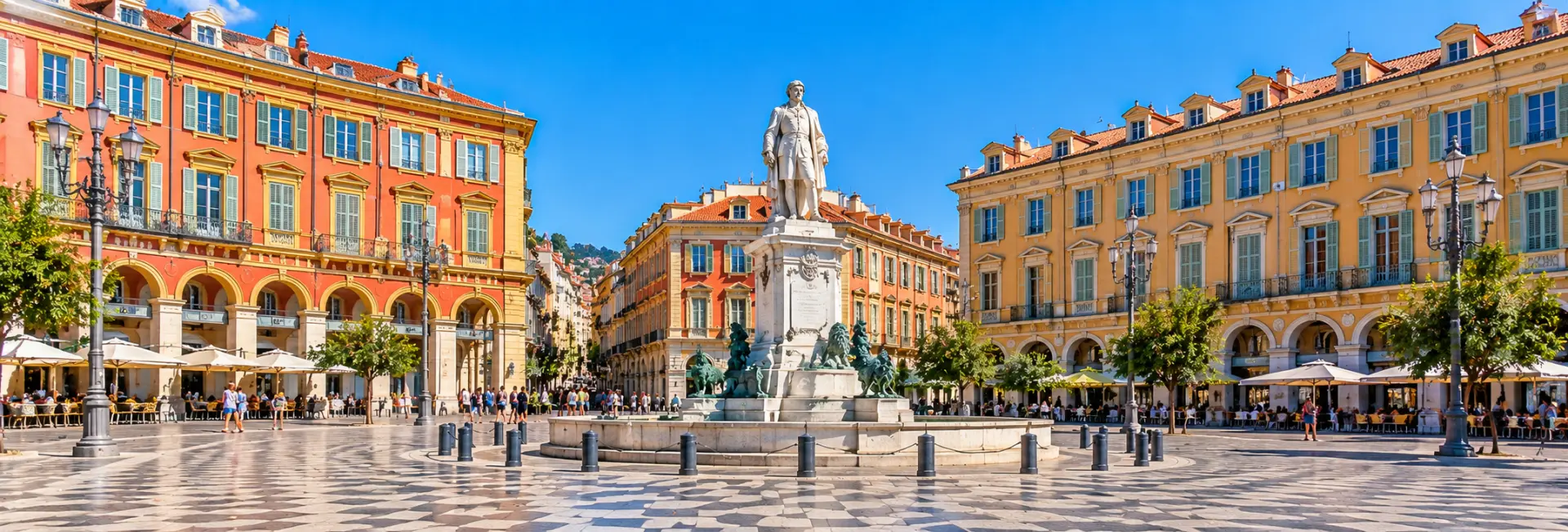
Place Garibaldi is a broad, sun-washed square on the northern edge of Vieux-Nice, where the old town gives way to the lively Port district. Ringed by ochre facades, shaded arcades and café terraces, it is widely regarded as the oldest square in Nice and one of the city's most characteristic public spaces.
At its center stands a statue of Giuseppe Garibaldi, the Italian patriot born in Nice in 1807, rising above a large circular basin. Around it, the square works on several levels at once: it is a transport crossroads, a neighborhood meeting point, a showcase of Niçois Baroque design and, hidden below the paving, a gateway to the city's medieval past.
Few places in Nice pack so many layers into a single walk. You can admire painted facades, step into a Baroque chapel, linger over a coffee, and then descend beneath the tram tracks to see the remains of a fortified town. This guide covers the story behind the square, what to look for when you arrive, and how to fit it into a day in Nice.
History
A Royal Square on the Road to Turin
The square dates to the late 18th century, when Nice belonged to the Kingdom of Sardinia, ruled by the House of Savoy. The Savoyard authorities were investing heavily in the city's northern and eastern edges, building a proper port and new districts. A new royal road to Turin, then the Savoy capital, needed a dignified starting point, and this square was designed to provide it.
Local heritage sources attribute the design to the Niçois architect Antoine Spinelli. Sources differ on the exact dates, with works usually placed in the 1770s and the formal plan credited to the early 1780s, so the safest summary is that the square took shape across those years.
Many Names for One Square
Under Savoy, the square honored the reigning king, Victor-Amédée III, and was known in the local Niçois language by a name echoing his own. During the Napoleonic era it became Place Napoléon. The name changed for good in 1870, when it was dedicated to Giuseppe Garibaldi on the proposal of the prefect of the day.
Before the Square
The ground here was not empty before the 18th century. This was the site of Nice's northern fortified entrance, part of a defensive circuit dating back to the 14th century. When the old fortifications fell out of use, the area was cleared and eventually transformed into the open civic space visitors see today. The medieval remains were rediscovered in the 2000s and now form one of the city's most surprising heritage attractions.
Who Was Garibaldi?
Giuseppe Garibaldi was born in Nice in 1807, at a time when the city was part of a Mediterranean world that looked as much toward Italy as toward France. He grew up to become one of the central figures of the Risorgimento, the movement that unified Italy in the 19th century, and his name is attached to streets and squares across Europe and the Americas.
His connection to Nice was complicated. When the County of Nice was ceded to France in 1860, many people who identified as Italian-speaking Niçois left for Genoa or Turin, and Garibaldi himself publicly resented the transfer. Even so, he admired the French Republic, and in 1870 he took command of the Army of the Vosges during the Franco-Prussian War.
Renaming the square after him that same year was a gesture of reconciliation with a native son. The statue that now dominates the square was added in 1891, the work of the sculptors Etex and Deloye, and it keeps the memory of that history in plain view of everyone crossing the square.
Architecture & Streetscape
Ochre Facades and Arcades
The most striking feature of Place Garibaldi is its color. The buildings that frame the square are painted in warm ochre and yellow tones that glow in afternoon light, and their ground floors open onto continuous arcades. Those arcades now hold shops, cafés and restaurants, giving walkers shade in summer and shelter on rainy days.
Trompe-l'oeil Details
Look up and you will notice windows, shutters and moldings that are not quite real. The painted trompe-l'oeil decoration on the facades dates to around 1800, and from a distance it is easy to mistake flat paint for carved stone. This playful illusionism is a signature of Niçois and Riviera architecture, which borrows heavily from Italian traditions.
Ironwork and Trees
The wrought-iron balconies seen on many upper floors were added in the 19th century, with the notable exception of the chapel, which keeps its own earlier details. Ornamental trees, including albizia, soften the square and add shade around the central monument.
- Uniform ochre palette that ties the whole square together
- Continuous arcades along the ground floor
- Painted architectural decoration on the upper facades
- 19th-century wrought-iron balconies
- Large central basin framing the statue
Notable Landmarks
The Statue of Giuseppe Garibaldi
The central monument is the square's visual anchor and its most photographed feature. The statue stands in a large rectangular space, surrounded by a broad basin of water whose presence helps cool the air on hot days. Benches and trees around it make it a natural spot to sit and watch the square's daily rhythm.
The Chapel of the Holy Sepulchre
On the southern side of the square stands the Chapelle du Saint-Sépulcre, built in the 18th century for the Confraternity of the Blue Penitents. Its Baroque character is typical of religious architecture in Savoyard Nice, and it completes the architectural ensemble by adding a more ornate, sacred counterpoint to the otherwise civic character of the square. Access to the interior can be limited, so it is worth appreciating the exterior even if the doors are closed.
The Tram Crossing
Modern Nice also runs straight through the square. The city's tram passes across it, and in this central zone the trams run without overhead wires, relying on onboard batteries instead. This keeps the historic skyline free of cables and is a quiet example of how Nice has blended modern transport with heritage spaces.
The Archaeological Crypt Beneath the Square
A Discovery Made by Accident
When construction began on the city's first tram line in 2006, archaeologists found unusually well-preserved remains just below the surface. Preventive excavations followed in two stages, first in the open air and then beneath a closed slab once the beams supporting the tram tracks had been placed. The result is an underground hall of around 2,000 square meters, roughly six meters below street level, preserving part of the fortified town.
What You Can See
The highlight is the Pairolière Gate and its adjoining tower, a 14th-century entrance to the walled city. The route also reveals other fortification remains and traces of the aqueduct that once supplied the ducal palace. Above your head, heavy concrete beams carry the tram line, a striking contrast between old stone and modern engineering.
Heritage Status
The crypt has been protected as a historic monument since 2012 and is often compared with the archaeological crypt beneath the Louvre for its scale and interest. The entrance is on Place Jacques Toja, beside the square, and the visit finishes under the central statue.
Ways to Experience It
Settle Into a Terrace
The simplest way to enjoy Place Garibaldi is to take a seat at one of the terraces under the arcades and watch the square change from morning to night. It works equally well for a coffee, a long lunch or an evening aperitif, and the surrounding streets offer a wide range of Niçois and Mediterranean dining.
Join the Crypt Visit
For a deeper look, the archaeological crypt offers a guided or audio-led journey through the buried fortifications. It suits curious travelers of most ages and takes less than an hour, making it easy to combine with a stroll around the square.
Walk It as Part of a Wider Route
Place Garibaldi makes a natural gateway between the old town and the harbor. Many visitors use it as a starting or finishing point for a heritage walk through the Port district or a loop that continues into the narrow streets of Vieux-Nice.
- Photography of facades, arcades and the central statue
- People-watching from a café terrace
- Guided or audio-guided crypt visit
- Self-guided walk linking the square, the Port and the old town
Best Time to Visit
By Season
Spring and early autumn are especially pleasant, with mild temperatures that suit lingering outdoors and exploring on foot. In high summer the square can be hot and busy, but the trees, arcades and basin offer welcome relief, and evenings are often the most atmospheric time to be here. Winter is quieter, and while some terraces may be less lively, the facades and the crypt remain rewarding.
By Time of Day
Morning light is soft and good for calm photography, with fewer people crossing the square. Late afternoon brings the warmest glow on the ochre walls, and the early evening is when terraces fill up and the square feels most social. The crypt, being underground, is a useful choice for midday heat or a rainy afternoon.
Visitor Tips
Getting There
Place Garibaldi is well connected by public transport. The Garibaldi - Château stop is served by the Nice tram, and the crypt can be reached from the same stop. The square is also an easy walk from Vieux-Nice and the harbor, so a car is not needed.
Practical Advice
- The square itself is open to the public at all times, and entering it is free
- Check the city's official heritage pages for current crypt access, opening days, ticketing and language options before you go
- Wear comfortable shoes, as the paving is uneven in places and the crypt involves some walking
- Be mindful of trams and cyclists when crossing the central area
- Terraces are most crowded at lunch and in the early evening, so arrive early if you want a good table
- If you visit the chapel, dress respectfully and keep noise down, as it remains a place of worship for its confraternity
The square is generally suitable for most visitors, including families and those using wheelchairs, though conditions in individual venues and the crypt should be checked in advance.
Nearby Attractions
Vieux-Nice
The old town lies just south of the square, with its narrow lanes, markets, bakeries and pastel-colored buildings. It is the obvious next stop for anyone wanting to continue exploring the historic heart of the city.
The Port District
The Port of Nice and the neighborhood around it are within an easy stroll. This area has developed a trendy reputation, with independent shops, restaurants and a more local feel than the seafront promenades.
The Castle Hill
The hill that rises above the old town was once the site of the city's castle and fortifications, which ties in directly with the story told in the crypt. It offers wide views over the bay and the rooftops of Nice.
Why Combine Them
Pairing the square with the port and old town gives a well-rounded half day that blends heritage, food and scenery without needing any transport beyond your own feet.
FAQs about visiting Place Garibaldi
What is Place Garibaldi known for? +
It is one of the oldest squares in Nice, known for its ochre arcaded facades, a central statue of Giuseppe Garibaldi, a Baroque chapel and the archaeological crypt beneath it.
Who was Giuseppe Garibaldi? +
He was an Italian patriot born in Nice in 1807 and a leading figure in the unification of Italy. The square was renamed in his honor in 1870.
Is Place Garibaldi free to visit? +
Yes, the square is a public space and can be explored at no cost at any time. Only the guided crypt visit and some activities around it may require a ticket.
How much time should I spend there? +
Plan about 30 to 45 minutes for a stroll and photos, or a couple of hours if you add a meal on a terrace and a visit to the crypt.
How do I get to Place Garibaldi? +
Take the Nice tram to the Garibaldi - Château stop, or walk from Vieux-Nice or the Port, both of which are only a few minutes away.
Can I visit the archaeological crypt? +
Yes, the crypt below the square is open to visitors, with its entrance on Place Jacques Toja. Opening days, tickets and language options change, so check the official city website before you go.
What is the best time of day to visit? +
Late afternoon and early evening are best for warm light on the facades and a lively terrace atmosphere, while mornings are calmer for photos.
Is the square suitable for kids and visitors with reduced mobility? +
Generally yes, as the space is open and largely flat, and the crypt has been designed to be accessible. It is still wise to confirm access details with the venue before visiting.
