Table of Contents
Overview
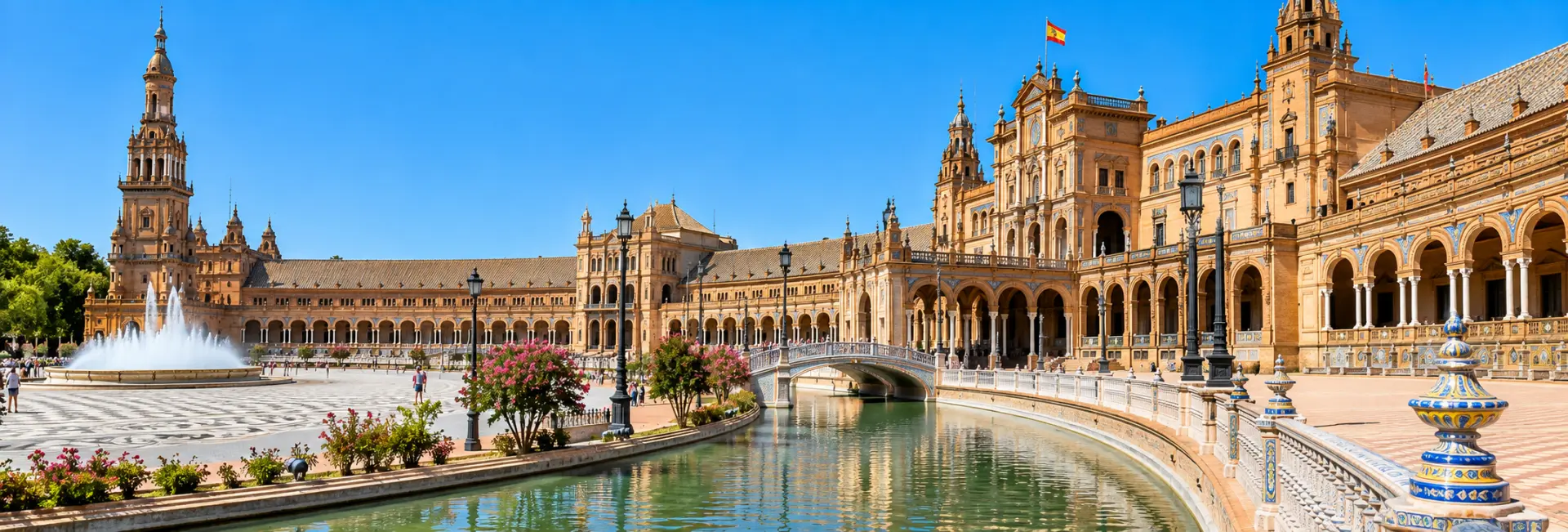
Plaza de España is the single most photographed spot in Seville that isn't a church or a palace, a sweeping semicircular building wrapped around a canal, four ornamental bridges, and a central fountain. It was built as the centrepiece of the 1929 Ibero-American Exposition, and unlike most world's fair structures it was never intended to be temporary: nearly a century later it still anchors the southern edge of the city's historic centre.
Set within the shaded gardens of Maria Luisa Park, the plaza combines huge scale with an obsessive level of decorative detail, most famously in the 48 tiled alcoves lining its base, each one dedicated to a different Spanish province. It has also become an unlikely fixture of popular culture, having stood in for locations in films ranging from Lawrence of Arabia to Star Wars.
Unlike Seville's cathedral or its royal palace, there's no ticket, no set route, and no single "correct" way to see it: visitors wander freely between the gallery, the canal, and the open plaza, which is part of why it works equally well as a quick photo stop and as somewhere to spend a full unhurried afternoon.
History
Built for a World's Fair
Plaza de España was conceived as the centrepiece of the Ibero-American Exposition of 1929, a world's fair held in Seville to strengthen cultural and economic ties between Spain, Portugal, and the countries of Latin America. Planning for the exposition had dragged on for years, delayed first by financial and logistical setbacks and then by the First World War, before finally opening on 9 May 1929 and running until June 1930.
Construction
Sevillian architect Aníbal González, chief architect of the exposition as a whole, began construction on the plaza in 1914, and building work continued for well over a decade, employing roughly a thousand workers at various stages. González oversaw most of the design and construction himself, though he stepped back from the project before its completion amid disputes over its rising cost, with other architects and engineers seeing the final stages through in time for the 1929 opening. The plaza's central fountain was designed separately by Vicente Traver. King Alfonso XIII inaugurated the completed exposition, of which the plaza was the grandest single structure, finished only weeks before the fair opened to the public.
Later Use and Restoration
After the exposition closed, the buildings were converted into offices for Spanish government agencies, a function they still serve today. Between 2007 and 2010, Seville's city council carried out a restoration costing several million euros, aimed at recovering original details such as the ceramic street lamps, benches, and paving that had deteriorated or been altered over the decades.
Architecture & Design
The plaza is built in a distinctive Regionalist style that blends Spanish Renaissance Revival and Neo-Mudéjar elements with touches of Art Deco and Baroque Revival detailing, a combination that was popular across Spain's public architecture in the early 20th century. Its footprint forms a huge semicircle roughly 200 metres across, faced with exposed brick, elaborate wrought ironwork, and dense passages of Triana-style ceramic tile.
Two towers roughly 80 metres tall anchor either end of the curved façade, visible from many points across the city and popularly said to represent the King and Queen of Spain. Between them, a covered gallery runs the length of the building beneath a coffered ceiling, offering shade and a closer look at the tilework as visitors walk its length.
The overall shape, a half-circle open toward the park and, symbolically, toward the Guadalquivir River and the Americas beyond it, was itself a deliberate piece of design: contemporaries described it as Spain extending an embrace toward its former colonies, one of several layers of symbolism built into a structure that was as much a political statement about Spain's place in the world as it was a piece of architecture.
Notable Features
The Canal and Bridges
A canal roughly 500 metres long traces the plaza's curve, giving it a nickname locals sometimes use, the "Venice of Seville." Visitors can rent small rowing boats to explore it, and four ornamental bridges cross the water at intervals, each one representing one of the medieval kingdoms that eventually unified into modern Spain: Castile, León, Aragón, and Navarre.
The Alcoves of the Provinces
Running along the base of the building are 48 tiled alcoves, each fitted with a bench and dedicated to one of Spain's provinces as they existed in 1929. Every alcove follows the same basic layout: a painted historical scene at the back, a tiled map of the province set into the floor, and the region's coat of arms, flanked by a pair of built-in bookshelves that today function informally as small free-book exchanges. Spanish visitors often seek out the alcove for their own home province to take a photograph.
The Central Fountain
At the heart of the plaza sits the fountain designed by Vicente Traver, a focal point that draws the eye down the length of the gallery from almost any point along the curve and provides one of the most reliably photographed views of the entire complex.
Recognition & Cultural Significance
The buildings that make up Plaza de España were declared a Bien de Interés Cultural, the highest level of heritage protection under Spanish law, in the category of monument in 2023, formally recognising the complex's architectural and historical importance. It sits within Maria Luisa Park, itself a landmark of early 20th-century landscape design, though the plaza is a separate site from the nearby Cathedral, Alcázar, and Archive of the Indies, which hold their own joint UNESCO World Heritage listing.
Beyond its architectural standing, the plaza has taken on a life of its own in popular culture. It appeared as a backdrop in Lawrence of Arabia in 1962, and more famously stood in for the city of Theed on the planet Naboo in Star Wars: Episode II – Attack of the Clones in 2002, a connection that continues to draw fans of the franchise decades later. It has also featured in later productions, including the 2012 comedy The Dictator and the Netflix series Kaos, and has served as a backdrop for music videos and countless wedding and portrait photographs.
Ways to Experience It
The plaza is an open public space with free access, so most visits are entirely self-guided: walking the length of the gallery, crossing the bridges, and browsing the tiled alcoves takes most visitors an hour or two at a relaxed pace.
- Walking the gallery: covers the full sweep of the building and its coffered ceiling detail
- Renting a rowing boat: a popular way to see the canal and bridges from the water
- Guided walking tours: many Seville tours pair the plaza with nearby Maria Luisa Park and the Cathedral-Alcázar area
- Climbing to the first-floor balconies: offers an elevated view over the plaza and canal
Because the buildings themselves now house government offices, most interiors are not open to the public, and the experience is centred on the plaza's exterior, gallery, and grounds rather than a guided interior tour.
Best Time to Visit
Early morning and early evening are the most comfortable times to visit, both for lighter crowds and for avoiding the direct sun that floods the open central area of the plaza, which offers little shade outside the covered gallery. Late afternoon light also tends to bring out the colour in the tilework more vividly than the flatter light of midday.
Visiting outside the summer months, roughly September through May, is generally more comfortable given how intense Seville's summer heat can be in the open parts of the square. The plaza is illuminated after dark and takes on a noticeably different, more atmospheric character in the evening, making it worth a second visit for anyone staying in the city for more than a day or two.
Visitor Tips
- Bring sun protection: sunglasses, sunscreen, and a hat are worth having, since the central plaza offers little shade
- Wear comfortable shoes: the plaza is large, and a full loop involves a fair amount of walking
- Visit early or late in the day during summer to avoid the worst of the heat
- Look for your home region's alcove if travelling from Spain, a small tradition many visitors enjoy
- Combine the visit with a walk through the adjoining Maria Luisa Park, which offers shaded paths and additional monuments
- Note that the buildings themselves are government offices, so plan on an exterior and plaza visit rather than an interior tour
Nearby Attractions
Plaza de España sits at the edge of Maria Luisa Park, within reach of several other major sights in southern Seville.
- Maria Luisa Park, the shaded gardens surrounding the plaza, with fountains, pavilions, and walking paths
- Plaza de América, another square from the 1929 exposition, further into the park
- Seville Cathedral and the Royal Alcázar, a walk of roughly 15 to 20 minutes toward the historic centre
- Prado de San Sebastián, a transport hub useful for onward travel by bus or tram
- University of Seville, housed in the former Royal Tobacco Factory near the plaza's entrance
FAQs about visiting Plaza de España
What is Plaza de España known for? +
It's known for its grand semicircular building, the 48 tiled alcoves representing Spain's provinces, the canal and bridges running along its front, and appearances in films including Star Wars: Episode II.
Is Plaza de España free to visit? +
Yes, it's an open public plaza with free access at all times, though renting a rowing boat on the canal carries a small separate cost.
How long does a visit take? +
Most visitors spend one to two hours walking the gallery, crossing the bridges, and browsing the provincial alcoves at a relaxed pace.
Can I go inside the buildings at Plaza de España? +
No, the buildings now house Spanish government offices, so the visit centres on the plaza's exterior, covered gallery, and grounds rather than the interior.
Why does Plaza de España look like it's in Star Wars? +
Its courtyards and gallery were used as exterior filming locations for the city of Theed on the planet Naboo in Star Wars: Episode II – Attack of the Clones, released in 2002.
Is Plaza de España part of Seville's UNESCO World Heritage Site? +
No, it's a separate 20th-century monument with its own heritage protection; the UNESCO listing covers the nearby Cathedral, Royal Alcázar, and General Archive of the Indies.
What's the best time of day to visit? +
Early morning or early evening tend to offer the most comfortable temperatures, better light for photos, and fewer crowds than the middle of the day.