Table of Contents
Overview
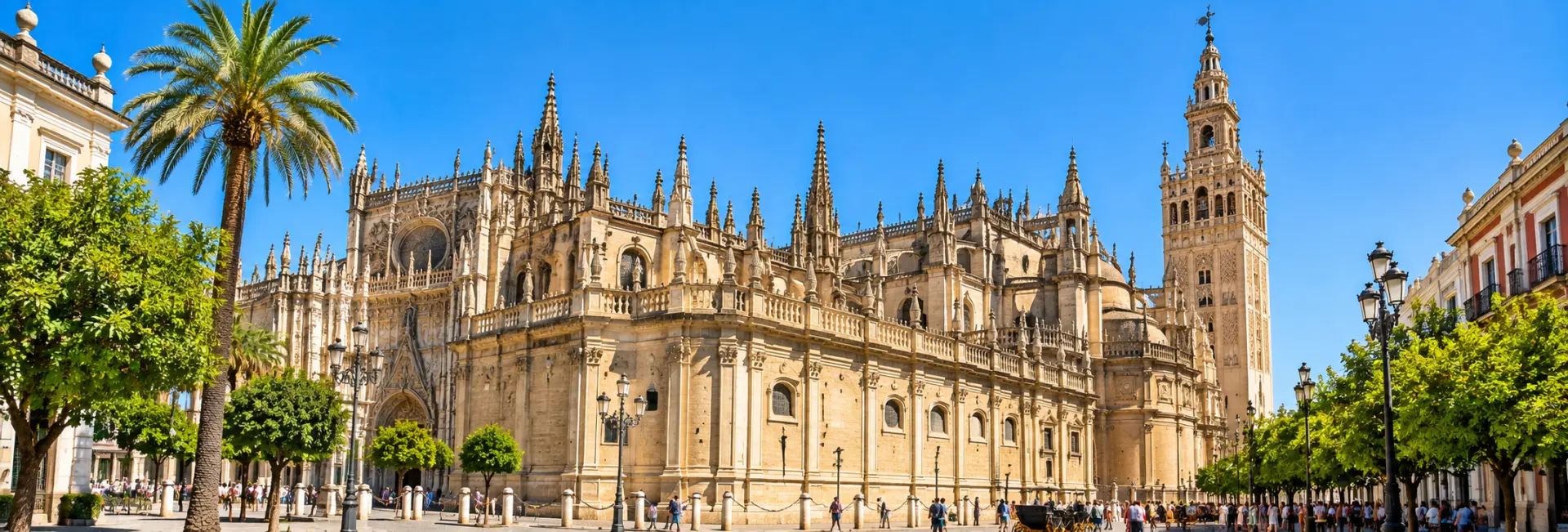
Seville Cathedral is, by most measures, the largest Gothic cathedral in the world, and after its completion in the early 16th century it briefly stood as the largest cathedral of any style anywhere on earth. Its scale alone would make it remarkable, but what makes a visit genuinely memorable is the layering underneath that scale: the building rises directly over the foundations of a 12th-century mosque, and its bell tower, the Giralda, began life as that mosque's minaret.
Standing beside the Royal Alcázar in the heart of Seville's historic centre, the cathedral is both an active place of Catholic worship and one of the most visited monuments in Spain, drawing visitors for its sheer size, its art collection, and the climb up the Giralda for views across the city.
Few buildings anywhere manage to combine a working religious community, a major art collection, and a physical record of over a thousand years of Andalusian history in one continuous structure, and that combination is a large part of what draws people here even among visitors who have already seen dozens of European cathedrals.
History
From Mosque to Cathedral
The site was originally home to Seville's Great Mosque, built by the Almohad caliph Abu Yaqub Yusuf between 1172 and 1198. After the Castilian king Fernando III captured Seville from the Almohads in 1248, the mosque was converted into a Christian church, a use it served for over 150 years while retaining much of its original Islamic structure.
Building the Gothic Cathedral
By the early 1400s, church authorities decided the converted mosque no longer matched Seville's ambitions, and in 1401 they resolved to demolish most of it and build an entirely new cathedral in its place. According to a chapter statement often quoted since, they set out to build a church "so beautiful and so great that those who see it finished will think we were mad." Construction began around 1401 to 1402 and continued for roughly a century, with the cathedral consecrated in 1507 and substantially complete in the following years. Architects and master builders across that century included figures such as Alonso Martínez and Pedro Dancart, whose successive work on the vaults, chapels, and altarpiece shaped the building generation by generation rather than to a single unified plan. The building's central dome collapsed twice over the centuries, once in 1511 and again in 1888 after an earthquake, and was rebuilt on both occasions, a reminder of how ambitious, and structurally risky, the original design was.
Recognition
Seville Cathedral was declared a Spanish national monument in 1928, and in 1987 it was inscribed as a UNESCO World Heritage Site together with the neighbouring Royal Alcázar and the General Archive of the Indies, recognising all three as a single interconnected historic ensemble.
Architecture & The Giralda Tower
The cathedral's five naves and forest of columns cover a total area of roughly 23,500 square metres, with the central nave rising around 42 metres, dimensions that place it among the largest church interiors anywhere in the world. Despite being built almost entirely in the Gothic style, later centuries added Renaissance and Baroque elements, including the Royal Chapel and grand sacristies, so the building today reads as a layering of styles rather than a single moment frozen in time. Walking its length from the main entrance to the Capilla Mayor gives a real sense of that scale, with columns receding into shadow on either side and vaulted ceilings that seem to disappear upward into darkness.
The Giralda
The Giralda, the cathedral's bell tower, is the clearest surviving link to the site's Islamic past. Its lower two-thirds formed the minaret of the original Almohad mosque, while a Renaissance belfry and weathervane were added on top in the 16th century, bringing its total height to roughly 104 metres. Rather than stairs, the tower is climbed via 34 gently sloping ramps, originally designed so the muezzin could ride up on horseback to call the call to prayer, a detail that still surprises visitors expecting a conventional spiral staircase.
Patio de los Naranjos
Alongside the Giralda, the Patio de los Naranjos, or Courtyard of the Orange Trees, survives from the old mosque's ablution courtyard. Planted with rows of orange trees and centred on an old fountain, it offers a quieter, more intimate space that contrasts sharply with the cathedral's vast Gothic interior just steps away.
Interior Highlights & Treasures
The Retablo Mayor
The Capilla Mayor houses the cathedral's Retablo Mayor, one of the largest and most elaborately carved altarpieces in the Christian world. Begun in the late 15th century and completed over several generations of woodcarvers and gilders, it rises in tiers of gilded relief scenes from the life of Christ and the Virgin, dominating the space in front of it.
Tomb of Christopher Columbus
Near the cathedral's entrance stands the elaborate tomb of Christopher Columbus, his coffin raised aloft by four large sculpted figures representing the medieval kingdoms of Castile, León, Aragón, and Navarra. Whether Columbus's actual remains lie here or in Santo Domingo has been debated since the 18th century; DNA testing carried out in the 2000s confirmed a partial match with descendants, which most historians take as reasonably strong evidence, though the question has never been settled beyond all doubt.
Chapels, Art, and the Choir
Dozens of side chapels line the cathedral's aisles, many holding paintings by major Spanish artists including Murillo, Zurbarán, Goya, and Velázquez. The Coro, a large enclosed choir set into the central nave, contains rows of intricately carved wooden stalls blending Gothic and Mudéjar craftsmanship, while the Royal Chapel at the building's head holds the tombs of Fernando III, the king who took Seville from the Almohads, and his son Alfonso X.
Cultural & Religious Significance
Seville Cathedral remains an active seat of the Archdiocese of Seville and a working church, hosting regular Mass and major religious feast days alongside its role as a monument. Its sheer scale was itself a statement: the decision in 1401 to demolish a functioning mosque-turned-church and replace it with the largest cathedral its builders could imagine reflected Seville's growing wealth and confidence following the Christian reconquest.
The building's layered history, Islamic minaret, Gothic nave, Renaissance chapels, also makes it a physical record of Seville's transition from a major city of Al-Andalus to a centre of Christian Spain and, later, of Spain's trade with the Americas, a period the neighbouring Archive of the Indies documents in detail. Seville's role as the exclusive port for trade with the Americas during much of the colonial period brought enormous wealth into the city, and a share of that wealth is visible in the cathedral's later chapels, sacristies, and art commissions.
Ways to Experience It
Most visits combine the cathedral interior with a climb up the Giralda, and many visitors also purchase a joint ticket covering the nearby Royal Alcázar given their shared UNESCO listing and proximity.
- General admission: covers the main cathedral, chapels, the Retablo Mayor, and Columbus's tomb
- Giralda climb: included with general admission, ascended via ramps rather than stairs
- Rooftop tours: a separate, often pre-booked option offering closer views of the exterior stonework and flying buttresses
- Audio guides and guided tours: available in multiple languages for a deeper look at the art and architecture
Because opening hours, ticket prices, and rooftop tour availability change periodically, and children under a certain age are sometimes restricted from rooftop routes, it's worth checking current details before planning a visit.
Best Time to Visit
Arriving soon after opening, or later in the afternoon, generally means shorter queues than the late-morning peak, when tour groups and cruise-ship visitors tend to arrive in the largest numbers. Because much of the interior sits in dim, atmospheric light, weather has less impact on the visit itself than it does for the cathedral's gardens or nearby outdoor sights.
Spring and autumn bring more comfortable temperatures for the Giralda climb and any time spent outdoors in the Patio de los Naranjos, while summer in Seville can be intensely hot, making an early or late visit more comfortable than the middle of the day.
Visitor Tips
- Book tickets online in advance where possible, since queues at the door can be long during peak season
- Wear comfortable shoes for the Giralda's long ramped ascent, which is more walking than a typical staircase
- Dress modestly, covering shoulders and knees, as is customary for an active place of Catholic worship
- Set aside at least 90 minutes to see the main highlights without rushing, longer if adding the Giralda and side chapels
- Check rooftop tour age restrictions in advance if travelling with young children
- Consider a combined ticket with the Royal Alcázar to save time and cost across both sites
Nearby Attractions
The cathedral sits at the centre of a cluster of major sights, all within easy walking distance in Seville's historic core.
- Royal Alcázar of Seville, sharing the same UNESCO listing and directly adjacent
- General Archive of the Indies, the third site in the joint World Heritage inscription
- Plaza Virgen de los Reyes, the square in front of the Giralda and Archbishop's Palace
- Barrio de Santa Cruz, Seville's historic former Jewish quarter
- Torre del Oro, a riverside watchtower a short walk toward the Guadalquivir
FAQs about visiting Seville Cathedral
What is Seville Cathedral known for? +
It's known as the largest Gothic cathedral in the world, built on the site of a former Almohad mosque, and for housing both a monumental gilded altarpiece and the tomb of Christopher Columbus.
Is the Giralda tower part of the cathedral? +
Yes. The Giralda is the cathedral's bell tower, and its lower section was originally the minaret of the mosque that stood on the site before the Gothic cathedral was built.
Is Christopher Columbus really buried in Seville Cathedral? +
His elaborate tomb sits inside the cathedral, and DNA testing has shown a partial match with descendants, though whether all of his remains are here rather than in Santo Domingo has been debated for centuries.
How long does a visit to Seville Cathedral take? +
Most visitors spend around 90 minutes to two hours covering the main cathedral, the Giralda climb, and a selection of chapels and artwork.
Do I need to dress a certain way to visit? +
Yes. As an active place of worship, modest dress covering shoulders and knees is expected for all visitors.
Is Seville Cathedral connected to the Royal Alcázar? +
They stand right next to each other and were jointly inscribed as a UNESCO World Heritage Site in 1987 along with the General Archive of the Indies, and combined tickets covering both are commonly available.
Can I climb the Giralda tower? +
Yes, general admission includes the climb, which is done via 34 sloping ramps rather than a staircase, originally designed to allow horseback ascents.