Table of Contents
Overview
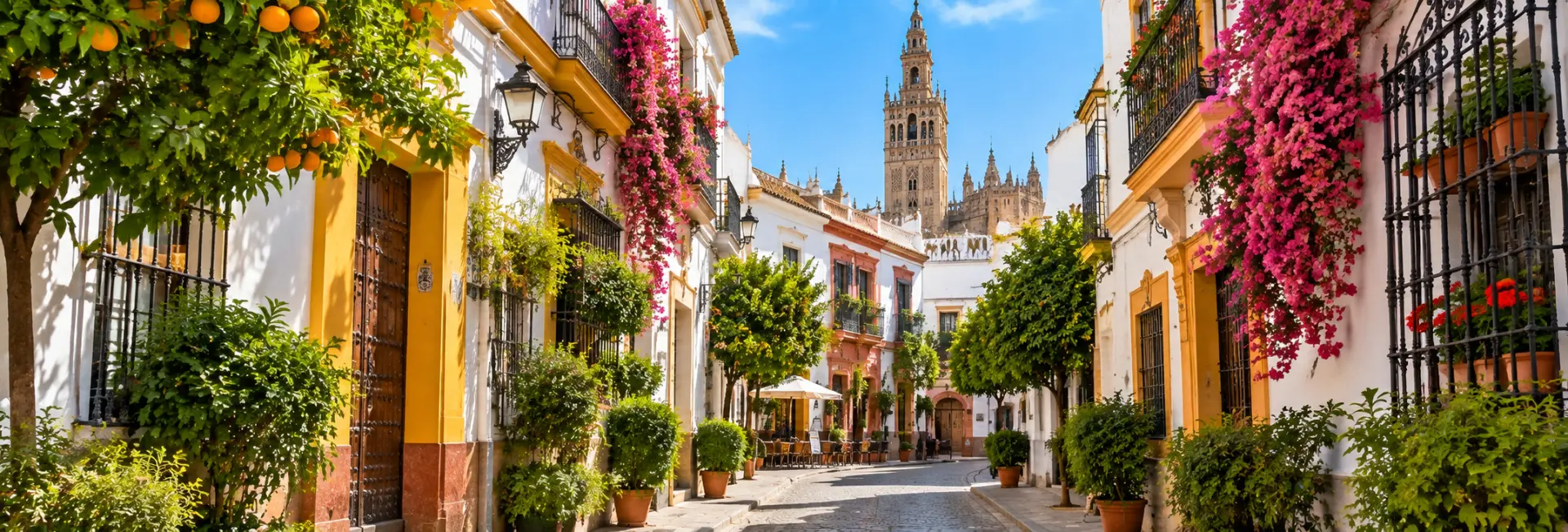
Tucked behind Seville Cathedral and the Real Alcázar, the Santa Cruz Quarter is a tangle of narrow, whitewashed streets that once formed the city's medieval Jewish quarter, or judería. Its scale is intimate rather than monumental: small plazas shaded by orange trees, wrought-iron gates opening onto tiled courtyards, and alleys so tight that neighbours could once lean out of opposite windows and touch hands.
Today it is Seville's most walked historic neighbourhood, threading together some of the city's best-known sights while keeping a village-like character of its own. Getting lost here on purpose, without a fixed route, is one of the more reliable ways to understand what draws visitors to Seville's old town in the first place.
History
The Medieval Judería
After King Ferdinand III of Castile took Seville from Muslim rule in 1248, the city's Jewish community was settled into this district, which grew into the second-largest Jewish quarter in Spain after Toledo's. Several former mosques in the area were converted into synagogues for the community, and the quarter developed as a distinct, semi-enclosed neighbourhood with its own gates and walls.
Decline and Expulsion
Relations between the Jewish quarter and the surrounding city deteriorated over the following century, culminating in a violent attack on the neighbourhood in 1391 that ended Jewish self-governance there; its synagogues were converted into churches soon after, including what is now Santa María la Blanca. The Alhambra Decree of 1492 then ordered the expulsion of Spain's Jewish population entirely, after which the quarter fell into a long period of decline and neglect.
A Twentieth-Century Revival
The neighbourhood's romantic, labyrinthine character as it exists today owes much to a deliberate remodelling in the early 20th century, led by the municipal architect Juan Talavera y Heredia in the years before Seville's 1929 Ibero-American Exposition. City plans at the time considered cutting wide new avenues through the district; local preservationists, including the Marqués de Vega-Inclán, successfully argued against it, and the historic street pattern was kept largely intact and restored rather than replaced.
Recognition & Status
The Santa Cruz Quarter forms part of Seville's historic centre, one of the largest in Europe, which was declared a Conjunto Histórico-Artístico (a nationally protected historic-artistic ensemble) in 1962. It sits immediately adjacent to the Cathedral, Alcázar, and General Archive of the Indies, which together were inscribed as a UNESCO World Heritage Site in 1987, making Santa Cruz the residential quarter that grew up in the shadow of one of Spain's most significant monumental complexes.
Architecture & Streetscape
Whitewashed Houses and Hidden Patios
Most buildings in Santa Cruz follow the traditional Sevillian townhouse pattern: plain, whitewashed street facades that give little away, opening inward onto tiled courtyards filled with potted plants, climbing bougainvillea, and often a central fountain. Wrought-iron gates (cancelas) at street level let passersby glimpse these private patios without entering them, a detail that has become one of the neighbourhood's signature sights.
Narrow Lanes by Design
The district's alleys are narrow by intention rather than accident, laid out to trap shade and funnel breezes through the neighbourhood during Seville's long, hot summers. Some, such as the Callejón del Agua, run directly alongside the old Alcázar walls, while others are barely wide enough for two people to pass, giving rise to the popular nickname "kissing lanes" for the tightest of them.
Key Areas & Squares
Rather than one continuous street plan, Santa Cruz is best understood as a string of small squares connected by winding lanes.
- Plaza de Santa Cruz- the square that gives the district its name, built over the site of a demolished 17th-century church and marked by an ornate wrought-iron cross at its centre
- Plaza de Doña Elvira- a quiet, tree-lined square with a central fountain, said to be where open-air theatre performances were once staged
- Plaza de los Refinadores- a small garden square holding a statue of the legendary Don Juan Tenorio, a character closely associated with the neighbourhood's literary lore
- Callejón del Agua- a shaded, romantic passage running along the Alcázar's garden walls, named for the water channel that once ran along the top of it
Notable Landmarks
Several individual buildings within the quarter reflect its layered religious and cultural history.
- Iglesia de Santa María la Blanca- a former synagogue converted into a Baroque church, with painted ceilings by the Sevillian artist Murillo
- Hospital de los Venerables- a 17th-century former home for elderly priests, now a cultural centre with a notable Baroque courtyard and chapel
- Casa de Murillo- a modest house on Calle Santa Teresa associated with the painter Bartolomé Esteban Murillo, who lived and worked in the district
- Casa de Pilatos- a grand Andalusian palace on the district's edge, blending Gothic, Mudéjar, and Renaissance styles around a series of tiled courtyards
Ways to Experience It
Santa Cruz rewards unhurried, on-foot exploration more than any single ticketed activity.
- Follow a self-guided walk between its main squares, allowing time to double back down side streets that catch your eye
- Join a guided walking tour focused on the district's Jewish history and legends, widely offered by local operators
- Take an evening tapas route through the neighbourhood's bars, many clustered around Plaza de la Alfalfa and Calle Mateos Gago
- Combine a visit with the adjoining Cathedral, Giralda, and Real Alcázar, all reachable on foot within the same outing
Best Time to Visit
Early morning and early evening are the most comfortable times to walk through Santa Cruz, particularly from late spring through summer, when the narrow streets trap heat during the middle of the day. Spring brings orange blossom and jacaranda in bloom across the district's squares, while a visit around Easter or the April Fair coincides with some of the city's most significant annual celebrations, alongside larger crowds.
Visiting slightly outside peak midday hours also means quieter squares and better light for photographing the whitewashed facades and courtyard gates that define the neighbourhood.
Visitor Tips
- Wear comfortable, flat shoes, since streets are cobbled and often uneven underfoot
- Carry a paper map or offline map, as mobile signal and GPS can be unreliable in the narrowest alleys
- Respect that many courtyards visible through iron gates are private homes, not public attractions
- Expect tourist-oriented shops and restaurants near the main squares; quieter, more authentic corners are usually a street or two further in
- Visit key landmarks like Santa María la Blanca earlier in the day to avoid the largest tour groups
FAQs about visiting the Santa Cruz Quarter
What is the Santa Cruz Quarter known for? +
It's Seville's former medieval Jewish quarter, known today for its narrow whitewashed streets, hidden courtyards, and small orange-tree-lined squares in the heart of the old town.
Is Santa Cruz free to visit? +
Yes, walking through the neighbourhood is free; only specific sites within or near it, such as certain churches or museums, may charge an entrance fee.
How much time do you need to see Santa Cruz? +
A couple of hours is enough for a relaxed walk through the main squares, though many visitors return more than once during a longer stay in Seville.
Is Santa Cruz safe to walk around at night? +
Yes, it's generally considered one of Seville's safer central neighbourhoods and is popular for evening walks and tapas, though the usual city-centre precautions still apply.
Is the Santa Cruz Quarter easy to navigate? +
Not particularly- its winding, similarly named lanes are easy to get lost in, which most visitors treat as part of the charm rather than a problem.
What's the connection to Seville's Jewish history? +
The district was home to Spain's second-largest Jewish community until a violent attack in 1391 and the 1492 expulsion decree ended Jewish life there, with several former synagogues later converted into churches.
What should I combine a visit with? +
Seville Cathedral, the Giralda, and the Real Alcázar all border the quarter and pair naturally with a walk through its streets.