Table of Contents
Overview
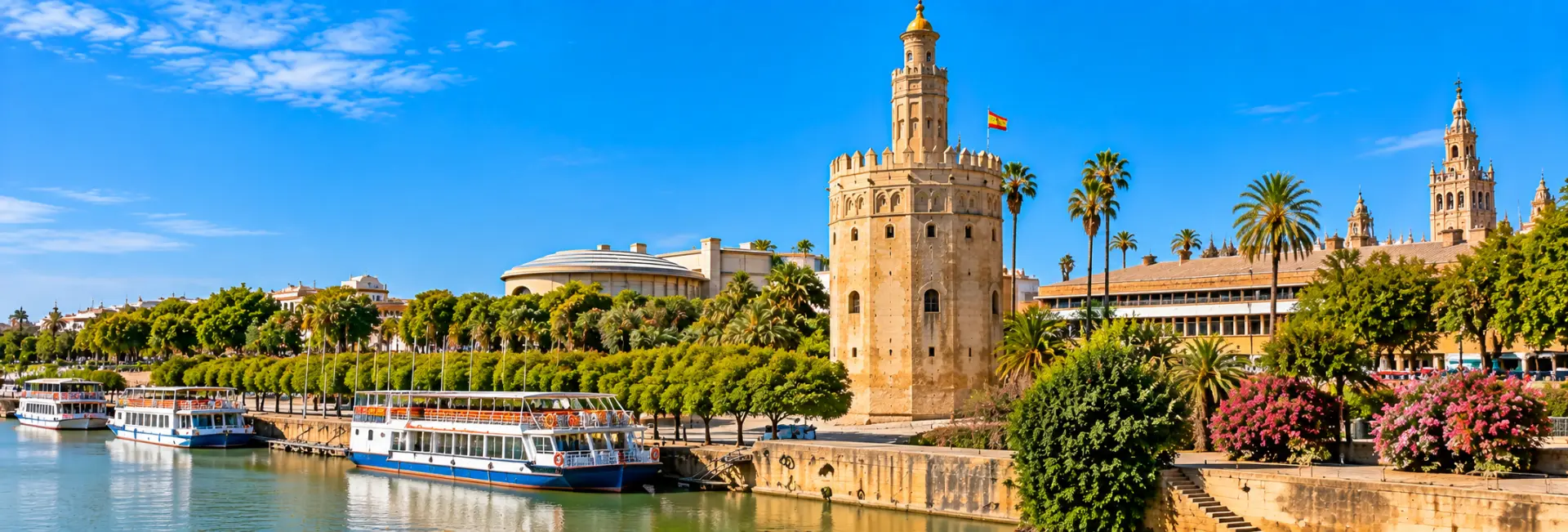
Standing on the left bank of the Guadalquivir River, the Torre del Oro is one of Seville's oldest surviving monuments, a squat, twelve-sided watchtower built by the city's Almohad rulers in the early 13th century. Its name, "Tower of Gold," comes from the warm glow its original building materials once cast across the water rather than from any literal gold used in its construction.
Today the tower houses a small naval museum tracing Seville's long relationship with the river and the sea, and its rooftop terrace offers one of the more accessible river views in the city centre. Compact and easy to visit in under an hour, it pairs naturally with a walk along the riverside promenade or a stop at the nearby bullring.
History
An Almohad Watchtower
The tower's oldest section was built between 1220 and 1221 under the Almohad governor of Seville, Abu al-Ula, as part of the city's river defences. It formed one end of a chain strung across the Guadalquivir to a matching tower on the opposite bank, blocking enemy ships from reaching the port, a defence that ultimately failed when Castilian forces broke through during the siege of Seville in 1248.
Later Additions
A second, smaller tier was added above the original Almohad structure in the 14th century under King Peter of Castile, and the tower took on a range of uses over the following centuries, serving at various points as a chapel, a prison for nobles, and a store for gunpowder. The original twin tower across the river, along with the defensive chain itself, was lost over time and no longer survives.
Earthquake Damage and Rebuilding
The 1755 Lisbon earthquake seriously damaged the tower's upper section, and city authorities briefly considered demolishing it entirely to widen the road toward the Triana bridge. Public objection saved the structure, and in 1760 the military engineer Sebastián Van der Borcht rebuilt the top as a cylindrical, dome-capped tier, giving the tower the three-part silhouette still visible today.
Architecture & Design
Three Tiers, Three Eras
The Torre del Oro's structure reflects its layered construction history: a twelve-sided Almohad base from the 13th century, a smaller twelve-sided second tier added under Peter of Castile in the 14th century, and a circular, dome-topped third tier added in the 18th century after earthquake damage. Standing around 36 metres tall, the tower's mixed geometry is unusual among Seville's historic monuments, most of which were built in a single sustained campaign.
The Source of Its Colour
For centuries it was assumed the tower's golden appearance came from decorative tilework, but restoration work in the 2000s confirmed that the colour instead comes from its original building material, a mixture of lime mortar and pressed straw that gave the stonework a warm, golden tone in sunlight. Traces of this original surface can still be seen on parts of the lower tier.
Recognition & Status
The Torre del Oro was declared a Spanish historical-artistic monument in 1931, formally protecting it as a site of national heritage value. It remains under the stewardship of the Spanish Ministry of Defence, which has overseen its use as a naval museum since the tower was formally handed to the Spanish Navy in 1870.
What to See There
The Naval Museum
Spread across the tower's lower two floors, the museum traces Seville's maritime history from its Almohad-era defences through the height of Spanish transatlantic trade. Exhibits include ship models, historical maps, navigational instruments, and material relating to the Magellan-Elcano expedition, the first voyage to circumnavigate the globe, which departed from Seville.
The Panoramic Terrace
A narrow staircase leads up to a small rooftop terrace at the top of the tower, offering views along the Guadalquivir toward the Triana neighbourhood on the opposite bank and back toward the historic centre. It's a compact but worthwhile payoff after climbing through the museum floors below.
Ways to Experience It
- Visit the naval museum and climb to the rooftop terrace, typically taking 30 to 45 minutes in total
- Combine a visit with a walk or bike ride along the Paseo de Cristóbal Colón riverside promenade
- Photograph the tower from across the river in Triana, particularly in the late afternoon light
- Take a river cruise departing from near the tower for a view of Seville's skyline from the water
Best Time to Visit
Mornings on weekdays tend to be quieter, since the tower is a compact stop that many visitors fold into a longer riverside walk rather than a dedicated outing. Late afternoon offers the best light for photographing the tower's golden tone against the river, particularly viewed from the Triana side of the Guadalquivir.
Visitor Tips
- Check opening days in advance, as the museum is typically closed on public holidays
- Entry is inexpensive, with free admission offered on certain days of the week
- Wear comfortable shoes for the narrow staircases leading up through the tower's floors
- Combine a visit with the nearby Plaza de Toros de la Maestranza, just a short walk along the river
- Allow time to walk across to Triana for a view of the tower from the opposite riverbank
Nearby Attractions
- Plaza de Toros de la Maestranza, Seville's historic bullring, a short walk north along the river
- Triana neighbourhood, reachable by crossing the Isabel II Bridge just north of the tower
- Seville Cathedral and La Giralda, a short walk inland toward the historic centre
- Archivo de Indias, within easy walking distance to the northeast
FAQs about visiting Torre del Oro
What is the Torre del Oro? +
It's a 13th-century Almohad watchtower on the Guadalquivir River in Seville, now home to a small naval museum and a rooftop viewing terrace.
Why is it called the Tower of Gold? +
The name comes from the golden glow its original lime-and-straw mortar cast on the river, not from any gold used in its construction, as was confirmed during restoration work in the 2000s.
How long does a visit take? +
Most visitors spend around 30 to 45 minutes touring the museum floors and climbing to the rooftop terrace.
Is it worth visiting if I'm not interested in naval history? +
Yes, the building's architecture and history, along with its river views, make it worth a short visit even without a strong interest in the museum's exhibits.
Is the Torre del Oro free to visit? +
Entry is inexpensive, and it's typically offered free on certain days of the week; check current details before visiting.
What's nearby? +
The Plaza de Toros de la Maestranza, the Triana neighbourhood, and Seville Cathedral are all within easy walking distance.
Does the tower have accessibility for wheelchairs? +
The tower's narrow historic staircases can be difficult for visitors with mobility limitations; check current accessibility information before planning a visit.