Table of Contents
Overview
The Royal Alcázar of Seville is often introduced with a single striking fact: it is the oldest royal palace in Europe still in active use, with the Spanish royal family maintaining an official residence in its upper floors to this day. That living connection sets it apart from most of the historic palaces visitors encounter elsewhere, where royalty moved out centuries ago and left the building to museums.
Behind its walls, more than a thousand years of building history sit side by side. Moorish fortifications, a 14th-century Mudéjar palace built for a Christian king in an Islamic style, Gothic halls, Renaissance additions, and sprawling gardens all coexist within a single walled complex in the heart of Seville, just steps from the city's cathedral.
What makes a visit here different from touring a single-period monument is precisely that layering: walking from one courtyard to the next means crossing several centuries of Spanish history in a matter of minutes, from Almohad fortification through Christian reconquest to Renaissance court life and on to the palace's continued modern-day use.
History
Moorish Foundations
The site began life as a fortified palace built by Muslim rulers in the 10th century, on ground that had already seen earlier Roman and Visigothic settlement. The Abbadid dynasty expanded it into a larger palace complex in the 11th century, and the Almohads added further fortifications and buildings during the 12th and early 13th centuries, shaping the walled enclosure that still frames the complex today.
Pedro I's Mudéjar Palace
After the Christian conquest of Seville in 1248, the site was progressively rebuilt by Castilian monarchs. Its defining transformation came under King Pedro I of Castile, who between 1364 and 1366 commissioned an entirely new palace built by Islamic craftsmen brought from Granada and Toledo. Rather than rejecting Moorish design, Pedro I deliberately echoed the aesthetic of the Nasrid rulers of Granada, producing what is today considered the finest surviving example of Mudéjar architecture anywhere in the world.
Later Additions
Subsequent monarchs kept building. Alfonso XI added a Gothic Hall of Justice with Mudéjar plasterwork in the first half of the 14th century, and the Catholic Monarchs, Ferdinand and Isabella, later commissioned further Gothic rooms and an oratory decorated with tiles by Niculoso Pisano in 1504. In 1503 they also founded the Casa de Contratación within the palace to oversee Spain's trade and exploration with the Americas, making the Alcázar an administrative hub for the early years of Spanish transatlantic contact as well as a royal residence. Charles V added a Renaissance pavilion to the gardens in 1543 and celebrated his wedding to Isabella of Portugal at the palace, prompting further Renaissance-era remodelling of the courtyards. Restoration work in the 19th century, notably under architect Vicente Traver, recovered many original Mudéjar details that had been altered or covered over in earlier renovations. The complex was declared a Spanish national monument in 1931 and, in 1987, was inscribed as a UNESCO World Heritage Site together with Seville Cathedral and the General Archive of the Indies.
Architecture & Notable Rooms
Patio de las Doncellas
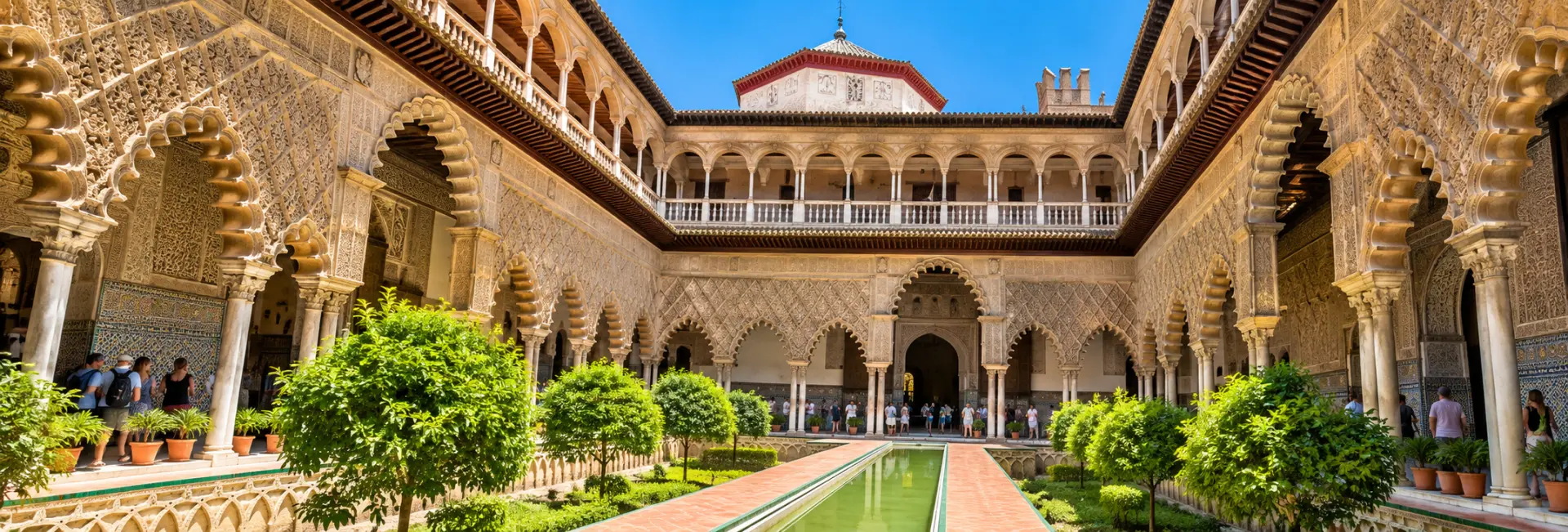
The Patio of the Maidens is the ceremonial heart of Pedro I's palace, where official court life once took place. Its lower level preserves the original Mudéjar arcades and plasterwork, framing a long reflecting pool, while the upper gallery was reworked during the Renaissance, giving the courtyard two distinct architectural languages stacked on top of one another.
Salón de Embajadores
The Hall of Ambassadors, the palace's grandest reception room, sits beneath a soaring gilded wooden dome representing the heavens. Horseshoe arches, carved stucco, and glazed tilework line the walls, making it widely considered the single finest interior space in the entire complex.
Patio de las Muñecas and the Baths
The smaller, more intimate Patio de las Muñecas, or Courtyard of the Dolls, takes its name from a set of tiny carved faces tucked into its decoration, said to have been a private space reserved for family life rather than state occasions. Below the Patio del Crucero, the Baños de Doña María de Padilla form a set of vaulted underground rainwater cisterns, named after a woman famously pursued by Pedro I, and are among the more atmospheric corners of the palace.
Surviving Almohad Structures
Not every part of the complex dates from Pedro I's reign. The Patio del Yeso and the Jardín del Crucero preserve fragments of the earlier Almohad palace, giving visitors a rare chance to see genuine 12th and 13th-century Islamic building work standing directly alongside the later Christian-era Mudéjar palace it helped inspire.
Grounds & Gardens
The Alcázar's gardens spread across several hectares behind the palace and, like the buildings themselves, layer different eras rather than presenting a single unified design. Formal Renaissance parterres, older Mudéjar-style courtyard gardens, and a 19th-century English garden all sit within the same walled grounds, connected by fountains, orange trees, and tiled pathways.
Among the most recognisable features is the Estanque de Mercurio, an Islamic-era pond crowned with a sculpture of Mercury, which also served as a filming location for the television series Game of Thrones. Nearby, the Galería de Grutesco reuses a stretch of the old Almohad city wall, reworked into an ornamental gallery, while the Pavilion of Charles V, built in 1543, adds a square Renaissance structure decorated with tiles and plasterwork that blend Renaissance and Mudéjar motifs.
Further into the grounds, the Jardín del Príncipe and the Jardín Inglés offer quieter, more secluded corners away from the main courtyards, while peacocks wandering the grounds and the scent of orange blossom in season add to a setting that feels as much like a botanical retreat as a historic monument. Taken together, the gardens cover a substantial share of the overall site and reward visitors who set aside real time to walk through them rather than treating them as a quick add-on to the palace rooms.
Cultural Significance & Royal Ties
The Alcázar's role has never been purely ceremonial or purely historical; it has continued in active use for state functions, royal visits, and official residence for centuries, a continuity that gives it a different character from monuments preserved only as museums. Pedro I's decision to build in Mudéjar style was itself a political statement as much as an aesthetic one, a Christian king asserting his authority using the visual language of the Islamic rulers he had defeated.
In recent decades the palace has also become widely known outside architectural and historical circles as a filming location, most notably standing in for the Water Gardens of Dorne in the fantasy series Game of Thrones, which introduced its courtyards and gardens to a global television audience.
Ways to Experience It
Most visits begin at the Puerta del León, the fortified gate that forms the main entrance, before moving through the Patio de la Montería into Pedro I's Mudéjar palace and on to the gardens beyond.
- General admission: covers the Mudéjar palace, Gothic Palace, courtyards, and gardens
- Cuarto Real Alto: a separate, timed ticket for the upper royal apartments still used by the Spanish royal family
- Guided tours: available in several languages and useful for tracing which sections belong to which historical period
- Combined tickets: often bundled with Seville Cathedral, given their shared UNESCO listing and proximity
Because visitor numbers are capped daily and same-day tickets can sell out, especially between April and October, booking online a few days ahead is generally recommended, and opening hours and prices are worth confirming with the official ticket office before visiting.
Best Time to Visit
Mornings, particularly before 10 a.m., tend to offer the most manageable crowds, since large tour groups typically arrive later. Visiting on a sunny day also makes a noticeable difference in the gardens, where light on the tiled fountains and reflecting pools is a large part of the appeal.
Spring and autumn bring milder temperatures than the intense heat of a Seville summer, making it more comfortable to spend an extended period walking the gardens rather than retreating indoors. Midsummer visits are still popular, but the lack of shade across much of the garden area makes early morning or early evening slots noticeably more comfortable than the middle of the day. The complex closes on Christmas Day, Good Friday, and for the first several days of January, so checking the calendar before planning a visit around those dates is worthwhile.
Visitor Tips
- Book tickets online in advance, particularly during the busy April-to-October season
- Wear comfortable shoes: the route covers uneven historic flooring, courtyards, and extensive garden paths
- Bring water and sun protection, since much of the garden area offers limited shade
- Set aside at least two hours to see the palace rooms and gardens without rushing
- Carry a valid passport or ID, as it may be requested at entry points
- Pair the visit with Seville Cathedral, directly adjacent, to make the most of a combined ticket
Nearby Attractions
The Alcázar sits at the centre of Seville's historic core, making it easy to combine with several other major sights on foot.
- Seville Cathedral and the Giralda bell tower, sharing the same UNESCO listing and directly next door
- General Archive of the Indies, the third site in the joint World Heritage inscription
- Barrio de Santa Cruz, the former Jewish quarter and one of Seville's most atmospheric old neighbourhoods
- Plaza de España, a short walk south through the Maria Luisa Park
- Torre del Oro, a riverside watchtower overlooking the Guadalquivir
FAQs about visiting the Royal Alcázar of Seville
What is the Royal Alcázar of Seville known for? +
It's known as the oldest royal palace in Europe still in active use, famous for its Mudéjar architecture, layered building history, and extensive gardens, and more recently for appearing as a filming location in Game of Thrones.
Is the Alcázar still a royal residence? +
Yes. The upper floors, known as the Cuarto Real Alto, remain an official residence used by the Spanish royal family, and access there requires a separate, timed ticket beyond general admission.
How much time should I plan for a visit? +
Most visitors spend around two hours seeing the main palace rooms and gardens, though history or garden enthusiasts often stay longer given the size of the grounds.
Do I need to book tickets in advance? +
It's strongly recommended, especially between April and October, since daily visitor numbers are capped and same-day tickets frequently sell out.
Is the Alcázar connected to Seville Cathedral? +
They stand right next to each other and were jointly inscribed as a UNESCO World Heritage Site in 1987 alongside the General Archive of the Indies, and combined tickets covering both are commonly available.
Where was Game of Thrones filmed at the Alcázar? +
Several courtyards and garden areas, including the Estanque de Mercurio, were used to depict the Water Gardens of Dorne in the show's fifth season.
Is the Alcázar suitable for visitors with mobility needs? +
Large parts of the palace and gardens are accessible, though some historic areas involve uneven paving, stairs, or narrow passageways, so checking current accessibility information before visiting is worthwhile.