Table of Contents
Overview
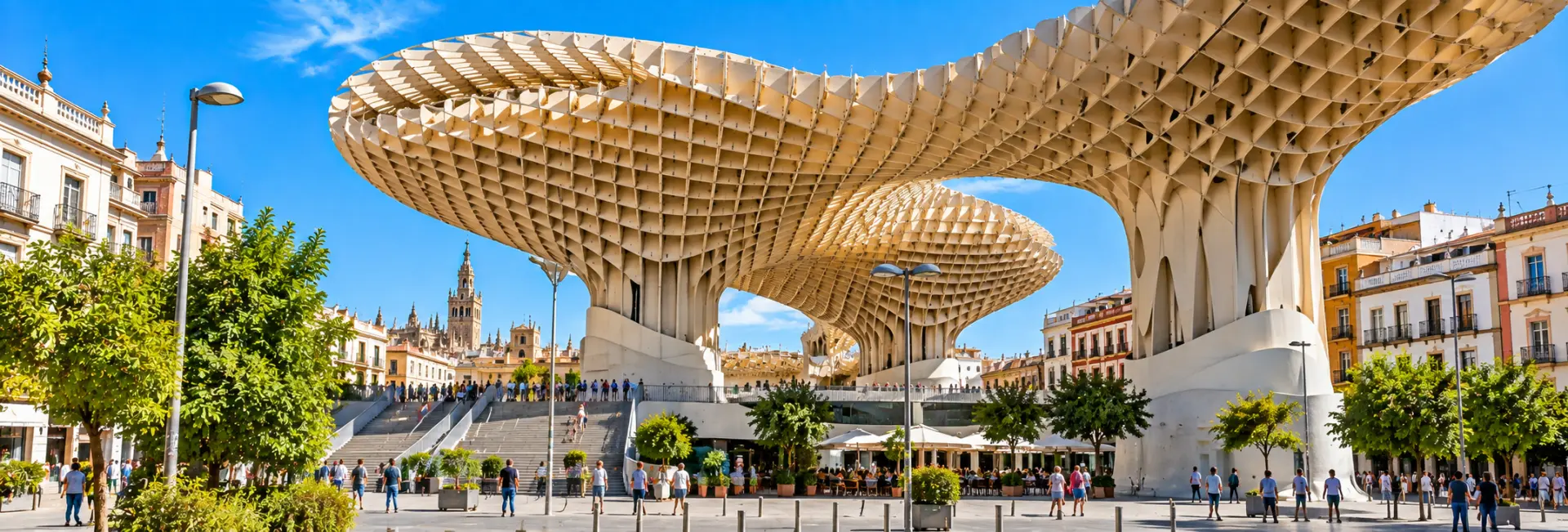
Rising above Plaza de la Encarnación in Seville's old quarter, Metropol Parasol is a canopy of six giant, mushroom-shaped wooden structures that locals simply call Las Setas, "the mushrooms." Completed in 2011, it is one of the largest timber structures in the world and stands as Seville's most visible piece of contemporary architecture, deliberately set against a backdrop of Gothic cathedrals and Moorish towers.
Beneath its curved wooden canopy sits a working food market, a public plaza used for events, and an underground archaeological museum built around Roman and medieval Islamic ruins uncovered on the site. A rooftop walkway threads between the parasols themselves, giving visitors one of the more unusual vantage points over the city's skyline.
History
A Forgotten Market Square
Plaza de la Encarnación was home to a 19th-century market building for decades before it was partly demolished in 1948 and finally cleared away in 1973. The site then sat largely empty and was used as a parking area for years while the city debated what to build in its place.
Ruins Beneath the Square
In the early 1990s, the city began work on an underground car park and new market hall, but construction stopped almost immediately when workers uncovered the remains of Roman houses, mosaic floors, and later Islamic-era streets beneath the plaza. Archaeological work continued through the following decade, and in 2004 the city launched an international competition, drawing 65 submissions, to redevelop the site around the discoveries rather than remove them.
A Difficult Construction
Construction on the winning design, by German architect Jürgen Mayer H., began in 2005 with an original budget of around 50 million euros and a planned completion date in 2007. Engineers later determined the original structural design was not feasible with the materials specified, forcing a lengthy redesign around a reinforced, glue-laminated timber system. The project was ultimately completed in 2011 at a final cost of roughly 100 million euros, and opened to the public that March.
Architecture & Design
Inspired by Cathedral Vaults and City Trees
Jürgen Mayer H.'s design takes its curving, branching form from two very different local references: the fan-like ribbed vaulting inside Seville Cathedral, and the broad ficus trees that shade the nearby Plaza del Cristo de Burgos. The result is six connected, tree-like columns that fan out into overlapping mushroom caps, shading the plaza below much as the ficus trees do elsewhere in the city.
Engineering Around the Ruins
Because the Roman and Islamic-era remains beneath the plaza could not be disturbed, the entire structure had to be supported on a small number of concrete pillars in carefully chosen positions, rather than a conventional grid of columns. The parasols are built from microlaminated Finnish pine, cut into thousands of individual pieces and bonded together with adhesive and a protective polyurethane coating, reinforced internally with steel where the timber alone could not carry the loads.
Scale and Materials
The finished structure measures roughly 150 by 70 metres and stands about 26 metres tall at its highest points, making it, by area of timber used, one of the largest wooden structures ever built. Its scale and unconventional silhouette made it controversial among Sevillians when it opened, given its position in the middle of a historic neighbourhood, though the structure has since become one of the city's most visited modern landmarks.
Recognition & Status
Metropol Parasol was a finalist for the European Union Prize for Contemporary Architecture (the Mies van der Rohe Award) in 2013, recognising it among the most significant new buildings completed in Europe in the preceding years. It has also been marketed as the largest wooden structure in the world by area, a claim tied to its use of laminated timber across the full span of its six parasols.
What to See There
The Antiquarium
Occupying the underground level, the Antiquarium displays the Roman and Islamic-era remains discovered during excavation, including sections of mosaic-floored houses, columns, wells, and fish-salting vats, viewed via glass walkways built directly over the ruins. The remains span roughly a thousand years of the site's history, from the 1st century BC to the 12th century AD.
The Central Market
At street level, beneath the shade of the parasols, a working market and a cluster of restaurants and tapas bars occupy the plaza's ground floor, giving the site a genuine local function alongside its role as a landmark.
The Rooftop Walkway
Reached by lift or stairs, the upper levels hold a panoramic walkway that winds across and between the tops of the parasols, offering views over the cathedral, the Giralda, and the surrounding rooftops of Seville's historic centre. A restaurant and event space sit partway up the structure, within the mushroom canopies themselves.
Ways to Experience It
- Buy a ticket for the rooftop walkway to cross between the parasols and take in the skyline, especially near sunset
- Visit the Antiquarium separately or as part of a combined ticket with the rooftop walkway
- Browse the ground-level market and tapas bars without needing any ticket at all
- Attend an event or concert on the open-air plaza beneath the canopy, when one is scheduled
Best Time to Visit
Late afternoon into early evening is widely considered the best time to visit the rooftop walkway, since it allows visitors to see the city in daylight and then watch the sun set over Seville's skyline from above. The structure is also illuminated after dark, making an evening visit worthwhile even outside the golden-hour window.
As with much of Seville, visiting outside the height of summer midday heat makes the mostly uncovered rooftop walkway considerably more comfortable.
Visitor Tips
- Book rooftop walkway tickets online in advance during busy periods, since capacity at the top is limited
- Wear sun protection on the rooftop level, as much of the walkway is exposed to direct sun
- Combine your visit with the Antiquarium ticket if you're interested in the site's Roman and Islamic history
- Check opening hours before visiting, since the market, Antiquarium, and rooftop walkway each keep somewhat different schedules
- Allow extra time around sunset, when the rooftop level tends to be busiest
Nearby Attractions
- Plaza del Cristo de Burgos, a small square lined with the ficus trees that partly inspired the parasol's design
- Iglesia del Salvador, a major Baroque church a short walk toward the cathedral
- Seville Cathedral and La Giralda, within easy walking distance to the south
- Alameda de Hércules, a lively square and nightlife area to the north of the site
FAQs about visiting Metropol Parasol
What is Metropol Parasol? +
It's a large wooden canopy structure in Plaza de la Encarnación, Seville, made up of six mushroom-shaped parasols that shade a market, a public plaza, and a rooftop viewing walkway.
Why is it called Las Setas? +
Sevillians nicknamed it Las Setas, meaning "the mushrooms," because of the shape of its six wooden canopies, and the name has stuck more than the official title, Metropol Parasol.
Do you need a ticket to visit? +
The ground-level market and plaza are free to walk through, but the rooftop walkway and the Antiquarium museum both require separate paid tickets.
What's inside the Antiquarium? +
It's an underground archaeological museum displaying Roman and Islamic-era remains, including mosaic-floored houses and streets, uncovered on the site during construction.
How long did it take to build? +
Construction began in 2005 and was originally meant to finish in 2007, but technical and structural problems delayed completion until 2011.
Is it worth visiting at sunset? +
Yes, the rooftop walkway is especially popular around sunset for views over the cathedral, the Giralda, and Seville's historic skyline.
What's nearby? +
Seville Cathedral, La Giralda, and the Alameda de Hércules nightlife district are all within easy walking distance of the site.