Table of Contents
Overview
Set back from the busy streets of Seville's historic centre, Casa de Pilatos is widely considered the finest example of a private Andalusian palace anywhere in the city. Built up over the late 15th and 16th centuries by successive generations of one noble family, it blends Gothic, Mudéjar, and Italian Renaissance styles into a single, unusually cohesive residence, still owned today by the Dukes of Medinaceli.
Its rooms and courtyards hold one of the largest surviving collections of early Spanish glazed tilework anywhere in the world, alongside sculpture, painted ceilings, and portrait galleries spanning centuries of the family's history. Unlike Seville's more monumental royal sites, Casa de Pilatos retains the feel of a genuine, lived-in family home.
History
A Noble Family's Project
Construction began in 1483 under Pedro Enríquez de Quiñones, chief governor of Andalusia, and his wife Catalina de Ribera, who steadily acquired adjoining properties in the neighbourhood to expand the site. The couple's high-ranking position and connections to Italy shaped the ambition of the project from the start, and by 1490 they had cleared nearby land to create what would become the Plaza de Pilatos in front of the palace.
The Marquis of Tarifa's Journey
The couple's son, Fadrique Enríquez de Ribera, first Marquis of Tarifa, completed much of the palace's decoration after inheriting it, drawing on ideas gathered during a lengthy journey through Renaissance Italy and the Holy Land between 1518 and 1520. On that trip, he measured the distance from Pontius Pilate's house to Golgotha in Jerusalem and found it matched the distance from his own Seville palace to a shrine called the Cruz del Campo, a coincidence that gave the building its popular name.
A Lasting Family Home
Fadrique's son, Per Afán de Ribera, continued embellishing the palace in the following decades, and it eventually passed by marriage into the House of Medinaceli, whose descendants still own and partly inhabit it today. The building was declared a national monument in 1931, cementing its status as one of the most significant civil buildings in the city.
Architecture & Notable Rooms
A Blend of Styles
Casa de Pilatos is often described as the prototype of the Andalusian palace precisely because of how it fuses several architectural traditions: Gothic structural elements, Mudéjar surface decoration, and Italian Renaissance proportion and ornament, brought together within a single continuous building programme rather than as later, mismatched additions.
The Marble Portal
Visitors enter through a Renaissance-style marble portal carved in 1529 by the Italian sculptor Antonio Maria Aprile da Carona, decorated with three Jerusalem crosses referencing the Marquis of Tarifa's pilgrimage. Beyond it, an arcaded carriage yard leads through to the palace's grand main courtyard.
Azulejo Tilework
The palace holds around 150 different glazed tile, or azulejo, designs produced in the 1530s by the brothers Diego and Juan Pulido, making it one of the largest and most significant collections of early-modern Spanish tilework anywhere in the world. Tiled dados line many of the ground-floor rooms and staircases, framing the palace's sculpture and painted ceilings throughout.
The Upper Floor
A tiled staircase, crowned by a golden coffered artesonado ceiling, leads up to the palace's upper floor, still partly used as a private residence by the Medinaceli family and open to visitors only by guided tour. Rooms here hold centuries of family portraiture alongside notable individual works, including painted ceilings attributed to Francisco Pacheco and canvases by Luca Giordano.
Grounds & Gardens
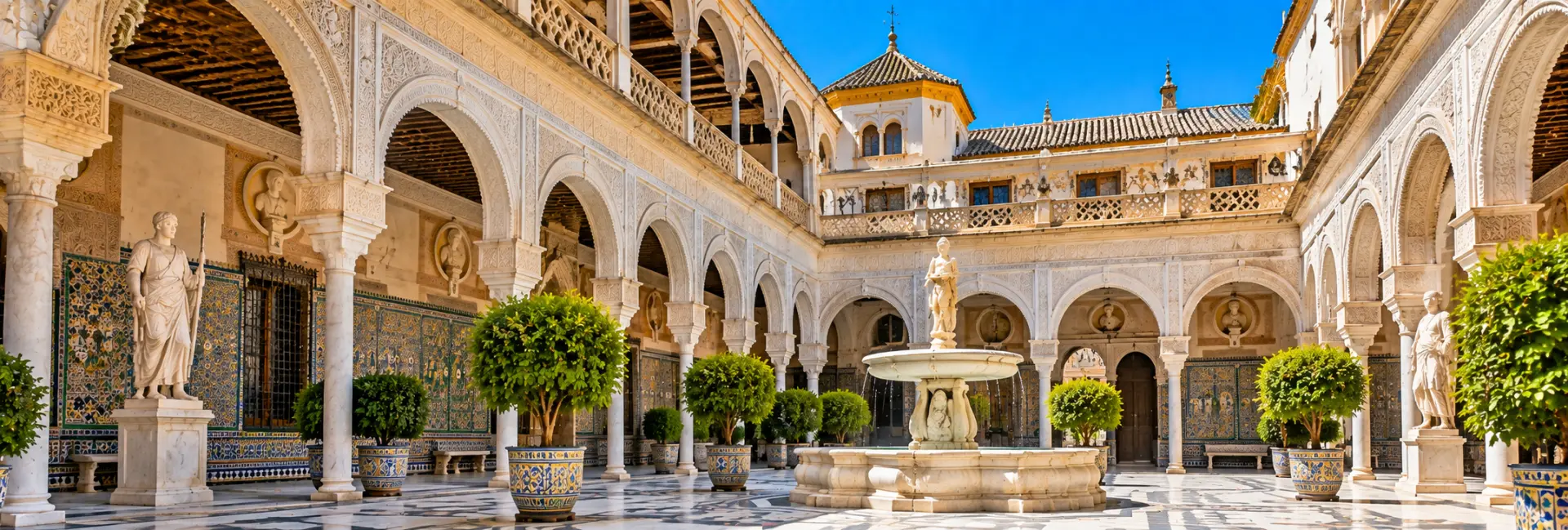
At the heart of the ground floor, the Main Patio is lined with arched galleries and decorated with sculpture, including ancient Roman statuary believed to have come from the nearby ruins of Italica, alongside a central fountain typical of Andalusian courtyard design. Two separate gardens, referred to as the small garden and the large garden, extend from either side of the main building, planted with orange trees, palms, magnolias, and bougainvillea.
The combination of enclosed courtyard and open garden reflects the palace's dual character as both a formal noble residence and a genuinely lived-in family home, a balance that has been preserved through successive generations of ownership.
Cultural Significance & Holy Week Ties
The palace's connection to Seville's religious life runs deeper than its nickname. In 1521, the Marquis of Tarifa inaugurated a formal Via Crucis, or Way of the Cross, beginning from the palace's own Chapel of the Flagellations and ending at a shrine outside the old city walls, a devotional walk still observed in Seville today. Several rooms inside the palace, including the Praetor's Room and Praetor's Study, take their names from this association with the biblical figure of Pontius Pilate.
Ways to Experience It
- Visit the ground floor independently, including the main courtyard, gardens, and tiled reception rooms
- Join a guided tour of the upper floor to see the family's private apartments, portrait galleries, and finer artworks
- Take advantage of free entry to the ground floor offered to EU citizens on Monday afternoons
- Combine a visit with a walk through the surrounding Santa Catalina and Santa Cruz neighbourhoods
Best Time to Visit
Because most of the palace's appeal lies indoors and around its shaded courtyards, it makes a good option even during the hottest parts of the Sevillian day, when outdoor sightseeing elsewhere in the city becomes less comfortable. Visiting earlier in the day tends to mean smaller guided-tour groups on the upper floor.
Visitor Tips
- Decide in advance whether you want the ground-floor-only ticket or the full ticket including the guided upper-floor tour
- Check the current Monday free-admission policy for EU citizens if travel dates allow flexibility
- Wear comfortable shoes for the tiled floors and staircases, which can be slippery when worn smooth
- Photography rules may differ between the ground floor and the privately inhabited upper floor, so check signage during the guided tour
- Allow at least an hour, more if joining the upper-floor tour
Nearby Attractions
- Santa Cruz Quarter, Seville's historic former Jewish district, a short walk to the southwest
- Seville Cathedral and La Giralda, within easy walking distance
- Metropol Parasol (Las Setas), a short walk to the north
- Iglesia de San Esteban, a nearby parish church in the same historic neighbourhood
FAQs about visiting Casa de Pilatos
What is Casa de Pilatos? +
It's a 15th- and 16th-century Andalusian palace in Seville, blending Gothic, Mudéjar, and Renaissance architecture, still owned by the Dukes of Medinaceli.
Why is it called the House of Pilate? +
The name comes from the first Marquis of Tarifa's pilgrimage to Jerusalem, after which he found that the distance from his own palace to a nearby shrine matched the distance between Pontius Pilate's house and Golgotha.
Is the whole palace open to visitors? +
The ground floor, courtyards, and gardens are open for independent visits, while the upper floor, still partly used as a private residence, can only be seen on a guided tour.
How long does a visit take? +
Around an hour for the ground floor alone, longer if you add the guided tour of the upper floor.
Is Casa de Pilatos connected to Seville's Holy Week traditions? +
Yes, a formal Way of the Cross beginning at the palace was established in 1521 and remains connected to the city's religious observances today.
Is it family-friendly? +
Yes, its courtyards and gardens are easy to explore with children, though the guided upper-floor tour may be less engaging for very young visitors.
What's nearby? +
The Santa Cruz Quarter, Seville Cathedral, and Metropol Parasol are all within easy walking distance.