Table of Contents
Overview
Standing between Seville Cathedral and the Real Alcázar, the Archivo de Indias is one of the world's most important historical archives, holding the written record of Spain's empire in the Americas and the Philippines. It occupies a sober, dignified Renaissance building originally built for the city's merchant guild, a fitting home for an institution built entirely around paper, ink, and centuries of correspondence.
Unlike many of Seville's grand monuments, the Archivo de Indias is not primarily built for spectacle; most of its millions of pages are reserved for researchers rather than display. Still, its public exhibition rooms, elegant courtyard, and sheer scale of holdings make it one of the more quietly remarkable stops in the historic centre, especially for anyone curious about the documentary side of the Age of Exploration.
History
A Merchants' Exchange
The building predates the archive it now houses by two centuries. In 1572, King Philip II commissioned the royal architect Juan de Herrera, best known for designing El Escorial, to build a dedicated exchange house for Seville's merchants, who had previously conducted their business informally on the cathedral steps. Construction ran from the 1580s to the 1590s, continued after Herrera's death by his collaborator Juan de Mijares, and the building served as the Casa Lonja de Mercaderes for nearly two hundred years.
Founding the Archive
By the late 18th century, documents relating to Spain's overseas empire were scattered across repositories in Simancas, Cádiz, and Seville, making research increasingly difficult. Acting on a proposal from the historian Juan Bautista Muñoz, King Charles III ordered the creation of a single, centralized archive in 1785, and the old merchants' exchange, by then no longer needed for its original purpose, was repurposed to hold it.
Growth and Recognition
The archive's holdings grew steadily over the following two centuries as further collections, including records from the Council of the Indies and the House of Trade, were transferred into its care. In 1987, both the building and its documentary contents were recognised internationally: the building was inscribed as part of a UNESCO World Heritage Site alongside Seville Cathedral and the Alcázar, while its archival collection was separately added to UNESCO's Memory of the World Register. The building underwent a substantial restoration between 2002 and 2004.
Architecture & Building
Herreran Classicism
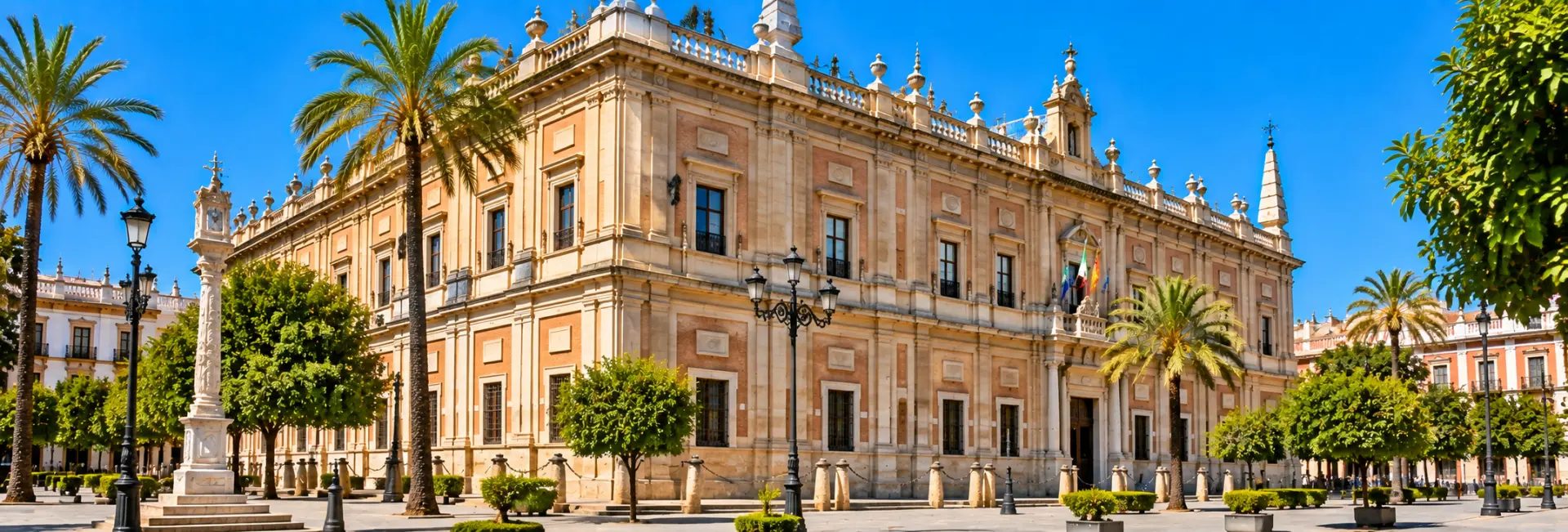
The Archivo de Indias is a leading Sevillian example of the austere, classically inspired style associated with Juan de Herrera, characterised by restrained facades, careful proportion, and a near-total absence of surface decoration. Built from stone and finished in a warm ochre tone, its exterior stands in deliberate contrast to the more ornate Gothic and Mudéjar buildings that flank it on either side.
A Courtyard Building
Inside, the building is organised around a central courtyard on two main floors, with galleries of arched windows looking inward rather than out onto the street. A grand marble staircase, added in the 18th century after the building's conversion into an archive, leads up to the principal exhibition and reading rooms on the upper floor.
Marks on the Walls
Look closely at the building's exterior and you'll spot faded reddish inscriptions known as vítores, painted onto the stone historically to commemorate a scholar's achievement of a doctoral degree, a tradition once common on notable buildings near Spanish centres of learning.
Collections & Holdings
The archive holds roughly 43,000 bundles of documents, amounting to somewhere in the region of 80 to 90 million individual pages, arranged along several kilometres of shelving. Its collections span the 15th through 19th centuries and include the administrative records of the Council of the Indies and the House of Trade, alongside material from Seville and Cádiz's merchant guilds.
Among its most celebrated holdings are original documents connected to major figures of the early colonial period, including autograph material linked to Christopher Columbus, Ferdinand Magellan, Hernán Cortés, and Francisco Pizarro. The collection also includes thousands of historical maps and plans charting the geography of the Spanish Americas and the Philippines as understood at the time.
Must-See Highlights
- The building's main facade on Avenida de la Constitución, a clear example of Herreran Renaissance design
- The central courtyard and its two-tier arcaded galleries
- Rotating exhibitions in the ground-floor and upper-floor exhibition rooms, which display selected original documents and maps
- The grand 18th-century staircase connecting the two main floors
Ways to Experience It
- Walk through the free public exhibition rooms, which rotate a changing selection of original documents and maps
- Join a guided tour focused on the building's history and its connection to the Age of Exploration
- Combine a visit with the neighbouring Cathedral and Real Alcázar, both a short walk away
- Researchers with a specific interest can apply in advance to consult the archive's reading room
Best Time to Visit
Mornings tend to be the quietest time to visit, particularly earlier in the week before the exhibition rooms fill with visitors also touring the nearby Cathedral and Alcázar. Since the archive's appeal lies mainly in its interior spaces and displayed documents, time of year matters less here than at outdoor attractions, though visiting outside the peak of summer tourist season generally means shorter waits.
Visitor Tips
- Admission to the exhibition rooms is free, so there's little cost to a short visit even if you're mainly passing through the area
- Check opening days before visiting, as the archive is typically closed on Sundays and Mondays
- Photography rules can be strict in places, so check signage before taking pictures of displayed documents
- Set expectations accordingly: this is a quieter, more contemplative visit than the adjoining Cathedral or Alcázar, geared toward those interested in history and documents rather than grand interiors
- Allow extra time if you plan to see all three UNESCO-listed sites, the Archivo, Cathedral, and Alcázar, in a single day
Nearby Attractions
- Seville Cathedral and La Giralda, directly adjacent to the north
- Real Alcázar of Seville, bordering the archive to the east
- Santa Cruz Quarter, Seville's historic former Jewish district, a short walk further east
- Torre del Oro, a riverside watchtower a short walk to the south
FAQs about visiting the Archivo de Indias
What is the Archivo de Indias? +
It's Seville's historic archive holding the documentary record of the Spanish Empire in the Americas and the Philippines, housed in a 16th-century former merchants' exchange building.
Is the Archivo de Indias free to visit? +
Yes, admission to its public exhibition rooms is free, though access to the research reading room requires advance arrangement for those studying its collections.
How long should I spend there? +
Most visitors spend around 30 minutes to an hour in the exhibition rooms, longer if a temporary exhibition is of particular interest.
Can the public see original historical documents? +
Yes, selected original documents and maps are displayed on rotation in the exhibition rooms, though the vast majority of the archive's holdings are reserved for researchers.
Why is it connected to Seville Cathedral and the Alcázar? +
All three buildings were jointly inscribed as a single UNESCO World Heritage Site in 1987, recognising their combined historical significance in the heart of Seville.
Who designed the building? +
It was designed by Juan de Herrera, the royal architect also responsible for El Escorial near Madrid, though it wasn't built as an archive originally, it started as a merchants' exchange.
What's nearby? +
Seville Cathedral, La Giralda, and the Real Alcázar all sit immediately adjacent, making the Archivo de Indias easy to combine with a visit to either.