Table of Contents
Overview
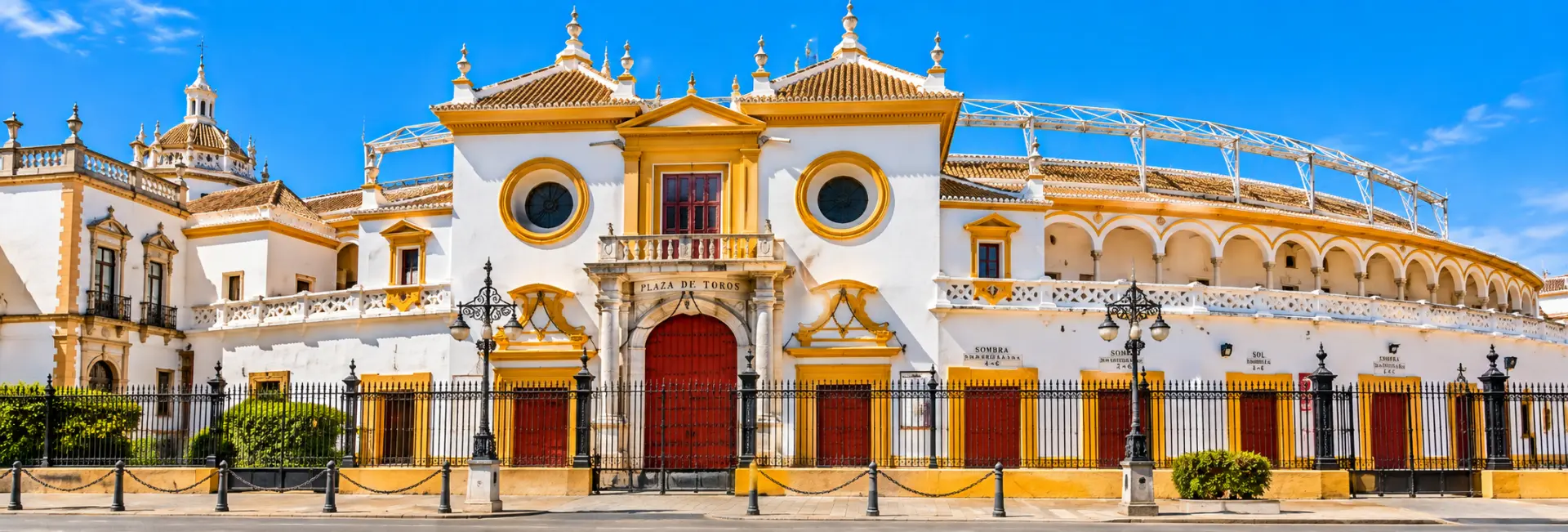
Set on the bank of the Guadalquivir River in Seville's Arenal district, the Plaza de Toros de la Maestranza is one of the oldest and most celebrated bullrings in Spain. Its whitewashed, ochre-trimmed facade and distinctive oval interior have made it a fixture of the city's skyline since the 18th century, and it remains the home of bullfighting during Seville's April Fair.
Beyond its role as a working bullring, the building houses a bullfighting museum, a chapel where matadors traditionally pray before entering the ring, and the headquarters of the Real Maestranza de Caballería, the noble cavalry corporation that built and still owns it. Guided tours run daily, giving visitors access to the arena, stands, and museum even outside the bullfighting season.
History
From a Wooden Ring to a Permanent Arena
Bullfighting in Seville originally took place in the Plaza de San Francisco, near the city hall, before the Real Maestranza de Caballería, a noble cavalry order founded in the 17th century, built a temporary square wooden ring on the site in 1730. That structure was replaced with a circular wooden ring in 1733, and in 1761 the corporation began work on a permanent stone bullring on the same spot, a low rise known as Monte del Baratillo overlooking the river.
A Century of Construction
Progress on the new ring was slow and repeatedly interrupted, including a period in the 1780s when bullfighting itself was restricted by royal decree. The Palco del Príncipe, the royal box built above the arena's main gate, was finished in 1765, but the surrounding stands were not completed in stone until 1881, some 120 years after construction began.
Twentieth-Century Additions
Between 1914 and 1915, the Sevillian architect Aníbal González, best known for designing Plaza de España, rebuilt the ring's stone stands in brick and reworked much of the arena's interior. The surrounding buildings, including the Real Maestranza's headquarters, museum, and chapel, were completed over subsequent decades, giving the complex its present appearance by the mid-20th century. The bullring was declared a national monument in 1931 in recognition of its historical and architectural significance.
Architecture & Design
An Unusual Oval Ring
Unlike most Spanish bullrings, which are circular, La Maestranza's arena is distinctly oval, a result of the piecemeal way it was built up over more than a century rather than to any deliberate design choice. The ring is faced in white plaster with ochre and red trim, a colour scheme repeated across its towers and archways that has become closely associated with Seville itself.
The Puerta del Príncipe
The bullring's most symbolically important feature is the Puerta del Príncipe, or Prince's Gate, set beneath the royal box on the river-facing facade. Matadors judged to have given an exceptional performance are carried out through this gate on the shoulders of the crowd, a tradition considered one of the highest honours in Spanish bullfighting.
Interior Galleries
Inside, tiers of stone and brick seating rise around the ring in a series of arcaded galleries, with the upper level sheltered beneath a tiled roof supported on slender columns. The layout also includes a chapel, stables, an infirmary, and the bullfighters' preparation rooms, all built into the structure surrounding the arena itself.
Recognition & Status
The Plaza de Toros de la Maestranza was declared a Spanish national monument in 1931, protecting both the bullring and its associated buildings as a site of historical and artistic importance. It remains under the ownership of the Real Maestranza de Caballería de Sevilla, the same noble cavalry corporation that began building it in the 18th century, making it one of the few major Spanish bullrings still run by its original founding institution.
What to See There
The Museo Taurino
The bullfighting museum occupies several rooms within the complex and displays paintings, engravings, costumes, and other memorabilia tracing the history of bullfighting in Seville, including works connected to well-known Spanish artists. Exhibits cover both the sport's aristocratic origins under the Real Maestranza and its later development into a wider public spectacle.
The Chapel of the Bullfighters
A small chapel within the bullring, centred on an altarpiece dedicated to the Virgen del Rosario, is where matadors traditionally pray before stepping into the arena. It remains an active devotional space rather than a purely historical display.
The Arena and Puerta del Príncipe
Guided tours take visitors through the stands and around the arena itself, including a close look at the Puerta del Príncipe and the royal box above it. Statues outside the building, including one of the celebrated matador Curro Romero, mark the entrance area facing the river.
Ways to Experience It
- Join a guided daytime tour covering the museum, chapel, stables, and arena, available on most days outside bullfighting hours
- Attend a bullfight during the spring and early autumn season, particularly around the April Fair, for the full working atmosphere of the ring
- Visit the Museo Taurino independently to focus on the collection without joining a full guided tour
- Photograph the riverside facade and Puerta del Príncipe from the Paseo de Cristóbal Colón along the Guadalquivir
Best Time to Visit
The bullfighting season runs roughly from spring through early autumn, with the most significant fights traditionally held during Seville's April Fair; visiting during this period offers the chance to see the ring in active use, though tickets and tours can be harder to secure. Outside the season, mornings tend to be quieter for guided tours of the museum and arena.
Late afternoon light along the riverside facade also makes for good photographs of the building's exterior, particularly from across the Guadalquivir.
Visitor Tips
- Book guided tours in advance during the spring bullfighting season, when availability is more limited
- Check the schedule before visiting, since the arena and museum may have reduced access on days with a bullfight or event
- Consider your own comfort with bullfighting as a spectator sport before attending a live event; the museum and architectural tour do not require this
- Wear comfortable shoes for the guided tour, which covers several levels of stands and passageways
- Combine a visit with a walk along the Paseo de Cristóbal Colón riverside promenade
Nearby Attractions
- Torre del Oro, a 13th-century riverside watchtower a short walk south along the Guadalquivir
- Seville Cathedral and La Giralda, within easy walking distance to the east
- Triana neighbourhood, reachable by crossing the Isabel II Bridge just north of the bullring
- Teatro de la Maestranza, an opera house adjoining the bullring complex
FAQs about visiting La Maestranza
What is La Maestranza? +
It's Seville's historic bullring, built between the 18th and 19th centuries, along with an attached bullfighting museum and the headquarters of the Real Maestranza de Caballería, the noble order that owns it.
Can you visit without seeing a bullfight? +
Yes, daily guided tours let visitors see the arena, museum, chapel, and stables without attending a live bullfight, and this is how most visitors experience the site.
When is the bullfighting season? +
It generally runs from spring through early autumn, with the most prominent fights held during Seville's April Fair.
Why is the ring oval instead of round? +
Because construction stretched over more than a century with several redesigns along the way, the arena ended up with a distinctly oval shape rather than the perfectly circular form found in most Spanish bullrings.
What is the Puerta del Príncipe? +
It's the bullring's main gate beneath the royal box, through which matadors judged to have given an outstanding performance are carried out on the crowd's shoulders.
Is the Museo Taurino worth visiting on its own? +
Yes, the museum's collection of bullfighting art, costumes, and memorabilia can be visited separately from a full guided tour of the arena.
What's nearby? +
The Torre del Oro, Seville Cathedral, and the Triana neighbourhood across the river are all within easy walking distance.