Table of Contents
Overview
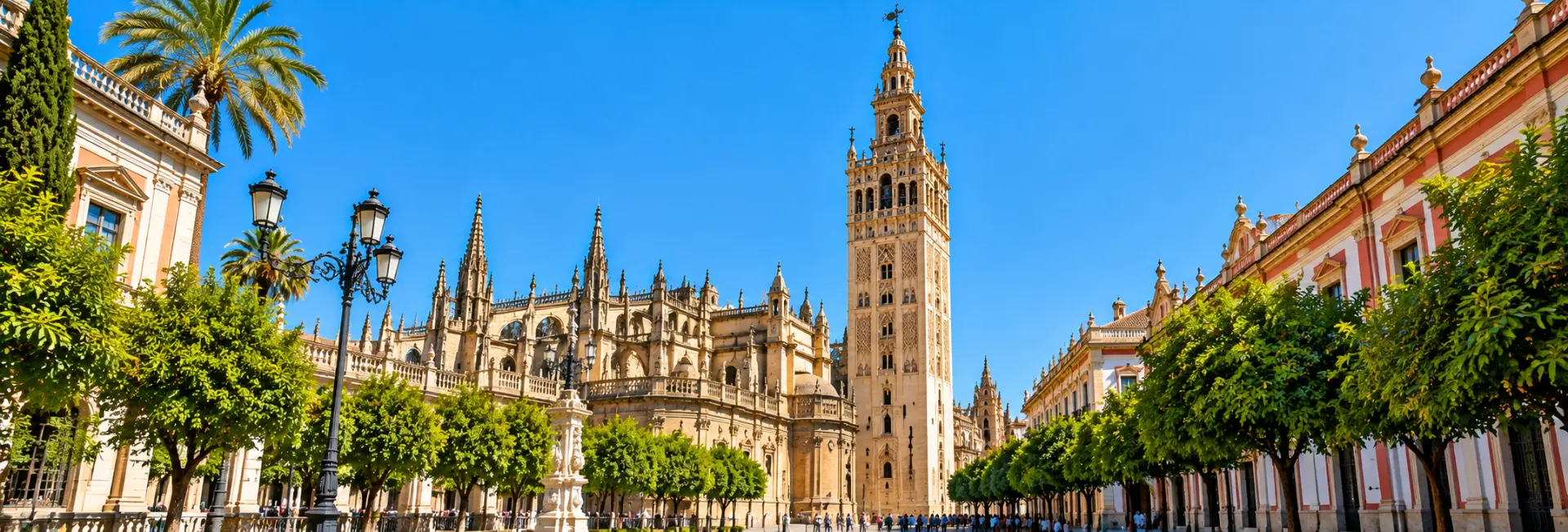
Rising above the rooftops of Seville's old quarter, La Giralda is the bell tower of Seville Cathedral and one of the most recognisable silhouettes in Spain. It began life as the minaret of the city's great Almohad mosque in the 12th century and was later fused with a Renaissance belfry, making it a rare structure where Islamic and Christian architecture meet in a single, continuous building.
Visitors climb its interior not by stairs but by a long sequence of sloped ramps, originally built so the tower's watchman could ride up on horseback. At the top, a viewing gallery looks out over the cathedral's rooftop, the Alcázar gardens, and the wider city, making La Giralda as much a lookout point as a monument to eight centuries of Sevillian history.
History
An Almohad Minaret
Construction began in 1184 under the Almohad caliph Abu Yaqub Yusuf, who had made Seville the capital of his empire in the Iberian Peninsula. The architect Ahmad ibn Baso designed the tower for the city's newly built congregational mosque, taking the Kutubiyya minaret in Marrakesh as a reference point. Builders reused stone from Roman ruins near the city, and the tower was completed by 1198 under Abu al-Layth al-Siqilli.
From Mosque to Cathedral
When Ferdinand III of Castile took Seville in 1248, the mosque was consecrated as a Christian church, and the minaret survived largely intact rather than being torn down. An earthquake in the mid-14th century toppled the bronze spheres that had originally crowned the tower, and for nearly two centuries the minaret stood without its original finial while the surrounding Gothic cathedral was built around it.
The Renaissance Belfry
In the 1560s the architect Hernán Ruiz II was commissioned to finish the tower properly as a Christian bell chamber. He added several new stages above the old Almohad shaft, blending Renaissance columns and lanterns with the brickwork below, and topped the whole structure with a bronze statue that doubles as a weathervane. That statue, cast to represent Faith, became known as El Giraldillo, and its name eventually passed to the entire tower.
Architecture & Design
A Tower Within a Tower
The Almohad section is built as two connected structures: an outer wall and an inner shaft, linked by the ramps that spiral between them. This double-wall design let the tower stand at what was, for its time, an extraordinary height while keeping the structure light enough to climb without stairs. Openings cut into the walls let daylight reach the ramps and give climbers glimpses of the city as they ascend.
Sebka Brickwork
The lower two-thirds of the tower are decorated on all four sides with sebka, a lattice of overlapping brick arches that was a hallmark of Almohad design. Paired windows with horseshoe arches break up the brickwork at intervals, echoing the same decorative language found on other Almohad minarets in North Africa.
The Renaissance Addition
Above the original Almohad shaft, Hernán Ruiz II's 16th-century belfry shifts to white stone and lighter brick, arranged as a series of stepped, increasingly narrow stages topped with a small dome. The transition between the two eras is visible from street level: dense geometric brickwork gives way to open arches, classical detailing, and finally the bronze Giraldillo, bringing the tower's total height to roughly 104 metres.
Recognition & Status
La Giralda was declared a National Monument in Spain in 1928, and in 1987 UNESCO inscribed it as a World Heritage Site together with Seville Cathedral, the Real Alcázar, and the General Archive of the Indies, recognising the group as an outstanding testimony to the city's Almohad and Christian past. It remains one of only a small number of Almohad-era minarets still standing anywhere in the world.
What to See There
The Bells
The belfry houses a set of bells, each historically given its own name, rung on feast days and important occasions in the cathedral's calendar. The largest of them, known as Santa María, is among the heaviest bells in the tower and can be seen up close from the belfry level near the top of the climb.
El Giraldillo
The bronze weathervane at the very top, a robed female figure holding a palm branch and shield, represents Faith standing guard over the city. Though the original still turns with the wind above the cathedral, a full-scale replica displayed at street level lets visitors examine details that are impossible to see from below.
The View from the Top
From the viewing gallery, arched windows frame the cathedral's flying buttresses and pinnacles in the foreground, with the Alcázar's gardens, the Guadalquivir river, and the wider rooftops of Seville's historic centre spreading out beyond. On clear days, the view extends well past the old town to the hills surrounding the city.
Ways to Experience It
La Giralda is entered from inside Seville Cathedral rather than as a separate building, so a visit is normally combined with time in the cathedral itself.
- Climb the ramps independently at your own pace as part of a standard cathedral ticket
- Join a guided tour that covers the cathedral, the Giralda, and the adjoining Patio de los Naranjos together
- Book a combined ticket that also includes the nearby Real Alcázar for a fuller half-day of sightseeing
- Photograph the tower from Plaza del Triunfo or Plaza Virgen de los Reyes, where its full height is visible without climbing
Best Time to Visit
Arriving at opening time or in the last couple of hours before closing generally means shorter queues and a cooler climb, which matters in a tower with no air conditioning and dozens of ramps to cover. Spring and autumn offer the most comfortable temperatures for the walk up, while summer afternoons in Seville can be intensely hot inside the enclosed ramp system.
Late afternoon light tends to favour photographs of the tower's western, Giraldillo-facing side, and visiting near sunset rewards climbers with softer light over the rooftops from the viewing gallery.
Visitor Tips
- Book tickets online in advance, since same-day cathedral tickets can sell out or involve long waits
- Wear comfortable shoes, as the ramps are long, sloped, and can feel steep by the upper levels
- There is no lift, so the climb is not accessible for wheelchair users or those with limited mobility
- Bags are checked at the cathedral entrance, and large backpacks or suitcases are generally not permitted
- Bells ring on the hour and can be loud near the top of the climb, so time your visit accordingly if you're sensitive to noise
Nearby Attractions
- Seville Cathedral, the world's largest Gothic church, surrounding the base of the tower
- Real Alcázar, a Mudéjar royal palace with extensive gardens a short walk away
- General Archive of the Indies, housed in a 16th-century building facing the cathedral
- Patio de los Naranjos, the surviving courtyard of the original mosque, adjoining the cathedral
- Barrio Santa Cruz, Seville's historic Jewish quarter with narrow lanes and small plazas
FAQs about visiting La Giralda
What is La Giralda? +
It's the bell tower of Seville Cathedral, originally built in the 12th century as the minaret of the city's great mosque and later topped with a Renaissance belfry after the Christian conquest of Seville.
Can you go inside La Giralda? +
Yes, visitors enter through Seville Cathedral and climb a series of interior ramps to a viewing gallery near the top of the tower.
How do you get to the top — are there stairs? +
There are no stairs for most of the climb; instead, a long sequence of sloped ramps winds up the tower, a design originally meant to let the muezzin ride a horse to the summit.
Is La Giralda accessible for wheelchairs or strollers? +
No, the ramp system has no lift and is not wheelchair accessible, so visitors with mobility limitations should plan accordingly.
Do you need a separate ticket for La Giralda? +
No, access to the tower is included with a standard Seville Cathedral ticket rather than sold separately.
How long does it take to climb La Giralda? +
Most visitors take between 20 and 40 minutes for the round trip, depending on crowds and how often they pause at the windows along the way.
What is the Giraldillo? +
It's the bronze statue at the very top of the tower, representing Faith, which also functions as a weathervane and gave the entire tower its name.
What else should I visit nearby? +
The Real Alcázar, the General Archive of the Indies, and the Barrio Santa Cruz are all within a short walk and pair naturally with a Giralda and cathedral visit.