
Table of Contents
Overview
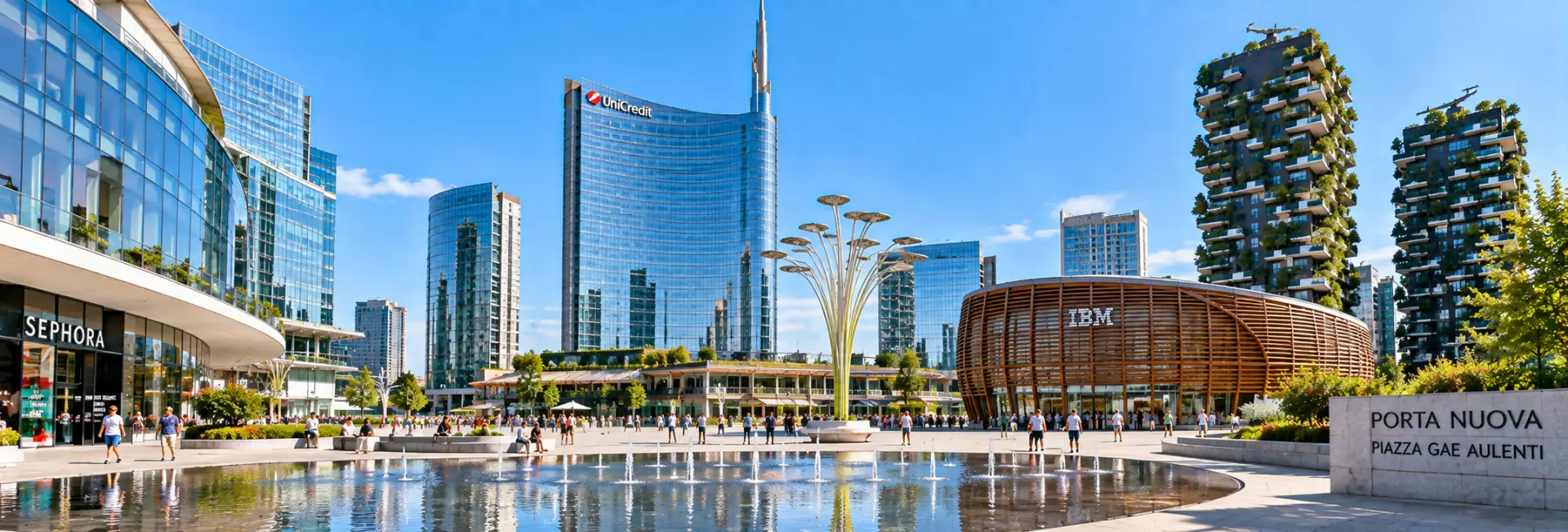
The district pairs striking architecture with genuine green space: the tree-wrapped Bosco Verticale towers, Italy's tallest skyscraper in the UniCredit Tower, and the large Biblioteca degli Alberi park all sit within a few minutes' walk of one another. Unlike Milan's older, historic quarters, Porta Nuova is a working showcase of the city's more recent identity, mixing offices, apartments, shops and public space into one connected, largely pedestrian area.
For visitors, that mix is part of the appeal: there's no single ticketed attraction to plan around, just a compact, walkable stretch of the city where striking buildings, a large public park and everyday Milanese life all overlap. It's a useful counterpoint to a day spent among the Duomo, the Brera galleries or Milan's older churches, showing a very different, much newer side of how the city sees itself.
History
The area now occupied by Porta Nuova was once home to the Garibaldi, Varesine and Isola districts, separated from each other by rail yards and a disused terminus known as the Porta Nuova delle Varesine station, which had served trains from Varese, Novara and Gallarate before closing in the early 1960s. For decades afterward, the roughly 290,000 square meter site sat as a fragmented, deteriorating gap in the city, crossed by road and rail infrastructure and cut off from everyday pedestrian life.
From Rail Yards to Skyline
Planning for the site's redevelopment took shape in the early 2000s, and construction of what became known as the Porta Nuova project began around 2005 to 2009, led by an international team of architects including Cesar Pelli, Stefano Boeri and Kohn Pedersen Fox. Rather than treating the area as a single project, planners split it into three connected zones, Porta Nuova Garibaldi, Porta Nuova Varesine and Porta Nuova Isola, joined by a continuous network of pedestrian paths, gardens and bridges.
Piazza Gae Aulenti opened on 8 December 2012 as the symbolic centerpiece of the district, named for the Italian architect and designer Gae Aulenti in recognition of her decades of work in a profession long dominated by men. The Bosco Verticale towers followed in 2014, and the surrounding park, gardens and remaining towers were completed through the mid to late 2010s, turning what had been a 50-year urban void into one of the largest redevelopment projects carried out anywhere in central Milan.
The project was also notable for how it was built, with much of it pursuing LEED sustainability certification and treating public space as a priority alongside the office and residential towers themselves. Rather than simply filling the site with buildings, planners set aside a large share of the land for the pedestrian paths, squares and eventually the park that now define how people actually move through the district day to day.
Architecture & Design
The district's skyline is anchored by the UniCredit Tower, which rises to roughly 231 meters including its distinctive spire, making it one of Italy's tallest buildings and the headquarters of the UniCredit banking group. Just as recognizable are the twin Bosco Verticale towers, designed by Stefano Boeri's studio, which stand around 110 and 76 meters tall and are covered in hundreds of trees and thousands of shrubs and plants rather than a conventional glass or stone facade, a design that earned the project international architecture awards after it opened.
The wider skyline around the piazza includes several other notable towers, among them the UnipolSai Tower and Diamond Tower, each contributing a different shape and material to what has become one of the densest and most varied clusters of contemporary architecture anywhere in Italy. Seen together from ground level in the piazza, the mix of curved glass, tree-covered facades and the UniCredit spire gives Porta Nuova a skyline that looks distinctly different from anywhere else in Milan.
Key Landmarks
- Piazza Gae Aulenti: the district's central plaza, with its color-changing fountains, curved seating and surrounding shopping arcades
- UniCredit Tower: Italy's tallest skyscraper, topped by a slender spire visible across much of the city
- Bosco Verticale: the two "vertical forest" residential towers, planted with roughly 800 trees and thousands of shrubs
- Biblioteca degli Alberi (BAM): a 95,000 square meter public park just south of the piazza, the third-largest green space in central Milan, with themed gardens and open lawns
- Corso Como: a pedestrian street just north of the district lined with boutiques, an art gallery and bars, connected to the piazza by a footbridge
- Palazzo Lombardia: the regional government's headquarters nearby, known for its curving glass form and public viewing areas
Together these landmarks give Porta Nuova a layout that rewards wandering: a short loop from the piazza through the park and out toward Corso Como takes in most of the district's best-known buildings and green spaces without needing a car or public transport in between.
The park deserves more than a passing glance: its winding paths are organized into distinct themed fields, each planted differently, and it has quickly become one of the most-used green spaces in central Milan since opening in 2018. Locals treat it as an everyday park rather than a tourist site, which makes it a good place to see a more relaxed, residential side of the district alongside its more photographed towers.
Ways to Experience It
- Free walking: the piazza, park and surrounding streets are all open, pedestrian-friendly public space with no ticket required
- Photography: the upper ring of the piazza and the southeastern edge of the park both offer classic framed shots of the towers, especially with the fountains in the foreground
- Shopping and dining: the arcades around the piazza and the length of Corso Como hold a mix of international and Italian retail, cafes and restaurants
- Park visits: BAM is free to enter year-round and makes an easy rest stop or picnic spot between sightseeing
- Guided architecture walks: several city tour operators run themed walking tours of the district's skyscrapers and public spaces for visitors who want more background on the design and construction
Best Time to Visit
The district works well in any season, since most of its appeal is outdoors and open year-round, though spring and early autumn tend to be most comfortable for lingering in the park or walking the full loop between the piazza and Corso Como. Evenings, particularly on weekends, bring a livelier atmosphere as the surrounding bars and restaurants fill up, while daytime visits suit those more interested in the architecture and park than the nightlife.
Visitor Tips
- The Garibaldi FS metro stop, served by lines M2 and M5, sits right beneath Piazza Gae Aulenti, making the district one of the easiest in Milan to reach by public transport
- Trams 10 and 33 and several bus lines also stop near the square, offering an alternative to the metro
- The piazza and park are both free and open around the clock, so there's no need to plan around opening hours the way you would for a museum
- The Bosco Verticale towers are private residences, so they're best appreciated from the park or street level rather than expecting entry inside
- Comfortable shoes help, since the piazza is raised above street level and the best photo spots and park paths involve a fair amount of walking
Nearby Attractions
- Corso Como and its boutiques and galleries, directly connected to the piazza by a pedestrian footbridge
- Cimitero Monumentale, a short walk or tram ride away, known for its elaborate 19th and 20th century funerary sculpture
- Brera district, roughly a fifteen to twenty minute walk, with its gallery, art academy and narrow historic streets
- Piazza del Duomo and the cathedral, about a twenty-five minute walk or a short metro ride south
FAQs about visiting Porta Nuova & Piazza Gae Aulenti
What is Piazza Gae Aulenti known for? +
It's known as the modern symbol of Milan's changing skyline, a raised circular plaza surrounded by skyscrapers, fountains and shopping arcades, and named after the pioneering Italian architect Gae Aulenti.
Is Porta Nuova the same thing as Piazza Gae Aulenti? +
Not exactly: Porta Nuova is the wider redevelopment district built over former rail land, while Piazza Gae Aulenti is the central square at the heart of that district, so most visitors end up seeing both together.
How do I get to Porta Nuova by public transport? +
The Garibaldi FS metro stop on lines M2 and M5 sits directly beneath the piazza, and several tram and bus routes also serve the area, making it one of the easiest districts in Milan to reach without a car.
Can I go inside the Bosco Verticale towers? +
No, the Bosco Verticale towers are private residential buildings, so visitors view them from the surrounding park, streets and piazza rather than entering.
Is there an entry fee for Piazza Gae Aulenti or the park? +
No, both the piazza and the Biblioteca degli Alberi park are free and open to the public at all times, with no ticket required.
How much time should I plan for a visit? +
An hour or two is enough to see the piazza, walk through the park and reach Corso Como, though visitors who want to linger over photography, shopping or a meal often spend closer to half a day in the district.
What's the best time of day to visit for photos? +
Late afternoon and early evening tend to work best, when the low sun lights up the glass towers and the piazza's fountains and lighting start to stand out.
What else is nearby worth combining with a visit? +
Corso Como, the Cimitero Monumentale, the Brera art district and Piazza del Duomo are all within a short walk or quick public transport ride of Porta Nuova.
