
Table of Contents
Overview
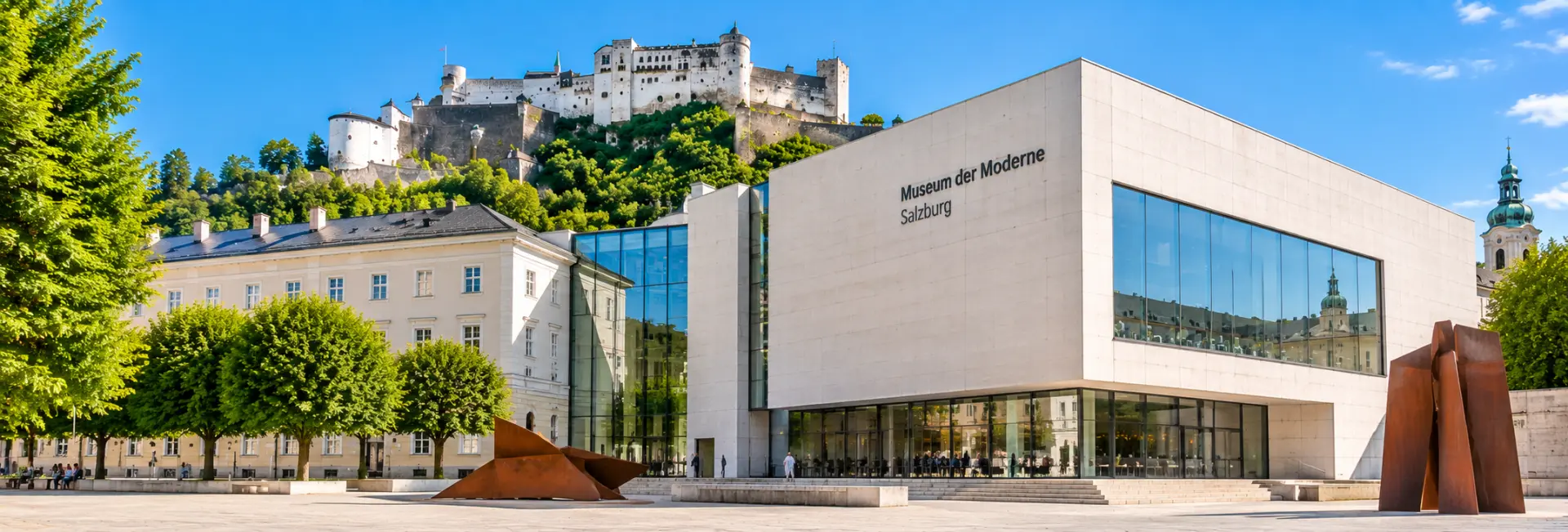
Museum der Moderne Salzburg is the city's home for twentieth and twenty-first century art, and it is unusual in that it lives in two very different buildings. One is a sleek, cube-shaped gallery perched on the edge of the Mönchsberg cliff, high above the rooftops. The other, known as the Rupertinum, sits in the heart of the Old Town beside the festival district.
Together the two houses present painting, sculpture, works on paper, photography, installation art and film. Programmes change regularly, which means a second or third visit rarely repeats the first. Exhibitions mix Austrian and international names, and they range from the nineteenth century to the present day.
For many travellers the museum offers a refreshing counterweight to Salzburg's baroque churches and palaces. Even people who do not usually seek out modern art tend to enjoy the combination of bold architecture, rotating shows and one of the finest panoramas in the city.
History of the Museum
From a Priests' College to an Art Museum
The story begins with the Rupertinum. The building appears in records as early as 1350, and in 1633 Prince-Archbishop Paris Lodron had it rebuilt in an early baroque style as a college for future priests. It later served as a student dormitory from 1974, and the Province of Salzburg took it over in 1976 with the aim of creating a home for a modern gallery and a collection of prints and drawings.
That plan took shape with the help of Friedrich Welz, a Salzburg art dealer whose private collection included many works by his friend Oskar Kokoschka. In 1983 the decision was made to establish a dedicated museum, and the Rupertinum opened that year. The collection was later widened to include a federal photography collection that the museum manages on permanent loan.
A Second House on the Mountain
Construction of the second building began in 2003, twenty years after the Rupertinum opened, and the site had a colourful past. As early as 1890 a restaurant called the Electric Lift Restaurant stood at the top of the Mönchsberg lift. In 1946 the hotelier Hermann Winkler opened the Grand Café Winkler there, a popular meeting place and dance café that also displayed the Sattler Panorama, a huge circular painting of the city. From 1977 to 1993 the premises housed Salzburg's casino, until it moved to Schloss Klessheim and left the mountain-top building empty. An earlier attempt to put a museum on the mountain, made around 1980, did not succeed.
The new gallery finally opened its doors on 23 October 2004, and Museum der Moderne Salzburg has operated as a two-house museum ever since.
Architecture and Buildings
Museum der Moderne Mönchsberg
The architects Friedrich Hoff Zwink from Munich won the commission from 145 competition entries. Their design is a clean, cubic structure clad in marble from the nearby Untersberg, so the building literally shares its stone with the surrounding landscape. Like many bold designs in historic cities, it drew criticism at first, but it has since become hard to imagine the Salzburg skyline without it.
Inside, exhibitions unfold across three open-plan levels covering more than 2,300 square metres. The restrained, minimal interior gives each show a neutral backdrop. A large terrace sits directly on top of the rock face, and the M32 restaurant occupies the same building. Glass walls around the staircase frame a view of a historic nineteenth-century water tower, so even the circulation spaces reward a pause.
Museum der Moderne Altstadt (Rupertinum)
The Rupertinum stands at Wiener-Philharmoniker-Gasse 9. Salzburg architect Gerhard Garstenauer adapted the old college for its new role, and the artist Friedensreich Hundertwasser was invited to decorate the facade. He added mosaic surfaces beneath the windows that look like tongues or beards, known as the Zungenbärte.
Many residents were outraged by the design, and the mosaics were taken down after the 1983 opening. They returned in 1987 as part of a Hundertwasser exhibition and have remained on the building ever since.
Collections and Exhibits
Rather than a single permanent display, the museum builds its programme around changing exhibitions drawn from its own holdings, loans and international collaborations. Visitors are likely to meet a different mix of work each time they come.
- Austrian photography after 1945: A focus collection that documents the country's photographic history and is one of the museum's defining strengths.
- Works on paper: Prints, drawings and graphic art grew out of the original collection assembled in the Rupertinum.
- Welz and Kokoschka legacy: The founding private collection included many pieces by Oskar Kokoschka, which gave the museum its early identity.
- Generali Foundation Collection: A permanent loan of contemporary art that adds an international, conceptual dimension.
- Temporary exhibitions: Shows at both buildings cover painting, sculpture, installation, photography and film from the nineteenth century to the present.
The museum describes its offer as one museum, two houses and five exhibition areas, so a full visit can include several distinct shows in a single trip.
Must-See Highlights
- The Mönchsberg terrace: Step outside the entrance and look across the Old Town towards the fortress. The terrace sits directly on the rock face, so the drop and the view are both dramatic.
- The marble cube itself: Walk around the exterior and the interior circulation to appreciate how the architects used stone, glass and open space.
- Hundertwasser's Zungenbärte: Spend a minute outside the Rupertinum to look closely at the colourful mosaic patches under the windows.
- The Rupertinum arcades: The arcaded interior of the old college keeps its early baroque character even though it now hosts contemporary art.
- The photography programme: Check what is on from the Austrian photography collection, since these shows often provide a distinctive view of twentieth-century life.
- The M32 restaurant: A meal or coffee here combines the museum visit with the same panorama seen from the terrace.
Ways to Experience It
The two houses can be visited separately or combined, and the way you arrive says a lot about the experience you will have.
- Ride the Mönchsberg lift: The lift from the Old Town reaches the museum entrance in about 30 seconds, and combination tickets including the lift are offered.
- Visit both houses: A museum ticket covers both locations for seven days, with one admission to each, so you can split the visit across two outings.
- Join a guided tour or workshop: The museum offers a range of tour and workshop formats, so look at the programme before you go.
- Use the multimedia guide: A guide is available through the MuseumStars app on iOS and Android.
- Add a walk on the ridge: After the galleries, paths on the Mönchsberg lead towards viewpoints and the fortress.
- Use your Salzburg Card: The card includes one free admission, which makes the museum an easy addition to a sightseeing day.
Best Time to Visit
Because the museum is largely indoors, it works in any season, and it is a useful plan for rainy or very hot days. The Mönchsberg terrace, however, rewards good weather, so a clear afternoon is the ideal moment to combine the exhibitions with the view.
Late afternoon and early evening are especially attractive. The low sun picks out the green cathedral domes and the fortress walls, and the lights of the Old Town begin to appear as the sky darkens. If you are visiting in summer, check the lift's extended opening hours and the restaurant's schedule, since both can change with the season and special events. The lift is known to stay open later on event evenings and when the restaurant is serving, which can make an after-hours visit to the terrace possible.
The Rupertinum is a good fallback whenever the weather turns, because it sits close to the festival district and pairs naturally with a stroll through the Old Town. Salzburg is busiest during the summer festival season and at Advent, so consider arriving early on those days.
Visitor Tips
- Confirm opening hours, ticket prices and current exhibitions on the museum's official website, as these change throughout the year.
- Remember that the two houses are in different parts of the city. Allow time to travel between them, especially if you plan to see both on the same day.
- The Mönchsberg lift is barrier-free, which makes the upper museum accessible without a climb.
- Combination tickets that include the lift, the museum and sometimes the restaurant can be better value than buying each separately.
- If you only want the view, check whether a lift ticket without museum entry suits you better.
- Photography rules differ between exhibitions, so look for signs or ask staff before taking pictures inside.
- Bring a light jacket in cooler months, as the terrace is exposed to the wind.
Nearby Attractions
Both houses are well placed for onward sightseeing, and each combines easily with other Old Town highlights.
- Hohensalzburg Fortress: A path along the ridge connects the Mönchsberg museum with the fortress, and the walk offers constant views.
- Mönchsberg trails and viewpoints: Quiet paths and lookouts such as Richterhöhe begin close to the museum terrace.
- Mozart's Birthplace and Getreidegasse: The lift's valley station lies only a few minutes' walk from the famous house on Getreidegasse.
- Salzburg Panorama Museum: The Sattler Panorama, once displayed on the Mönchsberg, can now be seen here.
- Festival Halls and Universitätsplatz: The Rupertinum sits on the edge of the festival district, close to the market square.
- Salzburg Cathedral and Residenzplatz: Both are a short walk from the Rupertinum.
FAQs about visiting Museum der Moderne Salzburg
What is Museum der Moderne Salzburg? +
It is Salzburg's museum of modern and contemporary art, housed in two buildings: one on the Mönchsberg and the other, the Rupertinum, in the Old Town. Together they present art from the nineteenth century to the present.
Where are the two locations? +
The Mönchsberg building is at Mönchsberg 32, reached by lift from the Old Town. The Rupertinum is at Wiener-Philharmoniker-Gasse 9, near the festival district.
How do I get to the museum on the Mönchsberg? +
The easiest route is the Mönchsberg lift from Anton-Neumayr-Platz, which takes about 30 seconds and is barrier-free. You can also walk up one of the stepped paths from the Old Town.
Does one ticket cover both buildings? +
A museum ticket is valid at both locations for seven days, with one admission to each. Check the official website for current ticket options, including combinations with the lift.
Can I visit with a Salzburg Card? +
Yes, the Salzburg Card includes one free admission to the museum. Travel guides report that it also covers a lift trip, but check the current terms before you go.
How long should I plan for a visit? +
Allow about one to two hours for the Mönchsberg building, longer if you add a meal or time on the terrace. The Rupertinum can be done in a shorter visit, depending on the exhibitions on show.
Is the museum worth visiting if I am not into modern art? +
Many visitors say yes, mainly because of the architecture, the changing exhibitions and the terrace view. Even a short visit gives a different perspective on Salzburg's skyline.
Who decorated the facade of the Rupertinum? +
The Austrian artist Friedensreich Hundertwasser designed the colourful mosaic surfaces known as the Zungenbärte. They were removed after the 1983 opening and returned in 1987.
