
Table of Contents
Overview
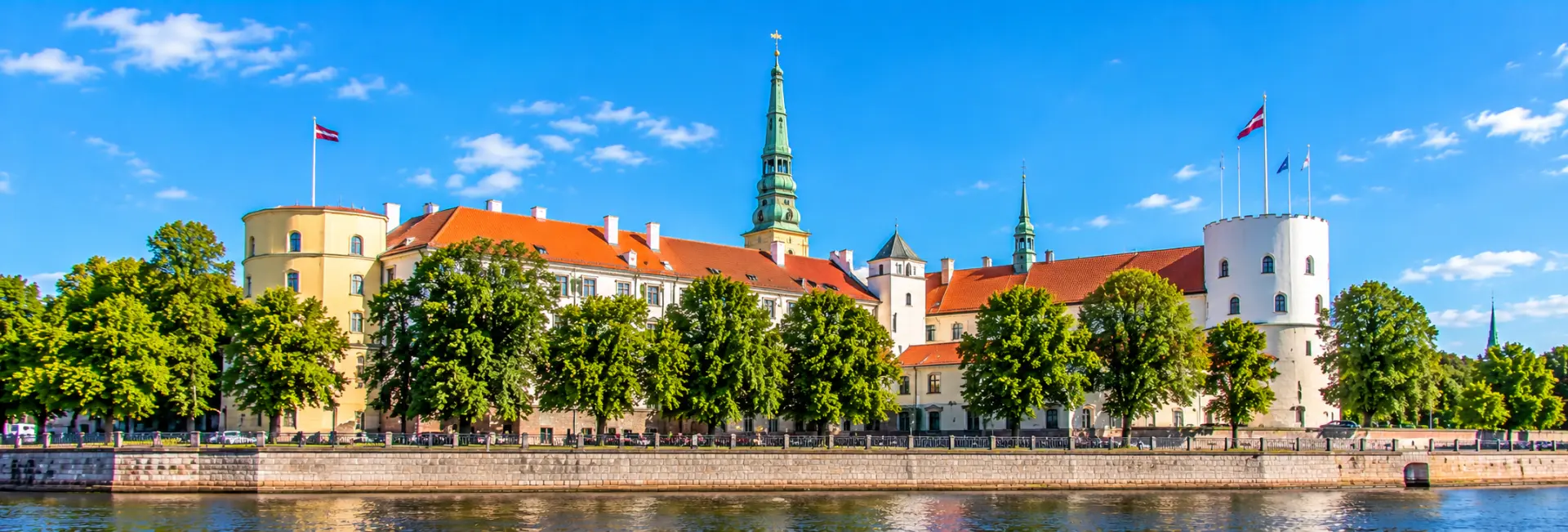
Riga Castle (Rīgas pils) rises from the right bank of the Daugava on the edge of Old Riga, a broad, pale-walled complex whose round towers are among the most recognisable shapes on the city's riverfront. Construction began in 1330, which places it among the oldest landmarks in the Latvian capital, and in the centuries since it has been wrecked, rebuilt, extended and put to new uses more times than most visitors would guess from its calm exterior.
Today the castle does two jobs at once. The large residential and office wing is the official seat of the President of Latvia, while the older southern wing has reopened as part of the Latvian National Museum of History, with exhibitions that range from medieval castle-building to a sweep through some 12,500 years of Latvian history.
That mix of working state building and living museum is what makes it distinctive. It is a place where ceremonial guards, diplomatic arrivals and school groups all share the same hill, and where an hour or two of looking around tells you a great deal about how Latvia has been governed, fought over and reinvented.
History
A Fortress Built Under Pressure
The castle's foundation stone was laid on 15 June 1330, after the Livonian Order had gained the upper hand over the townspeople of Riga. The citizens were made to construct a new stronghold for the Order, set apart from the heart of the city, and the Master of the Order made it his residence. The site had previously been occupied by a convent of the Holy Spirit, which swapped places with the Order's earlier castle in town.
Destruction and Rebuilding
The relationship between the Order and the city stayed tense, and in 1484 the people of Riga stormed and wrecked the castle. Little survived apart from part of the Holy Spirit tower, which sailors used as a riverside light, and fragments of the defensive walls. Under the terms of the city's surrender in 1491, the townspeople had to rebuild, and the work was finally completed in 1515 under Master Wolter von Plettenberg. That date is still treated as the birth year of the building you see today.
Under Foreign Rulers
When the Livonian Order dissolved in the sixteenth century, the castle passed to a succession of outside powers. Polish-Lithuanian officials were followed by Swedish administrators, who added spacious new annexes in 1641, and then by Russian governors after the siege of 1710. Each ruler adapted the building to its own needs, which is why it reads more like layered stonework than a single design.
Independence, Occupation and Return
The castle became the home of Latvia's presidents in 1922, and museums had been using parts of it since 1920. During the Soviet period the northern part was given over to a children's organisation and the building became popularly known as the Pioneer Castle. After independence was restored, President Guntis Ulmanis returned to work there in 1995.
The 2013 Fire
On the night of 20 June 2013, with restoration work already under way, a fire tore through the roof and upper floors. Firefighters estimated that roughly 3,200 square metres were destroyed, mostly offices, meeting rooms and attic space, while the museum collections were largely spared after a determined rescue effort. The president resumed work in the castle on 22 August 2016, and the museum's return to the southern wing followed years later.
Architecture & Notable Spaces
A Fortress First
The rebuilt castle was a three-storey, four-sided structure wrapped around an inner courtyard, with a tower at each corner. Two of the towers were round and did the heavy defensive work: the Tower of the Holy Spirit in the northwest and the Lead Tower in the southeast. The two square towers mainly held staircases.
Plain by Design
The medieval castle was deliberately austere, a reflection of its military purpose and of how often it was damaged. One of the very few decorative survivals is a pair of sixteenth-century sculptures, of the Virgin Mary and of Master Plettenberg, set above the former entrance.
Layers of Later Building
The part of the complex used by the presidency today is largely a later construction, built across the former castle forecourt in the eighteenth and nineteenth centuries and shaped by late Classicism. The most important twentieth-century intervention came in 1938 under architect Eižens Laube. His work gave the entrance hall its present look and added a grand Festival Hall and the Three Star Tower.
Spaces Visitors Can See
- The vaulted cellars from the fourteenth century, roughly 530 square metres in size, now used for an exhibition.
- A room off the cellar exhibition that contains a hot-air heating system of around 600 years old, known as a hypocaust furnace.
- The refectory and chapel of the reconstructed southern wing.
- The Lead Tower, which can be climbed on guided tours of the renovated wing.
Seat of the Presidency
A Working Head of State's Home
Riga Castle is both the residence and the workplace of the President of Latvia, a role it has held, with interruptions, since 1922. Presidents Jānis Čakste, Gustavs Zemgals, Alberts Kviesis and Kārlis Ulmanis all lived and worked here in the interwar years. That makes the building a symbol of statehood as much as a historic monument.
The Standard and the Guard
When the president is in residence, the presidential standard is flown from the Tower of the Holy Spirit. The National Armed Forces Guard of Honour keeps watch at the castle in that case, and the changing of the guard is a public ceremony that draws onlookers. On Lāčplēsis Day, 11 November, the guard change takes on a larger, more formal character as part of national remembrance events.
A Temporary Move
Between autumn 2012 and August 2016, while the building was restored after the fire, the president and the chancery worked from the House of Blackheads in the Old Town. The return in 2016 was marked by a ceremony that restored the guard of honour and hoisted the presidential standard once again.
Stories and Lore
Like many ancient strongholds, the castle has accumulated its own folklore, including tales of a ghost that nobody has actually seen. Such stories add colour for guides and visitors, but the real drama is documented in the record of sieges, surrenders and rebuilding.
The Museum & Its Exhibitions
A Long Association with the Building
The Latvian National Museum of History has been based in Riga Castle since 1920. After the 2013 fire its collections were moved to temporary premises and its exhibitions were housed elsewhere in the city. In summer 2024 the museum began returning to the renovated southern wing, and on 21 March 2026 it reopened to visitors with a new permanent exhibition and a series of restored rooms.
Streaming Time
The main exhibition, titled Streaming Time, tells the story of Latvia across about 12,500 years. Rather than marching through dates in a straight line, it organises the story around nine themes:
- Inventive Humans
- People of the Hillforts
- City Walls Unite
- Together in the Congregation
- Born into One's Class
- Power of the Movement
- Becoming a Citizen
- Totalitarian Stranglehold
- Return to Europe
The exhibition design deliberately pairs objects from different periods to show how older layers of culture continue to shape the present.
Livonian Castles
A second exhibition, Livonian Castles, opened on 17 June 2026 in the fourteenth-century cellars. It covers the medieval Livonian period, from the thirteenth to the sixteenth century, and the castles built during it. A raised walkway of modern material guides you through the old brick vaults, with touchscreens, projections and holograms layered over the historic stonework. The museum has indicated that further exhibitions, including one on the history of the castle itself, are planned.
Ways to Experience It
There is more than one way to approach Riga Castle, and it works well as either a quick stop or a longer, more focused visit.
- Visit the museum wing: Enter from Daugavas gāte to see Streaming Time, Livonian Castles and the restored historic rooms at your own pace.
- Join a guided tour: The museum runs guided tours of the exhibitions and of the renovated southern wing, from the vaulted cellars up to the top of the Lead Tower. Some tours are offered only in Latvian, so check the language before booking.
- Attend an event: The castle hosts occasional concerts and special programmes, including events around Lāčplēsis Day.
- Walk the exterior: Castle Square and the embankment can be enjoyed at any time, and the facade and towers are well worth a slow circuit even if you do not go inside.
- Admire it from across the river: The Kipsala side of the Daugava gives one of the best full views of the castle's silhouette against the Old Town.
- Explore remotely: The museum offers a 360-degree virtual tour of the castle spaces, helpful if you want a preview or cannot visit in person.
Best Time to Visit
Season
The museum is indoors, so the castle works in any season. Late spring through early autumn brings the easiest walking weather and long daylight for exploring Old Riga on foot. In winter the exhibitions are a comfortable refuge, and a frozen or misty river can make the exterior view especially atmospheric.
Time of Day
Early morning light and sunrise give the best photographs of the castle from the riverbank. Weekday visits to the museum are generally quieter than weekends, particularly when cruise or tour groups are in town.
Special Dates
Lāčplēsis Day on 11 November brings ceremonial guard changes and a special programme at the castle, which suits visitors interested in national traditions. Check the museum's event calendar before you travel, because exhibitions, tours and special openings change through the year.
Visitor Tips
- Know which part you can enter: The museum wing is open to visitors, but the presidential offices and residence are a working government space and are not part of a regular visit.
- Use the right entrance: The museum entrance is on the Daugavas gāte side rather than the main presidential frontage.
- Plan 1 to 2 hours: This gives you time for both exhibitions and a walk around the exterior. Allow more if you plan to take a guided tour.
- Confirm practical details first: Opening hours, ticket prices, tour languages and any temporary closures can change, so check the Latvian National Museum of History website or ticket office on the day.
- Check accessibility: The Livonian Castles exhibition in the cellars is not reachable by elevator, so ask the museum about step-free options if you need them.
- Be respectful around ceremonies: Keep a polite distance from guards on duty and follow any instructions from staff during official events.
- Getting there: The castle is a short walk from most of Old Riga. Public transport stops at the 11. novembra krastmala embankment are only a few minutes away, and taxi drivers will know it as Rīgas pils or Pils laukums.
Nearby Attractions
Riga Castle sits in one of the most walkable parts of the capital, so it pairs easily with other sights. Most of the places below are within a short stroll.
- Riga Cathedral: One of the largest medieval churches in the Baltics, only a few minutes away on foot.
- House of Blackheads: The ornate Town Hall Square building that served as the president's temporary workplace while the castle was being restored.
- The Three Brothers: A trio of historic houses on Mazā Pils iela that illustrate how ordinary Riga residents lived across several centuries.
- Powder Tower and the Latvian War Museum: A surviving tower of the old city fortifications, home to the war museum since 1919.
- Museum of the Occupation of Latvia: A thought-provoking museum on the twentieth-century occupations, close to the Old Town edge.
- Freedom Monument: The national symbol of independence, also watched over by the Guard of Honour.
FAQs about visiting Riga Castle
Can you go inside Riga Castle? +
Yes, but only part of it. The southern wing is open as a branch of the Latvian National Museum of History, while the presidential residence and offices are a working government space and are not open for regular visits.
Who lives in Riga Castle today? +
It is the official residence and workplace of the President of Latvia. The president's standard flies from the Tower of the Holy Spirit when the head of state is in residence.
How old is Riga Castle? +
The foundation stone was laid on 15 June 1330. After the townspeople destroyed it in 1484, it was rebuilt, and 1515 is traditionally given as the date of the building's completion.
What happened in the 2013 fire? +
A fire broke out on the night of 20 June 2013 during restoration work and destroyed around 3,200 square metres of roof, attic and upper floors. The museum collections were largely saved, and the president returned to the castle in August 2016.
What can you see at the museum in Riga Castle? +
The reopened museum offers the exhibition Streaming Time, a thematic journey through about 12,500 years of Latvian history, and Livonian Castles, which is set in the fourteenth-century vaulted cellars. Guided tours of the renovated southern wing, including the Lead Tower, are also offered.
How long should you spend at Riga Castle? +
Plan roughly one to two hours for the exhibitions and a walk around the exterior, and longer if you join a guided tour or want to see the surrounding Old Town sights.
Is Riga Castle part of a UNESCO World Heritage Site? +
Yes. It stands within the Historic Centre of Riga, which is on the UNESCO World Heritage List.
Where is the best place to photograph Riga Castle? +
The Kipsala side of the Daugava gives one of the best full views of the castle, and the riverside embankment is a good alternative at sunrise.
How do you get to Riga Castle? +
Most visitors walk from elsewhere in Old Riga. Public transport stops near the 11. novembra krastmala embankment are a few minutes away, and taxis will take you to Rīgas pils or Pils laukums.
